
REVIEW · GDANSK OLD TOWN TOURS
TriCity Tour (Gdansk, Gdynia, Sopot) – PRIVATE (8h)
Gdansk to Sopot in one smooth day. You get the best kind of Tri-City shortcut: three very different coastal towns, handled by a professional local guide, with hotel pickup and drop-off so you spend your energy sightseeing instead of figuring out transit. I especially like the way the route moves from Gdansk’s medieval heart to Gdynia’s modern harbor story and then lands in Sopot’s pier-and-sea-resort mood. One consideration, though, is that the day is packed, so comfortable shoes and a “see, then move” attitude really help.
Two things I like a lot: the stops are mostly free to enter, and the walking segments focus on the places that give you the feel of each city fast. I also love hearing how the guide ties details together, like why Dluga and Dlugi Targ are called the Royal Route and how Neptune’s Fountain became a Gdansk symbol. The main drawback is simple timing, you only have so long at each highlight, so if you want museum time deep in the corners, you might want a longer follow-up day.
In This Review
- Key takeaways before you go
- Why This Private Tri-City Loop Works
- Price, Pickup, and What You’re Really Paying For
- Gdansk First: From Medieval Port Power to Walkable Old Town
- Dluga Street and Dlugi Targ: The Royal Route Shortcut to the City’s Story
- Neptune’s Fountain: A Small Stop With Big Local Meaning
- St. Mary’s Basilica: Brick Gothic Scale and the Astronomical Clock
- The Crane: Port Technology That Changed the Town’s Real Life
- Gdynia’s Harbor District: Modern Port Energy and Naval Stories
- Sopot’s Pier and Plac Zdrojowy: The Sea-Resort Finale
- Guide Quality Makes or Breaks the Day
- How to Pace It Without Feeling Rushed
- Who This Private Tri-City Tour Is Best For
- Should You Book This Private Tri-City Tour?
- FAQ
- How long is the TriCity private tour?
- What cities are included in the tour?
- Is hotel pickup and drop-off included?
- Is this tour private?
- What language is the tour offered in?
- Are admission tickets included?
- Do I get a mobile ticket?
- What is the cancellation policy?
Key takeaways before you go
- Hotel pickup and drop-off means a low-stress start and finish, especially when you want to maximize an 8-hour window.
- Mostly free sights across Gdansk, with optional paid entry only for things like the Crane.
- A professional guide with a calm pace, including named guides like Andrzej Falkowski and Peter.
- The Tri-City contrast is the point, medieval port power in Gdansk, naval and emigration stories in Gdynia, then seaside resort life in Sopot.
- English is covered, with a mobile ticket for easier check-in.
Gdansk repeats itself well. The other versions we reviewed
- Gdańsk City Sights & History Guided Walking Tour in English
★ 4.8 · 876 reviews - Gdansk: Firearm Shooting Experience with Instructor
★ 4.8 · 866 reviews - Gdansk: Guided Round-Trip Cruise to Westerplatte
★ 4.3 · 865 reviews - Gdańsk: Sightseeing EcoCruise around the Old Town of Gdansk
★ 4.6 · 719 reviews
Why This Private Tri-City Loop Works
If you only have one day for Gdansk, Gdynia, and Sopot, this format makes a lot of sense. You’re not trying to squeeze three destinations into three separate days. Instead, you’re doing one well-planned circle, with transportation handled and a guide keeping you pointed at what matters.
What makes it feel real is the balance of big icons and readable street-level stops. You get Gdansk’s medieval waterfront vibe without needing to be an expert first, and you get to shift gears in Gdynia to the harbor-era story that shaped Poland’s modern coast. Then you finish in Sopot, where the long wooden pier and Plac Zdrojowy give you an easy visual “we made it” moment.
You should still go in with your expectations set: this is a highlight tour. It’s not trying to replace a full-day museum crawl. The payoff is momentum and perspective, the kind that helps you decide what to explore deeper later.
Price, Pickup, and What You’re Really Paying For
The price is $351.49 per person for a private 8-hour experience. That can sound steep until you factor in what’s actually included: hotel pick-up and drop-off, a professional local guide, an air-conditioned vehicle, private transportation, and a mobile ticket.
Here’s how I look at value on tours like this:
- You’re paying for time savings and direction. In the Tri-City, that’s huge.
- You’re paying for a guide who can connect dots, like royal-route street names, port-crane technology, and how the waterfront identity changes from one town to the next.
- You’re paying for privacy, so your group sets the pace and you avoid the stop-and-start feeling that comes with larger group tours.
Also, there’s a practical plus: the itinerary is built mostly around free admission sights. The Crane stop is explicitly marked as not included, so you have a clear sense of where the only likely paid add-on might land.
Gdansk First: From Medieval Port Power to Walkable Old Town
Gdansk is the heart of the day, and the schedule gives it room. You start with about 3 hours in Gdansk, then you spend more time in the Old Town zone and key streets afterward. That sequencing matters, because it helps you build context early, before you start pointing at specific landmarks.
What you’ll notice right away is how the city’s story feels layered. The guide’s explanations are designed to help you read that layering, including periods of Polish, Prussian, and German rule, plus the “free city state” period that shaped Gdansk’s self-governance. If you like cities where the past still shows on street corners and façades, Gdansk delivers.
The Old Town portion is about understanding the “glory and importance” of the medieval city through a walkable stretch. Expect cobblestoned streets and the historical waterfront feeling you get in a port city that built its identity around ships, trade, and shipbuilding.
Dluga Street and Dlugi Targ: The Royal Route Shortcut to the City’s Story
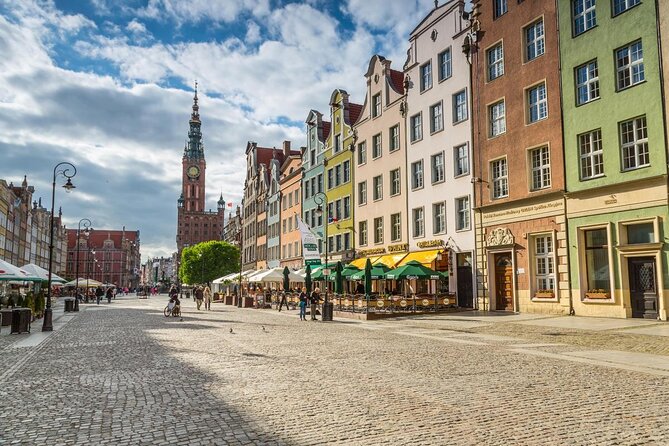
After Old Town, you move into the Dluga and Dlugi Targ area, about 45 minutes of pedestrian time. This is one of those stops that’s short enough to fit, but specific enough to stick.
The key idea is the Royal Route label. These streets were the former processional path for kings visiting Poland, and the buildings along the way were reconstructed in historical style, with plenty of ornamentation and symbolism. You’ll also see how the layout works, starting at the Golden Gate, passing major landmarks like the Town Hall and the Neptune fountain, and ending by the Green Gate overlooking the Motlawa River.
If you tend to like streets more than squares, this is a strong segment. You get to “read” the architecture while walking, and you’re not stuck in a single viewpoint waiting for a photo moment.
The other two cities, and how we got around them
- Highlights of Gdańsk, Gdynia and Sopot 1-day Private Tour★ 4.9 · 59 reviews
- Gdansk Sopot and Gdynia 3 Cities Private Full-Day Tour★ 5.0 · 56 reviews
- Best of Gdańsk, Gdynia and Sopot in 1-Day Private Car Tour★ 5.0 · 37 reviews
- Undercover City Games: Gdynia★ 5.0 · 34 reviews
- Gdańsk Shore Excursion: Private Gdańsk, Sopot & Gdynia Tour★ 5.0 · 20 reviews
Neptune’s Fountain: A Small Stop With Big Local Meaning
Next comes a quick but important icon, Neptune’s Fountain by the Artus Court area, timed at about 15 minutes. This is one of those classic European city-center symbols that looks simple until you learn what it represents.
You’ll hear that the fountain dates to 1633, and it’s tied to Gdansk’s identity as a port city through Neptune symbolism and the sea-creature details added later. The story also includes the fountain initiative from the mayor and town council, plus the bronze casting in Augsburg. Even if you only spend a few minutes, it gives you a “why this matters” anchor for the rest of your walk.
There’s also a local superstition you might hear about, tossing a coin for luck. Whether you do it or not, the point is that Neptune’s Fountain works as a city marker, the kind locals use to orient and visitors remember.
St. Mary’s Basilica: Brick Gothic Scale and the Astronomical Clock
One of the best “pause and look up” stops is St. Mary’s Church, scheduled for about 30 minutes. You’re told it’s the largest brick church in the world, and the size cues show up fast when you’re inside or looking toward the tower.
The building timeline is part of what makes this visit click: construction began in 1343 and ended in 1502. The church contains important works from medieval and baroque eras, including a stone Pieta from around 1410, a copy of Hans Memling’s The Last Judgement, and an astronomical clock from the second half of the 15th century built by Hans Düringer over seven years.
If you care about craft and engineering as much as art, the astronomical clock detail is the kind of fact that makes the visit feel more than a quick landmark photo. And if you prefer views, there’s a viewing gallery on the tower, with the main tower height listed at 255 feet, so the scale is a real theme here.
One caution: this stop can feel “long” even when the schedule says 30 minutes, because the church is built for taking in details. If your group hates slow looking, mention it to your guide early so you can keep the day moving.
The Crane: Port Technology That Changed the Town’s Real Life
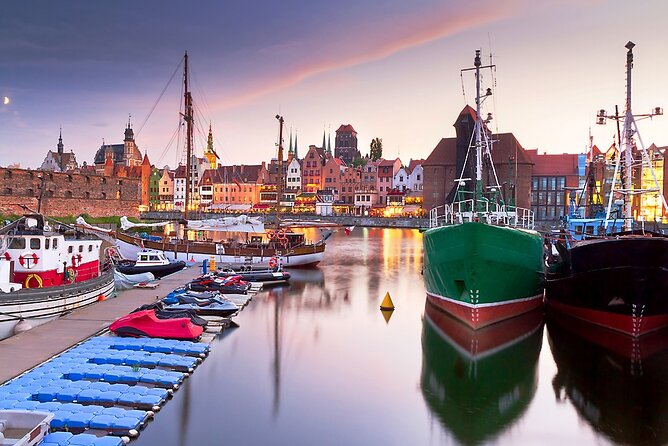
Then you reach the Crane stop, about 15 minutes, and this is the one place where the entry cost may show up. It’s part of the National Maritime Museum, and the ticket for the crane is marked as not included.
Why it matters is not just the photo-friendly silhouette. This crane was built in the first half of the 15th century between the pylons of Brama Szeroka, and it’s described as the largest port crane in Europe at the time. You’ll learn that it lifted 4 tons to a height of 36 feet and was powered by workers walking inside two tread wheels.
That’s the kind of technology story that turns a city from “pretty streets” into “this is how people actually lived and worked.” You’ll likely walk away with a clearer picture of why Gdansk was such a major seaport and shipbuilding town, especially when you connect it to the later Gdynia harbor focus.
If you’re trying to keep costs down, you can treat this as an exterior-focused stop if you choose not to add paid entry. But the crane story hits hardest when you can see it as a functioning piece of port history rather than just a monument.
Gdynia’s Harbor District: Modern Port Energy and Naval Stories
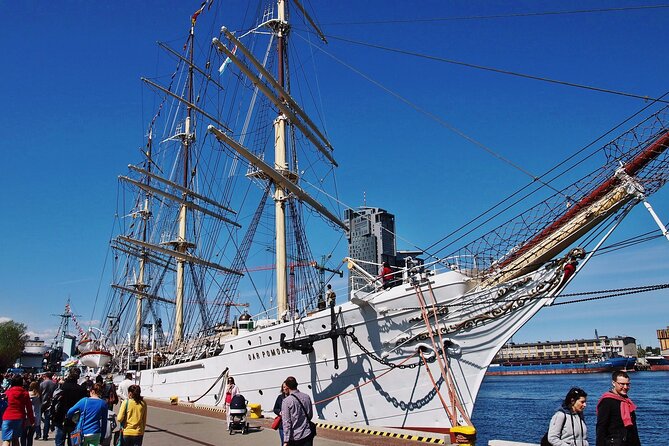
After the Gdansk portion, you switch to Gdynia, where the total time is about 2 hours. Gdynia is a distinctive contrast because it was constructed in the 1920s with a modern harbor as the backdrop. That modern-harbor setup is still what you’ll feel most in the city’s promenade and harbor area.
This stop is built around the ships and museums docked nearby. You’ll see historic ships mentioned as ORP Blyskawica, a 1930s destroyer and the oldest preserved ship of its class, plus the sailing frigate Dar Pomorza. There’s also a Naval Museum that covers Polish navy history and the Emigration Museum in the former Maritime Station, described as covering about 200 years of Polish emigrations from the 19th century to modern days.
The itinerary lists these with free admission, but you still need to work with the time you have. With only a couple hours total for Gdynia, your best approach is to pick what you care about most before you arrive. If you love naval history, focus on the museum and ships first. If you’re more into the human story, steer toward the Emigration Museum angle. Either way, the promenade is the thread that ties it together.
Sopot’s Pier and Plac Zdrojowy: The Sea-Resort Finale
The final city is Sopot, also about 2 hours. If Gdansk is about layered port power and Gdynia is about modern harbor identity, Sopot plays the role of seaside release.
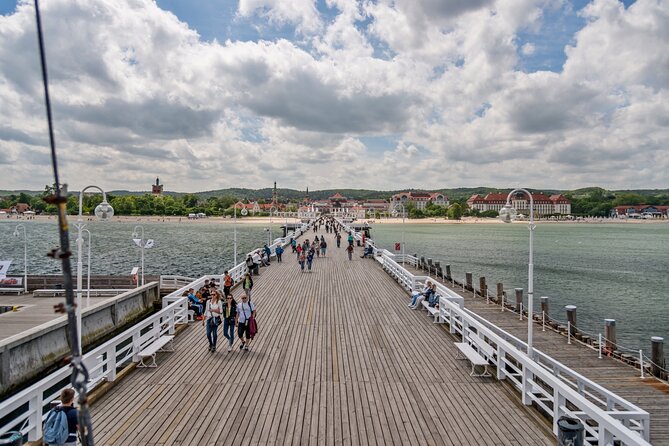
The signature here is the pier, a long wooden structure that juts 560 yards into the sea, described as the longest wooden pier in Europe. Even if you don’t go far out, you get an immediate sense of why Sopot became a resort town and why it works as a place for mass events and summer gatherings.
You’ll also spend time around Plac Zdrojowy, the central square that extends from the pier on land. The light-house above the square is part of the experience and is meant to offer panoramic views of the area. Nearby, there’s also an outdoor concert hall mentioned as active in summer, so the area has that event-ready feel even if you visit outside the peak season.
This is a great ending because it’s low pressure. You’re not forced into a hard museum decision. You can just enjoy the harbor-to-resort shift, walk the pier, and let the day slow down.
Guide Quality Makes or Breaks the Day
This tour format is only as good as the guiding. In this case, the feedback points to the same theme again and again: a strong balance of professional knowledge and a friendly, relaxed delivery.
Two guide names come up clearly: Andrzej Falkowski and Peter. Andrzej Falkowski is described as extremely knowledgeable about the history and background behind the sights, in a way that still feels enjoyable. Peter is noted as being a policeman who does tours as an aside from his regular job, and what stands out is that he was accommodating, informative, and did not overload people with more facts than they could handle.
That matters for your experience because the Tri-City has a lot to say. Gdansk alone can go from medieval to port to religious and art history quickly. A guide who keeps it organized, and doesn’t drown you in dates, is the difference between a tour that feels like a classroom and one that feels like a guided walk you can remember.
How to Pace It Without Feeling Rushed
Because the day covers multiple cities and several key landmarks, pacing is your secret weapon.
Bring:
- Comfortable walking shoes, the stops include cobblestones and long promenade walking.
- A water bottle, especially if you do the full pier time in Sopot.
- A simple plan for your group, decide which city museum angle matters most to you in Gdynia, since you only have about 2 hours there.
Also, I recommend a “watch, then ask” rhythm. Look at the sight, then ask one good question. You’ll get more value from the guide, and the tour stays fun instead of feeling like nonstop lectures.
Who This Private Tri-City Tour Is Best For
This is a solid match if you:
- Want to see Gdansk, Gdynia, and Sopot in one day with less logistics stress.
- Prefer a private group experience rather than sharing time with strangers.
- Like city walking that includes famous landmarks, but also wants context for what you’re seeing.
It’s also a good choice for first-time Tri-City visitors, because the order builds understanding. Start in Gdansk, then shift to Gdynia for harbor and naval focus, then finish in Sopot for the classic resort payoff.
If you are the type who needs hours inside every church and museum, this may feel too tight. In that case, use the tour to “map the territory,” then plan extra time later.
Should You Book This Private Tri-City Tour?
I’d book it if your goal is a smart first pass at the Tri-City, with hotel pickup, a professional guide, and an itinerary heavy on recognizable highlights with mostly free admission stops. The price can be justified by the transportation included plus the time you save, and the private setup is a real quality-of-life upgrade.
I would think twice if your group hates walking and hates time limits. This day works best when you can handle short stops and keep moving with the schedule. If you want deep museum time in multiple places, you’ll probably want a longer or more specialized plan.
If you’re deciding between winging it and booking this, I’d pick the tour. You get structure, context, and a calmer day from start to finish.
FAQ
How long is the TriCity private tour?
It runs for about 8 hours.
What cities are included in the tour?
The tour covers Gdansk, Gdynia, and Sopot.
Is hotel pickup and drop-off included?
Yes. Hotel pick-up and drop-off are included, and the guide meets you at your hotel lobby with your name.
Is this tour private?
Yes. It is a private tour, so only your group participates.
What language is the tour offered in?
The tour is offered in English.
Are admission tickets included?
Entry or admission fees are not included. The itinerary notes most stops as admission ticket free, but the Crane stop is listed as not included.
Do I get a mobile ticket?
Yes, the tour includes a mobile ticket.
What is the cancellation policy?
Free cancellation is available. You can cancel up to 24 hours in advance for a full refund. Canceling less than 24 hours before the start time is not refundable.
More Tour Reviews in Gdansk


Sopot, Gdynia and the Rest of the Tricity


Gdansk, Three More Ways
Recently written up around Gdansk





More Gdansk Old Town Tours.
 ★ 4.8City Cruise on Historical Polish BoatFrom $222,913 reviews
 ★ 4.9Sunset Cruise on a Historic Polish BoatFrom $26977 reviews
 ★ 4.8Gdańsk City Sights & History Guided Walking Tour in EnglishFrom $26876 reviews
 ★ 4.8Firearm Shooting Experience with InstructorFrom $41866 reviews
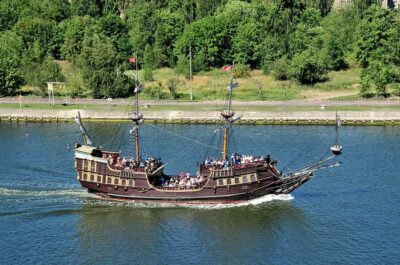 ★ 4.3Guided Round-Trip Cruise to WesterplatteFrom $33865 reviews
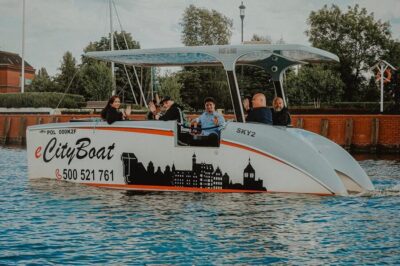 ★ 4.6Sightseeing EcoCruise around the Old Town of GdanskFrom $19719 reviews
 ★ 5.0Main Town Gdańsk Walking TourFrom $26644 reviews
 ★ 5.0Gdansk Pub Crawl with Free DrinksFrom $21553 reviews
Also on these Poland lists