
REVIEW · SZCZECIN CITY TOURS
Szczecin Walking Tour: Explore Top Sights & Hidden Gems
A city feels easier when someone else handles the turns. This Szczecin walking tour is a focused, map-free stroll that strings together major landmarks and riverfront areas in about two hours. You get free admission for the key stops, plus time to ask your guide questions in a group that stays small.
I especially like the small group size. It makes it simple to raise questions and get clear answers, instead of shouting over other people. I also like that you are not stuck with directions or guesswork, because the guide takes you from sight to sight.
One consideration: if you want long museum time at every location, this format moves quickly. You are getting a smart overview, not an all-day sightseeing marathon.
In This Review
- Key things to know before you go
- Why This Szczecin Walking Tour Feels Like a Smart Shortcut
- Meeting at Kino Pionier and How to Set Yourself Up
- Karłowicz Philharmonic: A Modern Landmark to Start Your Bearings
- Archcathedral Basilica of St. James the Apostle: Gothic Detail You Will Actually Notice
- Pomeranian Dukes’ Castle: From 14th Century Foundations to Today’s Exhibitions
- Lastadia Łasztownia on the Oder: Where Maritime Szczecin Shows Through
- Wheel of Szczecin and the Surprise Stops That Keep It Fun
- Price and Value: What $32 Buys You in Real Terms
- English-Language Touring That Actually Lets You Ask Questions
- Timing, Pace, and What the Tour Does Not Try to Do
- Who Should Book This Szczecin Walking Tour
- Should You Book? A Simple Decision Checklist
- FAQ
- What is the duration of the Szczecin walking tour?
- Where does the tour start and where does it end?
- What language is the tour offered in?
- How much does the tour cost?
- Are admission tickets included?
- How big is the group?
- Do I need a map?
- Is there free cancellation?
- Is the tour suitable if I travel with a service animal?
Key things to know before you go
- Small group (max 15) for more real conversation with your guide
- English tour with a map-free route through Szczecin’s top sights
- Free admission tickets included for every named stop
- Kino Pionier start point makes it easy to orient before you begin
- Riverfront time at Lastadia Łasztownia for views over the Oder
- Some stops stay a surprise, so you keep a little momentum to the end
Other Szczecin walks on our list
- Szczecin: Old Town Highlights Private Walking Tour
★ 4.7 · 76 reviews - Szczecin: Medieval Old Town Private Walking Tour
★ 4.7 · 17 reviews - Szczecin Walking Tour: Explore Top Sights & Hidden Gems
★ 4.5 · 15 reviews - Szczecin: Private Traditional Polish Food Tour
★ 3.9 · 13 reviews
Why This Szczecin Walking Tour Feels Like a Smart Shortcut
If you arrive in Szczecin with limited time, a walking tour can do more than show buildings. It gives you context, names, and a sense of how the city hangs together. In this case, the route is built around the places that make most first visits click: music and modern culture, a major Gothic church, a castle complex, and then the Oder River waterfront.
The biggest practical win is that you do not need a map. Your guide handles the route, so you can stay present and actually look at what you are passing. I also like that the timing is tight enough to keep your energy up, but spaced out so each stop is more than just a photo stop.
The tour runs about two hours, and the group stays under 15 people, which changes everything. With fewer faces in the mix, you are more likely to get personal answers, including the kind of details that make you understand what you are seeing.
Meeting at Kino Pionier and How to Set Yourself Up
The tour starts at Kino Pionier, al. Wojska Polskiego 2, 70-471 Szczecin, and ends back at the same point. Starting at a landmark like this helps, because you get a clear anchor for your day.
Plan to arrive a few minutes early. The meeting point is easy to find, and it is near public transportation, so even if your timing is slightly off, you should be able to catch up. The tour also offers a mobile ticket, so have it ready on your phone before you meet.
What to bring is simple:
- Comfortable shoes for walking
- A jacket or layer, depending on season
- A camera, because several stops have strong exterior views and close-up architectural details
One more note that matters: service animals are allowed. If you travel with one, you can plan without stress.
Karłowicz Philharmonic: A Modern Landmark to Start Your Bearings
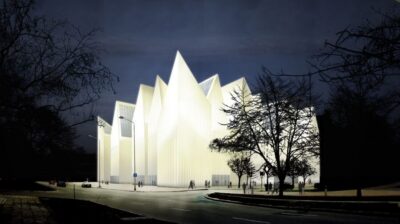
You begin at the Karłowicz Philharmonic, a major cultural spot in the city center. The building is known for its modern architecture, designed by Spanish architect Alberto Veiga and Portuguese architect Fabrizio Barozzi. Even if you are not a concert-goer, seeing how the venue’s design shapes the neighborhood helps you read the city differently.
This stop is about 20 minutes, and since admission is included, you can spend that time soaking in the space without worrying about entry costs. The guide’s job here is to connect the venue’s role in Szczecin’s cultural life to what you are seeing in front of you.
A small caution: if you expect a deep program inside the building, this is still a walking-tour pace. You will get a good orientation and the story behind the architecture, but you are not there long enough for a full, independent exploration.
Archcathedral Basilica of St. James the Apostle: Gothic Detail You Will Actually Notice
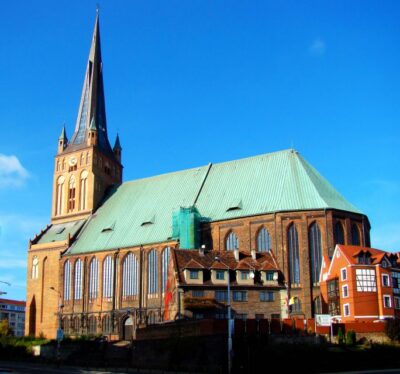
Next up is the Archcathedral Basilica of St. James the Apostle, with origins going back to the 12th century. The style is Gothic, and the basilica is especially known for its detailed design work and stained glass.
This is another 20-minute stop, and again, entry is included. That matters, because churches often have quiet rules, and having a guide helps you understand what is worth looking at first. Expect the conversation to focus on how the building reflects centuries of faith and the city’s identity.
Here is what I think works well for most people: stained glass can feel like a generic attraction from a distance. Up close, with time and direction, you start to notice patterns, structure, and how light changes the whole experience. If you care about architecture, this stop gives you real payoff in a short time.
Possible drawback: if you are not into churches or religious architecture, you might find this stop slower than the waterfront segment later in the tour. But even then, the basilica is a major landmark, and the guide’s framing usually makes it more interesting.
Below are the other Szczecin trips we have logged
- Szczecin Old Town with Pomeranian Dukes’ Castle Private Walk★ 5.0 · 3 reviews
Pomeranian Dukes’ Castle: From 14th Century Foundations to Today’s Exhibitions
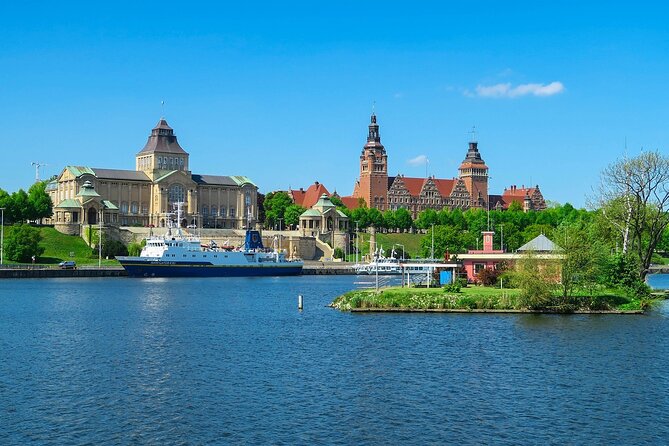
The tour then moves to The Pomeranian Dukes’ Castle, originally built in the 14th century. The castle’s story is tied to long stretches of power, intrigue, and architectural change. Today, it functions as a cultural hub with museums, exhibitions, and events connected to Szczecin’s heritage.
You get around 20 minutes here. The included ticket makes a difference, since castles and museum-adjacent sites can add cost quickly on your own.
The best way to enjoy this stop is to listen for the contrast. You are looking at a structure that has existed through shifting eras, yet its current role is educational and cultural. That shift is part of why the castle matters. It is not only a photo backdrop, it is a place where the city keeps telling its own story.
One consideration: museum exhibits can be tempting to linger over, but the walking-tour format keeps you moving. If you fall in love with something inside, save time for a separate revisit later. The tour gives you the spark.
Lastadia Łasztownia on the Oder: Where Maritime Szczecin Shows Through
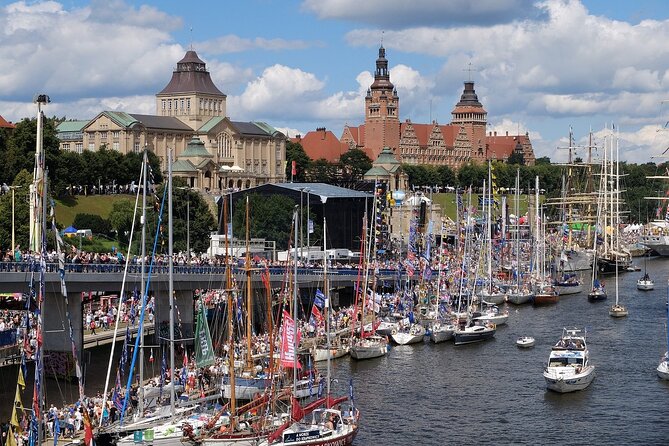
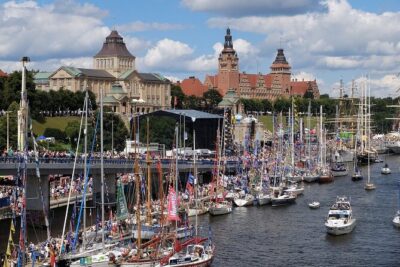
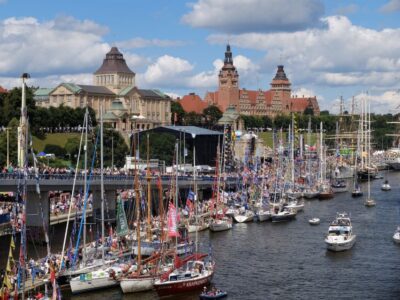
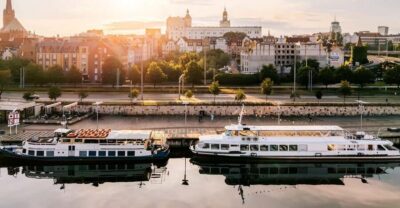
Now for a change of pace. Lastadia Łasztownia is the waterfront district on the Oder River, and it has a maritime character shaped by cargo handling and shipbuilding in earlier days. What makes this area especially good for a guided tour is that you can connect the physical layout to the work that once happened here.
This stop runs about 30 minutes, which is a bit longer than the earlier stops for a reason. You need time to walk the promenade, look for the details in the restored areas, and take in views over the river.
The area is known for restored warehouses that now hold restaurants, cafés, and art galleries. Even if you do not stop for a meal, it is useful to know where these spaces are because they shape where locals choose to spend time.
Practical tip: use this portion to get orientation about which side of the river you want to explore on your own later. If you are the type who likes to wander, the waterfront segment gives you a natural path.
A possible drawback: weather can affect how enjoyable the promenade feels. In cold or rainy conditions, you might want to keep your time focused on the most scenic stretches and then plan an indoor stop afterward.
Wheel of Szczecin and the Surprise Stops That Keep It Fun
After Lastadia, the tour heads toward the Wheel of Szczecin. This segment is about 30 minutes, and admission is included, so you can look at the site without adding extra costs.
The tour also includes a few additional stops along the way, but they are intentionally kept as a surprise. That is a nice choice for two reasons. First, it keeps the momentum high so you do not spend the whole first half scanning for what’s next. Second, it allows your guide to respond to what is happening on the day, like crowds or seasonal changes around the city.
From a practical standpoint, these extra stops matter because they often turn a checklist into a flow. Instead of just hitting landmarks one by one, you get short moments that explain why a street, building, or viewpoint belongs in the bigger picture of Szczecin.
One small time tip: keep your camera ready during the mid-to-late part of the walk. The route tends to shift from architecture to more open views, and those views are usually easiest to capture when you are not stopping to dig for your phone.
Price and Value: What $32 Buys You in Real Terms
The price is $32.00 per person, for a 2-hour guided walking tour. That might look like a straightforward fee, but the value comes from what is included.
You get:
- A professional guide
- The guided walking route itself, which removes navigation stress
- Admission tickets included for each named stop
In other words, part of what you are paying for is not just storytelling. You are paying for access and time efficiency. If you tried to do this on your own, you would likely spend money on tickets and time figuring out routes, timing, and what is actually worth stopping for.
Also, the group limit of 15 people helps justify the price. It supports the kind of interaction where you can ask questions and get answers that fit what you are curious about, not just what the guide can cover quickly.
One more value point is the start time at 10:00 am. Starting in the morning often means better light for exterior architecture and less pressure to find a plan for the day later.
English-Language Touring That Actually Lets You Ask Questions
The tour is offered in English, and the guide is part of the whole experience. A good guide does two things: they explain what you are seeing, and they help you ask the right questions.
The strongest signal from the way this tour is experienced is access. With small groups, you can get answers instead of nodding along. In at least one instance, a guide named Glenn was described as highly motivated and interactive, which is exactly the kind of energy that turns a walk into a conversation.
If you care about history, architecture, or why Szczecin developed the way it did, this format works well because it gives you a chain of places to connect. You start with big identity landmarks, then move to the castle and the waterfront, which shows you how the city’s public face connects to its working life.
Timing, Pace, and What the Tour Does Not Try to Do
This tour is designed to be a first-pass overview. It moves across multiple major stops, each timed around 20 minutes (with Lastadia and the Wheel of Szczecin taking about 30 minutes each). That makes it ideal when you want to fit sightseeing into a tight schedule.
What it is not trying to do is replace independent exploration. If you love one site, plan a follow-up. The tour gives you what you need to know what to look for later.
If you prefer slow travel with lots of time inside every building, you might feel slightly rushed. But if you want bearings, context, and a smart route that keeps you from missing key spots, it is a very workable plan.
Who Should Book This Szczecin Walking Tour
I think this tour is a great fit for:
- First-time visitors who want a map-free route and a clear sense of where to go next
- People who like architecture and major landmarks, especially with free entry
- Anyone traveling with limited time who still wants a guided explanation, not just self-guided wandering
- Solo travelers who value small-group interaction and an easy chance to ask questions
It may be less ideal if:
- You plan to spend lots of time reading exhibit details inside museums
- You hate walking and prefer mostly indoor, sit-down attractions
- You are in a mood to do everything at your own speed without guidance
Should You Book? A Simple Decision Checklist
Book it if you want a fast, organized way to understand Szczecin, including Karlowicz Philharmonic, the Archcathedral Basilica of St. James the Apostle, the Pomeranian Dukes’ Castle, and the waterfront at Lastadia Łasztownia. The included admission tickets make it a cleaner value, and the small group size supports real conversation.
Skip it, or pair it with extra time, if you know you want deep museum time inside the castle or if you already have a strong plan for the waterfront and historic center. In that case, you might just want to use the guide as inspiration and do the rest on your own.
One practical note for planning: this tour is often booked around 15 days in advance on average, so if you have firm dates, reserve early rather than gambling.
FAQ
What is the duration of the Szczecin walking tour?
It runs for about 2 hours.
Where does the tour start and where does it end?
It starts at Kino Pionier, al. Wojska Polskiego 2, 70-471 Szczecin, Poland, and ends back at the same meeting point.
What language is the tour offered in?
The tour is offered in English.
How much does the tour cost?
The price is $32.00 per person.
Are admission tickets included?
Yes. Admission tickets are included for the stops on the tour.
How big is the group?
The tour has a maximum of 15 travelers.
Do I need a map?
No. The guide takes care of navigating, so you should not need a map during the walk.
Is there free cancellation?
Yes, you can cancel for a full refund up to 24 hours in advance of the experience start time.
Is the tour suitable if I travel with a service animal?
Service animals are allowed.
More Tours in Szczecin


More Tour Reviews in Szczecin

Szczecin, Other Reviewed Walks
Recently written up around Szczecin
More Szczecin City Tours.
 ★ 4.7Old Town Highlights Private Walking TourFrom $10776 reviews
 ★ 4.7Medieval Old Town Private Walking TourFrom $12817 reviews
 ★ 4.3Cruise to the Dąbie LakeFrom $2513 reviews
 ★ 3.9Private Traditional Polish Food TourFrom $19413 reviews
 ★ 4.1Szczecin Polish Beer and Food Tasting Private TourFrom $1738 reviews
 ★ 4.3Szczecin Pomeranian Dukes’ Castle Exterior Private TourFrom $1076 reviews
 ★ 5.0Szczecin Private Vodka Tasting TourFrom $1724 reviews
 ★ 5.0Szczecin Old Town with Pomeranian Dukes’ Castle Private WalkFrom $1233 reviews
Also on these Poland lists