
REVIEW · GOLF CART AND ELECTRIC CAR TOURS
Krakow: City Sightseeing Tour Eco Electric Buggy Golf Cart
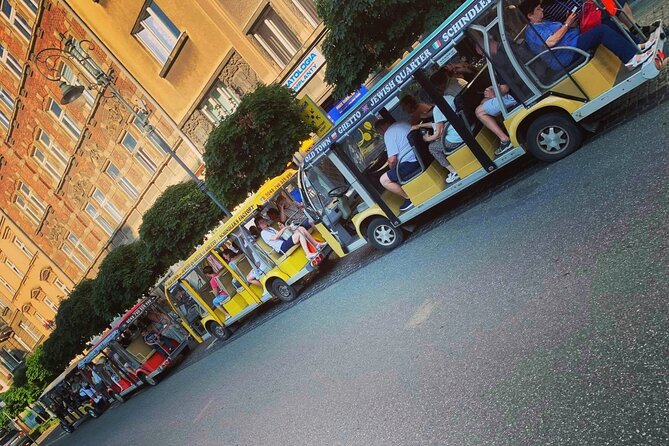
One hour 30 minutes, and Krakow feels mapped. You get an easy, warm buggy ride through major Jewish Quarter and WWII sites, plus stops at nearly 24 places with English narration. The main tradeoff is that the route is packed into a short time window, and if you are expecting lots of museum entry, you may find some stops are more about seeing from the outside.
I like this tour for its practical flow, especially when the weather turns cold. It is also easy to meet up, and the vibe is social, so you can make a few new friends while you move between neighborhoods. Just go in knowing the ride can get a bit bumpy and, on crowded carts, you might feel tight.
In This Review
- Key highlights you will actually feel on this tour
- Why an eco buggy tour is a smart way to orient yourself in Krakow
- Meeting point and pickup: where to go so you do not waste tour time
- The ride itself: warm, quick, and sometimes a little bumpy
- Kazimierz in one route: synagogues, squares, and the stories between stops
- Church on the Rock, Skałka: a dramatic start in a small space
- Plac Wolnica: the old market of Kazimierz
- Corpus Christi Basilica: monastery church origins
- A look at Libuszhof: the street-and-house rhythm of Kazimierz
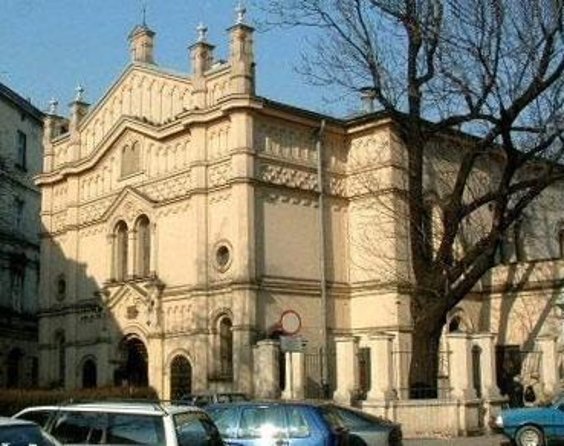
- Tempel Synagogue: cultural life, not just worship
- Kupa Synagogue: 17th-century community anchor
- Izaak Synagogue and its Italian-born designer
- High Synagogue: tall by design, and built to be seen
- Old Synagogue: the oldest still standing in Poland
- Wolf Popper Synagogue: decorative meaning and later reuse
- A stop tied to Augusta Rubinstein and her famous connections
- Remah Synagogue: the smallest, still active
- Podgórze ghetto sites: what you see, why it matters, and what to watch for
- Ghetto Heroes Square: the concentration point before deportations
- Eagle Pharmacy Museum: the only pharmacy inside the borders
- Oskar Schindler’s Enamel Factory: you may only see the exterior
- Old ghetto wall and St. Joseph’s Church: the route closes in Podgórze
- How long it takes and how many sights you really get
- English narration, audio support, and the guide style that makes it work
- Price and value: is $28.88 worth it?
- Who should book this Krakow eco buggy tour, and who should skip it
- Should you book this Krakow Eco Electric Buggy Golf Cart Tour?
- FAQ
- How long is the Krakow city sightseeing eco buggy tour?
- What is the price per person?
- Is pickup offered on this tour?
- What language is the tour offered in?
- Where is the meeting point in Krakow?
- Does the tour include audio or narration?
- Are there blankets or heating on the buggy?
- What is the cancellation policy?
- Is the Schindler factory included for museum entry?
Key highlights you will actually feel on this tour
- Nearly 24 sights in 1 hour 30 minutes, so you get your bearings fast
- Kazimierz synagogues focus, including Tempel Synagogue and the Old Synagogue area
- WWII Podgórze memorial stops, such as Ghetto Heroes Square and the Eagle Pharmacy Museum
- Warm buggy comfort, with blankets and heating mentioned by guests
- English narration with audio support, plus a driver who helps connect the dots
- Smaller group size (up to 50), which helps on busy streets
If the walking is the problem, these rolled-through reviews help
- Krakow: City Sightseeing Tour by Electric Golf Cart
★ 4.5 · 3,264 reviews - Krakow: City Sightseeing Tour Eco Electric Buggy Golf Cart
★ 4.7 · 3,143 reviews - Krakow: Extended City Sightseeing Tour – Eco Buggy Golf Cart
★ 4.7 · 794 reviews - Krakow: Electric Car Sightseeing Tour
★ 4.4 · 450 reviews
Why an eco buggy tour is a smart way to orient yourself in Krakow
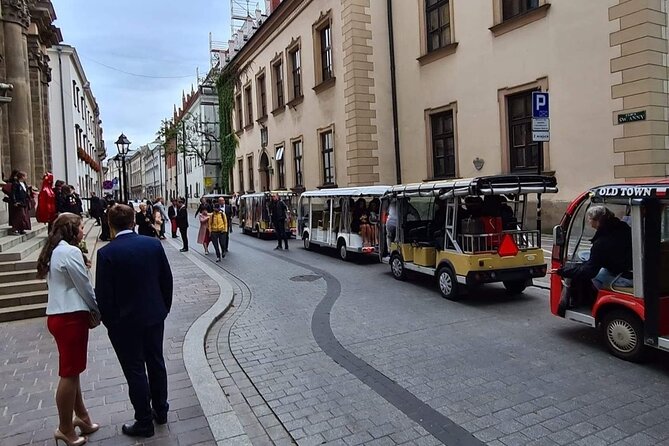
Krakow can feel like a puzzle at first. The old center is beautiful, but it is spread out, and walking everywhere eats your time quickly, especially if you have done museums already.
This electric buggy style tour is built for the job: you sit back, follow a route that threads together neighborhoods, and still get real context at each stop. If you want to understand how Kazimierz and Podgórze fit into the bigger story of Krakow, you will appreciate the pacing.
Meeting point and pickup: where to go so you do not waste tour time
The tour starts at Parking 24H Kraków old town car park, located at Mikołaja Zyblikiewicza 2, 31-029 Kraków. You end back at the same place.
One practical tip I found especially useful: the pickup point is near the busy main street area around Zyblikiewicza Street, and it is across from a Zabka shop. If you are arriving by tram or bus, this area is also described as near public transportation, which helps when your hotel is not right downtown.
The ride itself: warm, quick, and sometimes a little bumpy
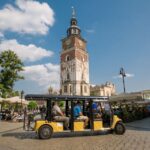
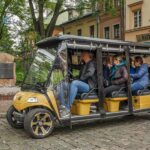
You are in an open-air or semi-open buggy setup, so in winter you will feel the cold at first contact. The good news is that guests specifically mention blankets and heating, which makes a huge difference when the temperature drops.
Comfort is usually a win, but you should know the downside. One unhappy experience complained about the buggy being packed tightly and earphones not working for everyone, so if you are sensitive to crowding, arrive with that in mind and be ready for a more social, group-focused ride.
Kazimierz in one route: synagogues, squares, and the stories between stops
Kazimierz is where Krakow’s Jewish life history is most visible today, and this tour leans hard into that. Instead of treating synagogues as a checklist, the stops connect the dots between different communities, architecture, and what life looked like across centuries.
Below are the other Krakow trips we have logged
- Creepy Krakow: 2-Hour City Walking Tour★ 4.7 · 1,131 reviews
- Krakow: City Pass With Transport★ 4.1 · 575 reviews
- Krakow: Guided City Tour by Golf Buggy (with hotel pickup)★ 5.0 · 426 reviews
- Private Departure Transfer: Krakow City To Krakow Airport Balice★ 4.5 · 367 reviews
- Krakow: City Sightseeing Tour Eco Electric Buggy Golf Cart★ 4.5 · 311 reviews
Church on the Rock, Skałka: a dramatic start in a small space
You begin at Church on the Rock (Kosciol na Skalce), also known as Skałka. This place sits on a small outcrop with a Pauline monastery, and it is tied to the 1079 killing of Saint Stanislaus by order of King Bolesław II the Bold.
It is a short stop, and one of the details worth knowing is that the admission ticket here is listed as free. Even if you do not go deep inside, the setting gives you a strong Krakow foothold before the tour shifts into Kazimierz.
Plac Wolnica: the old market of Kazimierz
From there you hit Plac Wolnica, a key square in the original market area of Kazimierz. You will learn that it was established when the city of Kazimierz was founded in 1335, and it functioned like a second civic center for trade and administration.
The name is also tied to free trade traditions. Why this matters for you on a tour: squares like this are the “stage” where communities formed, so understanding Plac Wolnica helps later stops feel less like random landmarks.
Corpus Christi Basilica: monastery church origins
Next comes a major church that was erected in stages from 1340 to about the mid-15th century, built as a monastery church. The tour context here is that King Władysław II Jagiełło gave it to the Canons Regular of the Lateran in 1404, and it is associated with a monastic cemetery beside the church.
If you are the type who likes when religion and architecture connect to politics, this stop gives you that link quickly. The “watch for it” moment is the scale and layout, which explain why it was designed as a monastery-focused site.
A look at Libuszhof: the street-and-house rhythm of Kazimierz
You also pause around the area known for Libuszhof, described as a former complex of streets and buildings. The current shape is said to have been established through regulatory projects in 1808 and 1844, and the tour ties buildings along the defensive walls to the Jewish hospital associated with the Kupa synagogue.
This is not a “wow facade” stop so much as a storytelling stop. It helps you picture the dense lived-in geography of Kazimierz, which you will feel again later when you stand near the ghetto sites.
Tempel Synagogue: cultural life, not just worship
At Tempel Synagogue, you learn it is a major place of worship and also a center for Jewish culture, with concerts and meetings tied to events and festivals.
This is a good stop for anyone who wants the tour to feel current, not only historical. It is also a reminder that cultural identity continued to pulse through institutions, even when history later turned violent.
Kupa Synagogue: 17th-century community anchor
The tour then visits Kupa Synagogue, a 17th-century synagogue in Kazimierz’s former Jewish quarter. The description connects it to the Jewish community area that was designated after 1495, when the community was moved from the Old Town.
Again, the value here is context. Understanding why the community was relocated helps you read the neighborhood like a map instead of a maze.
Izaak Synagogue and its Italian-born designer
At Izaak Synagogue, you get a specific identity story: it dates to 1644 and is named after Izaak Jakubowicz, described as Isaac the Rich, a banker to King Ladislaus IV. The tour mentions the designer as Francesco Olivierri, who was Italian-born.
If you enjoy architecture trivia that makes buildings feel personal, this stop delivers. It is also a nice counterpoint to the other synagogues on the route, which vary in era and style.
High Synagogue: tall by design, and built to be seen
The High Synagogue, also called the Tall Synagogue, is described as inactive and notable for its height and the prayer hall being upstairs. It is positioned as the tallest synagogue in the city and tied to Late Renaissance architecture.
Even if you do not go inside, you will likely remember this because it reads visually as an intentional statement. This is one of those stops where you understand why people would have navigated by landmarks.
Old Synagogue: the oldest still standing in Poland
The Old Synagogue (Alta Shul) is described as the oldest synagogue building still standing in Poland and one of the most precious landmarks of Jewish architecture in Europe. It served as a major center for the Kraków Jewish community until the Second World War.
This stop carries weight. The tour’s approach matters here: it gives you the building’s role in community life first, then lets the WWII context later in the route land harder.
Wolf Popper Synagogue: decorative meaning and later reuse
Next is Wolf Popper Synagogue, also known by the name connected to the stork. The details include the early 17th-century founding by Wolf “The Stork” Popper and the decorative motif over the entrance, described as animals symbolizing traits of a devout man.
You also learn that it declined after the founder passed and that it is now used in a different way, including as a bookshop and art gallery in the women’s area upstairs. That is a surprisingly hopeful detail, because it shows continuity through changing function.
A stop tied to Augusta Rubinstein and her famous connections
The tour includes a stop connected to Augusta Rubinstein, highlighting her family background and naming relatives in the wider cultural web. The description notes she was cousin to philosopher Martin Buber, and she connects to other noted family ties.
This portion is less about doors and more about people. It is the kind of moment that makes the neighborhood feel like it held real lives, not only structures.
Remah Synagogue: the smallest, still active
Finally in Kazimierz, you reach Remah Synagogue, described as the smallest historic synagogue in the district and named after Rabbi Moses Isserles, whose name is linked via the acronym ReMA. The tour also notes that it is one of two active synagogues in the city.
This is a strong close to the synagogue sequence, because it shifts from preserved heritage to something living. You end this section with the sense that institutions can survive even after severe disruption.
Podgórze ghetto sites: what you see, why it matters, and what to watch for
The tour then moves into Podgórze, where WWII history becomes unavoidable. I appreciate how the route uses spacing and multiple stops, rather than forcing everything into one memorial.
Ghetto Heroes Square: the concentration point before deportations
Ghetto Heroes Square is the focal point here, tied to the years 1941 to 1943 in the Kraków ghetto. The site is described as a place of concentration before people were transported to concentration camps, and it also notes the pharmacy Under the Eagle as the only non-Jewish inhabitant at number 18.
If you want to understand the human mechanics of history, this stop does it quickly: it tells you where people gathered and how the system worked in daily life.
Eagle Pharmacy Museum: the only pharmacy inside the borders
The Eagle Pharmacy Museum is at number 18 and described with names and dates tied to the Pankiewicz family. It also explains that before World War II there were multiple pharmacies in Podgórze, and during the ghetto period this pharmacy was the only one within the borders, with the proprietor described as the only Pole with rights to stay in the area.
This is often the stop that people remember most because it is specific and personal. Even on a short tour, the concentration on one place and one role makes the story feel grounded.
Oskar Schindler’s Enamel Factory: you may only see the exterior
You also pass Oskar Schindler’s Enamel Factory area, now associated with museums, including a contemporary art venue and a historical museum branch. One note from experience accounts: the tour can pass by without including an interior museum tour.
So here is my practical advice: if you truly want to go inside the Schindler factory exhibits, plan it separately. Use this buggy tour as the orientation and context layer, then follow with a dedicated visit.
Old ghetto wall and St. Joseph’s Church: the route closes in Podgórze
The tour includes a stop for the old ghetto wall, which helps you visualize the physical boundary that shaped daily movement. It also visits St. Joseph’s Church in Podgórze, located on Podgórski Square near the foothills.
This church stop gives you a visual counterbalance to the ghetto sites. It does not dilute the story, but it gives you somewhere to look that is rooted in place, not only in tragedy.
How long it takes and how many sights you really get
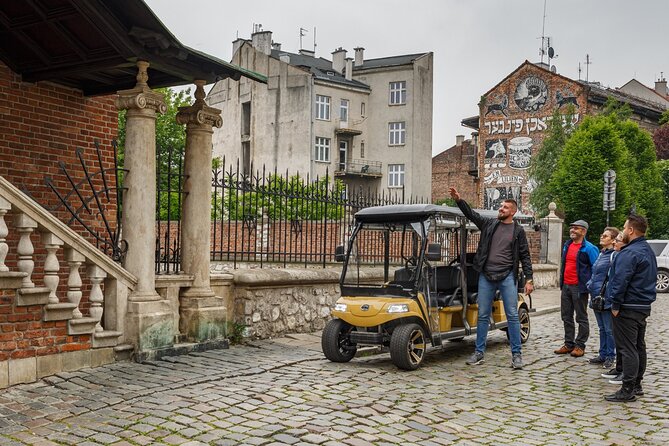
The tour runs about 1 hour 30 minutes and is described as stopping at nearly 24 different sights. That density is the main reason it is popular for first-day planning.
In practice, you get enough time to orient, take a few photos, and hear key points. If you want deeper time inside buildings, you need to know this is a “route tour,” not a “museum marathon.”
One more practical consideration: the tour is capped at 50 travelers. That helps, but the buggy itself can still feel tight in winter clothing, so if you are traveling with friends or family and care about comfort, keep expectations realistic.
English narration, audio support, and the guide style that makes it work
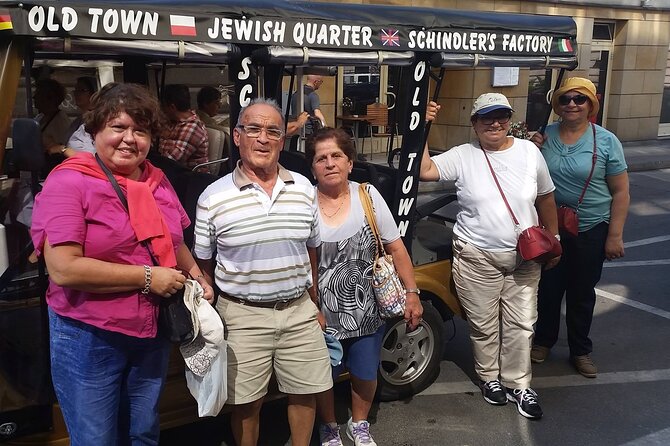
The experience is offered in English, with pickup and a mobile ticket. In guest feedback, the best moments often involve how the driver connects places into a coherent picture, not just reading facts.
Some guests mention the recorded narration and that it helps during the ride. If you are hard of hearing or rely on audio, it is worth bringing earbuds or double-checking you can use the audio support at the start, since one complaint raised issues with headphones working properly for everyone.
Price and value: is $28.88 worth it?
At $28.88 per person, the value here comes from three things you get together: time, comfort, and guided context. In 1 hour 30 minutes, you cover multiple neighborhoods without spending that time walking uphill, crossing long distances, or trying to stitch together a self-guided route.
The “rest factor” is real. Guests call out that the buggy is warm and toasty, with blankets and heating, which effectively buys you a calmer pace in cold weather. Add pickup availability and English narration, and this starts to look less like a novelty and more like a practical orientation tool.
Where the cost might feel high is if your top priority is deep museum entry at every stop. This tour may not be the best choice if you want to go inside major sites every time, especially in cases involving Schindler’s factory.
Who should book this Krakow eco buggy tour, and who should skip it
I think this is a great fit if you:
- Want a first-pass overview of Krakow’s Jewish Quarter and WWII memorial sites
- Are visiting in winter and want warmth between short stops
- Prefer guided context over scanning signs on your own
- Like building a route in your head before you spend longer later
I would skip or adjust expectations if you:
- Want maximum time inside museums, not just stops for seeing and learning
- Are very sensitive to crowding, since one account described the cart as too packed
- Are relying on audio to the point where broken headphones would ruin your experience
Also, if you can, schedule this earlier in your trip. One of the best pieces of advice from experience accounts is that doing the tour early helps you decide what to return to on foot.
Should you book this Krakow Eco Electric Buggy Golf Cart Tour?
Yes, if you want an efficient, comfortable way to understand Krakow across neighborhoods, especially Kazimierz synagogues and Podgórze WWII sites. The price is reasonable for a guided route that saves your legs, and the warm buggy setup makes it practical even when the weather is unpleasant.
I would book with one mindset: treat it as your route and context pass. Then, if a specific site like Oskar Schindler’s Enamel Factory is a must-see for you inside, plan that as a separate visit so you do not leave disappointed.
FAQ
How long is the Krakow city sightseeing eco buggy tour?
It is about 1 hour 30 minutes.
What is the price per person?
The price is listed as $28.88 per person.
Is pickup offered on this tour?
Yes, pickup is offered, and the tour returns to the starting meeting point.
What language is the tour offered in?
The tour is offered in English.
Where is the meeting point in Krakow?
The start point is Parking 24H Kraków old town car park at Mikołaja Zyblikiewicza 2, 31-029 Kraków, Poland.
Does the tour include audio or narration?
Audio support is mentioned in guest feedback, including an audio guide.
Are there blankets or heating on the buggy?
Guests report blankets were on the cars and that heating helped keep the ride warm in cold weather.
What is the cancellation policy?
Free cancellation is available up to 24 hours in advance for a full refund. If you cancel less than 24 hours before the start time, no refund is given.
Is the Schindler factory included for museum entry?
The tour is described as stopping at or passing the Oskar Schindler’s Enamel Factory area, but at least one experience account indicates there was no museum entry on that run.
More Tours in Krakow

More Tour Reviews in Krakow
Sightseeing Without the Walking
Recently written up around Krakow
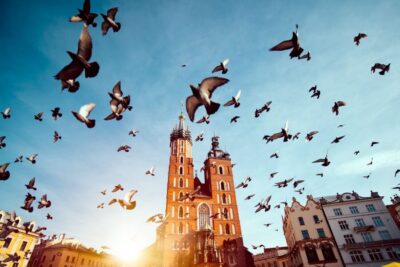
More Golf Cart and Electric Car Tours.
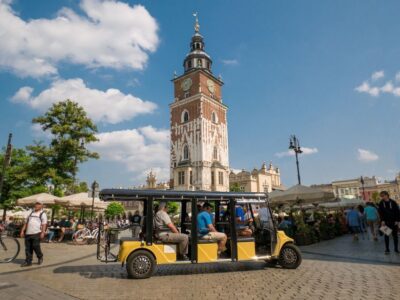 ★ 4.5City Sightseeing Tour by Electric Golf CartFrom $133,264 reviews
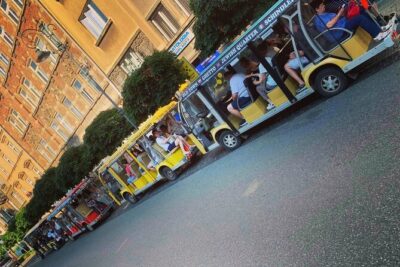 ★ 4.7City Sightseeing Tour Eco Electric Buggy Golf CartFrom $133,143 reviews
 ★ 4.6E-Car Tour and Audio GuideFrom $161,738 reviews
 ★ 4.82-Hour Private Guided Tour by Electric CarFrom $38805 reviews
 ★ 4.7Extended City Sightseeing Tour – Eco Buggy Golf CartFrom $13794 reviews
 ★ 4.9City Sightseeing Tour by Golf Cart/Buggy Guided TourFrom $40510 reviews
 ★ 4.4Electric Car Sightseeing TourFrom $25450 reviews
 ★ 5.0Guided City Tour by Golf Buggy (with hotel pickup)From $53426 reviews
Also on these Poland lists