
REVIEW · GOLF CART AND ELECTRIC CAR TOURS
Krakow Guided Tour by Electric Golf Cart
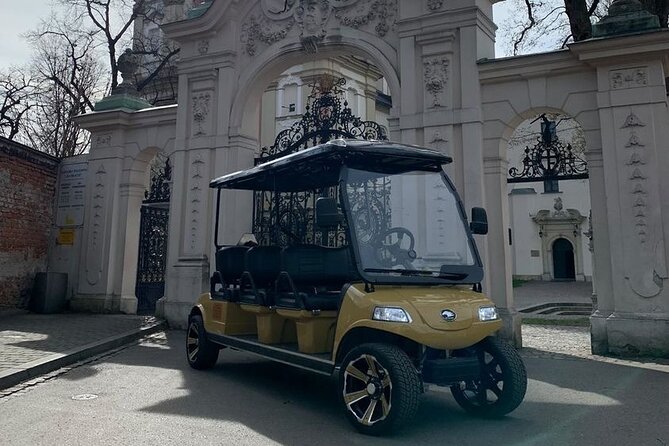
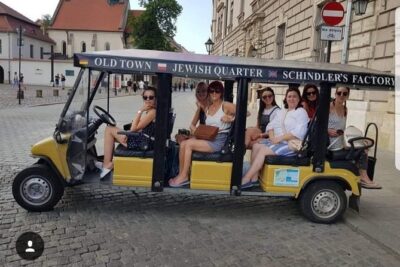
Electric carts make Krakow feel fast. You cover huge ground in about 1.5 to 2 hours, gliding past Schindler-era and Jewish heritage sites with English audio guidance while your driver keeps the story moving. I like that it’s built for photos, not just staring at buildings from a distance, and I especially like that the commentary stays in English even when you’re weaving through tight old streets.
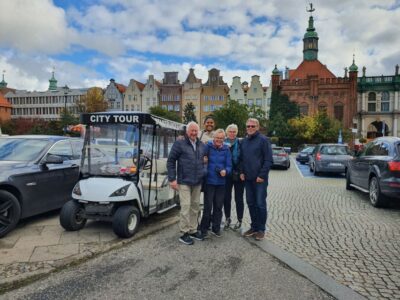
My other favorite detail is the flexibility: if you want a few extra minutes to grab a picture, ask. Some guides also take a lot of photos for the group, and one repeat theme in feedback was a comfy cart with blankets. The main thing to watch is logistics, especially pickup changes, which can cause long waits if you’re not paying attention.
In This Review
- Key highlights you’ll notice right away
- Electric Golf Cart Touring: Why it works for Krakow’s tight lanes
- Schindler’s Factory drive-by and Ghetto Heroes Square: paying attention without buying tickets
- Market Square and the zapiekanki break you can ask for
- Old Synagogue, Kupa Synagogue, and Wawel Castle: big sights, no inside access
- Plac Wolnica: the “second largest” market square story
- St. Joseph Church, the ghetto wall, and the Eagle Pharmacy Museum context
- Church on the Rock (Skałka): canonization, a small rock, and a free stop
- Corpus Christi Church: a monastery church with long construction roots
- Kazimierz synagogues: Tempel, Izaak, High, Popper, and Remuh stops
- Krakus Mound and the promise of a quick city view
- Barbican and Matejko Square: defensive bricks and royal monuments
- Price and value: what you pay for, what you must bring yourself
- Who this tour fits best, and who might want something else
- Should you book this Krakow Electric Cart tour?
- FAQ
- How long is the Krakow guided tour by electric golf cart?
- Is the tour offered in English?
- Are admission tickets included for all sights?
- What food and drinks are included?
- What ticket format do I get?
- Can I cancel for a full refund?
Key highlights you’ll notice right away
- English narration plus an audio guide so you can follow the story end to end
- Electric golf cart comfort with time built in for photos and short wandering breaks
- Jewish Krakow and wartime reminders are treated as the core of the route, not side notes
- Zapiekanki stop in Market Square area if you ask, so you can eat on your schedule
- Multiple major landmarks are “seen” not “entered” (synagogues and Wawel are typically viewed from the cart)
- Short, well-paced church stops with free admission for a lighter moment between heavier sites
If the walking is the problem, these rolled-through reviews help
- Krakow: City Sightseeing Tour by Electric Golf Cart
★ 4.5 · 3,264 reviews - Krakow: City Sightseeing Tour Eco Electric Buggy Golf Cart
★ 4.7 · 3,143 reviews - Krakow: Extended City Sightseeing Tour – Eco Buggy Golf Cart
★ 4.7 · 794 reviews - Krakow: Electric Car Sightseeing Tour
★ 4.4 · 450 reviews
Electric Golf Cart Touring: Why it works for Krakow’s tight lanes
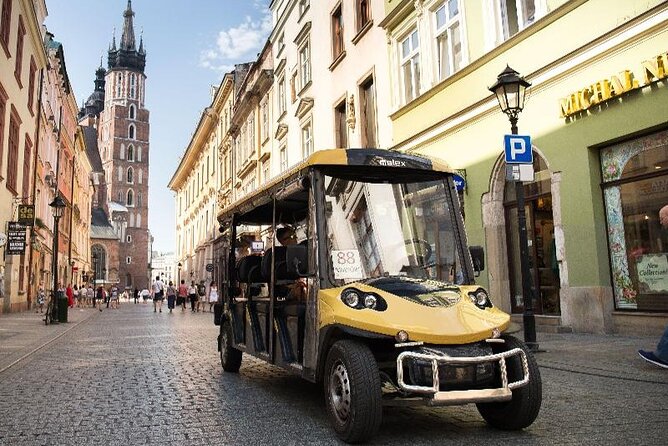
Krakow has a way of making you walk more than you planned. Old Town is lovely, but the sidewalks add up fast. This tour solves that with an electric golf cart that moves you through the city’s key quarters without wearing you out before you even reach the best viewpoints.
The other practical win is pacing. In 90 minutes to 2 hours, you’re not bouncing between far-flung neighborhoods on foot. You’re connected in one loop: old streets, Kazimierz (the historic Jewish quarter), Podgórze, and then back toward Old Town highlights. That means you spend more time understanding where you are, and less time trying to read a map while traffic and crowds tug at you.
You also get time for photos, which sounds basic, but it matters. With a guided cart route, you can stop at the exact spot where you’ll actually see what the guide is talking about, instead of hoping the view lines up.
Schindler’s Factory drive-by and Ghetto Heroes Square: paying attention without buying tickets
The tour starts by rolling through the Fabryka Emalia Oskara Schindlera area. Important detail: you get the ride and the context, but without an admission ticket. If you already planned to visit Schindler’s Factory museum inside later, this is a good way to get oriented first, so the museum visit makes more sense when you go deeper.
Then you pass through Ghetto Heroes Square (Plac Bohaterów Getta), a place tied to executions and displacement during the Kraków Ghetto liquidation in 1943. This is one of those stops where the guide narration is doing real work. The square name itself is a clue, and the meaning is heavy.
One practical tip for this part: don’t rush your photos. Even if you’re tempted to take quick shots for your camera roll, slow down just enough to read what’s around you. Places like this are not about sightseeing shortcuts.
Market Square and the zapiekanki break you can ask for
You’ll cross toward Market Square, and there’s a specific chance to add food without breaking the flow. When you ask the driver, he can stop for the famous zapiekanki, typically a 5 to 10 minute window for buying and eating.
Why this matters: on a short tour, food stops either happen too late or take too much time. This one is designed to be quick, and it’s placed right where the route naturally passes. It’s also a nice contrast after the darker wartime context you just rode through.
A small caution: this snack time is not included in the tour price. Plan for your own budget, and keep your expectations realistic. You’re buying a quick Krakow favorite, not settling into a full meal.
Old Synagogue, Kupa Synagogue, and Wawel Castle: big sights, no inside access
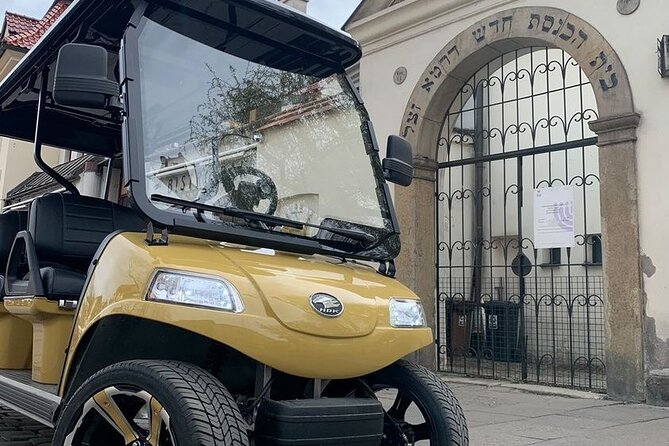
In Kazimierz, you’ll see multiple historic synagogues, but the tour is explicit about one limitation: for the Old Synagogue (Synagoga Stara) and Kupa Synagogue, it isn’t possible to enter during the tour. You’ll view them as part of the drive-by story.
That approach can feel different depending on what you want. If your goal is photos and understanding the geography of Jewish Krakow, it works well. If your goal is going inside places of worship, you’ll likely want to plan separate visits on another day.
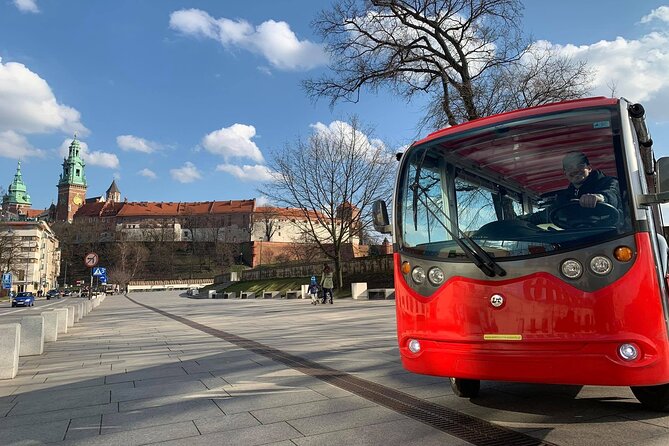
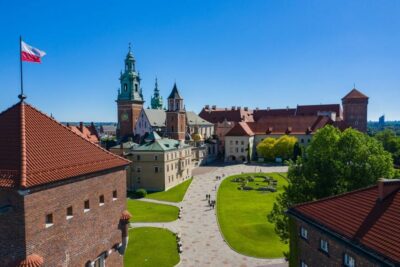
Next comes Wawel Royal Castle and Wawel Hill. Again, you’ll see it from the cart, not enter. Still, this stop is powerful because Wawel is one of Poland’s most recognizable cultural symbols, tied to royal power and major architectural eras. Seeing it from the right angle while your guide connects it to Krakow’s larger story helps the site stick in your mind.
Photo tip: if you’re aiming for a postcard-style Wawel shot, position yourself at the side your guide indicates and hold the camera steady. These moments are short, and the cart is moving.
Below are the other Krakow trips we have logged
- From Krakow: Auschwitz-Birkenau Guided Tour & Hotel Pickup★ 4.5 · 33,358 reviews
- From Krakow: Auschwitz-Birkenau Guided Tour & Hotel Pickup★ 4.5 · 29,340 reviews
- Krakow: Auschwitz Guided Tour with Optional Hotel Pickup★ 4.5 · 15,280 reviews
- Krakow: Auschwitz-Birkenau Guided Tour with Pickup & Lunch★ 4.5 · 9,800 reviews
- Krakow: Auschwitz-Birkenau Guided Tour Pickup/Lunch Options★ 4.5 · 9,057 reviews
Plac Wolnica: the “second largest” market square story
As you continue through Kazimierz, you pass Plac Wolnica, once a major square of the former city of Kazimierz. This is one of those stops where the facts matter because they change how you picture the area. It once measured about 195 meters by 195 meters, just a few meters smaller than the main market square, and it held administrative and judicial functions along with stalls trading goods from fur and tobacco to salt and amber.
You don’t need to fully memorize the numbers to get something from this. The point is to understand that Kazimierz wasn’t a quiet side neighborhood. It was a real economic center with its own scale.
Even if you only get a quick glance from the cart, the guide context can turn “another square” into a meaningful one.
St. Joseph Church, the ghetto wall, and the Eagle Pharmacy Museum context
The route shifts to St. Joseph’s Church in the Podgórze district. The admission is listed as free, and the stop time is short. Treat it as a brief reset, a moment of steadier ground between heavy stops.
Then you get one of the most direct reminders of the ghetto’s physical reality: a 12-meter stretch of original ghetto wall. There’s a commemorative plaque raised in 1983 in Hebrew and Polish that speaks plainly about Jewish life, suffering, and death at the hands of German torturers, and the final journey that began from there.
After that, you pass Eagle Pharmacy Museum on the southwest edge of Bohaterów Getta Square (number 18). This stop is valuable because it gives you a human, everyday angle on how ghetto policies worked. The pharmacy’s proprietor was Jozef Pankiewicz, later run by his son Tadeusz Pankiewicz. Before World War II, it served Polish and Jewish residents of Podgórze and served customers involved with charity, including Bikkur Cholim.
One detail worth holding onto: when a ghetto was established in Podgórze in March 1941, this pharmacy was the only one inside the borders, and the proprietor was the only Pole with rights to stay in it. Even without entering a museum space, this is the kind of story that makes the surrounding district feel specific, not generic.
Church on the Rock (Skałka): canonization, a small rock, and a free stop
Next is Church on the Rock (Kościół na Skalce). It’s on a small outcrop with the Pauline monastery, and it’s tied to the story of Saint Stanislaus and the events of 1079, when he was slain on the orders of King Bolesław II the Bold. The church is free to enter, and the stop time is about 10 minutes.
Why I like this stop on the same day as ghetto memorials: it adds religious and historical depth without turning into another long museum segment. You’re still learning, just in a different direction, with Krakow’s layered medieval story.
If you want good photos here, time your shots. The “small rock” location gives you elevation and angles that can be hard to recreate later without knowing where you were standing.
Corpus Christi Church: a monastery church with long construction roots
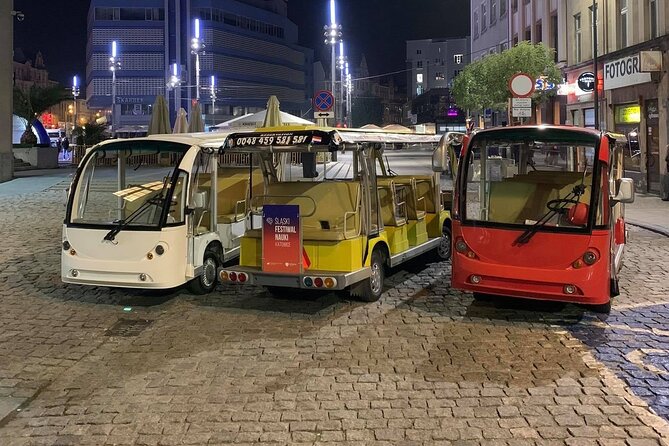
You also stop at Corpus Christi Church (Kościół Bożego Ciała). The basilica was erected in stages starting in 1340 and continuing until about the mid-15th century. It began as a monastery church, which helps explain why it sits on a large plot and has a monastic cemetery nearby.
This is another free admission stop with about 10 minutes. Since the tour is time-limited, think of it as a quick “this exists and why it matters” moment. The architecture timeline is a useful mental hook, especially if you later compare it to Wawel or other buildings you saw on earlier days.
Kazimierz synagogues: Tempel, Izaak, High, Popper, and Remuh stops
This part of the route is the Kazimierz spine. You’ll pass multiple synagogues tied to different eras and roles in Jewish community life.
You’ll see:
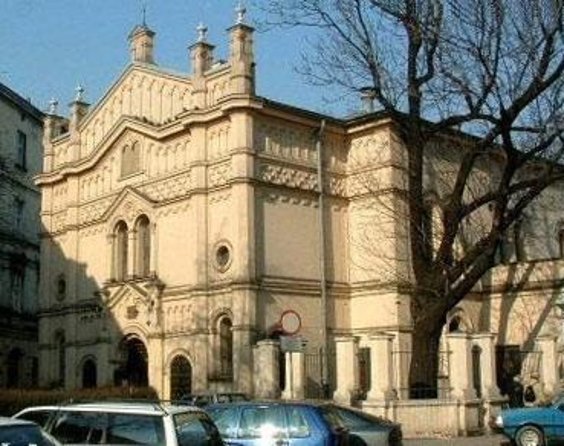
- Tempel Synagogue (Synagoga Tempel), described as a major worship place and also a hub for Jewish culture with concerts and meetings (especially during festivals).
- Izaak Synagogue (Synagoga Izaaka), an Orthodox synagogue from 1644 with donor Izaak Jakubowicz, and designed by Italian-born architect Francesco Olivierri.
- High Synagogue, an inactive 16th-century Orthodox synagogue also known as the Tall Synagogue, noted as the tallest synagogue in the city and an example of Late Renaissance architecture.
- Wolf Popper Synagogue (Synagoga Poppera), which today serves as a bookshop and art gallery, with an emphasis that its historical entrance used symbolic animal carvings.
- Remuh Synagogue (Synagoga Remu), a 16th-century synagogue and the smallest among the historic ones, named after Rabbi Moses Isserles (ReMA). It’s currently one of two active synagogues in Krakow.
Not every site is set up for entry. For the Old and Kupa synagogues, entry isn’t possible during the tour. For Remuh, admission tickets are explicitly not included. So if inside access matters to you, you should treat the cart tour as a fast map of the area, then plan targeted visits later.
One practical move: if you care about a specific synagogue building, keep your eyes up and ask the guide at the start of the Kazimierz portion which stop is most worth exploring on your own time. That lets you use the cart tour for context, not regret.
Krakus Mound and the promise of a quick city view
After the synagogue cluster, you head to Krakus Mound (Kopiec Krakusa) on Lasota Hill, about 3 kilometers south of the center. You can go up the hill for a view over Krakow, and this stop is about 20 minutes.
This is where you get a change of pace. You’ve been in tightly packed streets and memorial sites, and now you get a taller vantage point. It’s also a good place to stretch your legs because it gives you something active to do without needing a whole hike day.
Bring a little patience. Hill climb + photos can eat time fast. If you’re traveling with seniors or anyone who prefers minimal walking, decide ahead of time whether you’ll do the climb or stay closer to the base.
Barbican and Matejko Square: defensive bricks and royal monuments
You’ll also pass the Barbican and the Museum of Krakow area. The barbican is described as a medieval defensive structure, usually a round brick building connected to the city gate by a sheltered passage. Even from the outside, it’s a rare chance to see Krakow as a fortified city, not just a romantic postcard.
Then the tour reaches Matejko Square, where you’ll see the Grunwald Monument, an equestrian statue of King Władysław II Jagiełło. The monument has a complicated past: erected in 1910, demolished by the Germans in 1939, and reconstructed in 1976. In front is the Tomb of the Unknown Soldier.
This is a quick stop, about a minute. Don’t expect deep narration here, but it’s a good closing beat that anchors the day in national memory and identity.
Price and value: what you pay for, what you must bring yourself
At $37.99 per person, you’re paying for a short, guided crawl through multiple districts, delivered by an English-speaking driver with an English audio guide. You also get time for photos and a way to see sites that are otherwise spread out.
What you do not get:
- bottled water
- snacks
So if zapiekanki sounds like your thing, or if you get thirsty easily, plan to buy during the snack window or bring what you can before the tour.
Where the value really shows is that the cart makes it practical to hit a lot of meaningful stops in one sitting. If you tried to do the same route by yourself, you’d likely spend time figuring out transit, finding photo angles, and stitching the story together.
Who this tour fits best, and who might want something else
This tour is a great match if you want:
- a fast overview of Krakow’s key areas in under two hours
- English narration while you glide through Old Town, Kazimierz, and Podgórze
- a structured route that keeps you from wandering the wrong streets
It’s also a good option if you dislike long walking days. The cart experience tends to feel easier than shoe-leather sightseeing, and the feedback includes comfort extras like blankets.
Who might not love it as much:
- If you want to go inside many of the synagogues or Wawel, this tour is mostly a view from the cart for major sites. You’ll want separate, longer visits on your own schedule.
- If your schedule is sensitive to pickup confusion, be extra alert about where you meet.
Should you book this Krakow Electric Cart tour?
I’d book it if you want an efficient, English-guided way to understand Krakow’s biggest layers, especially the Kazimierz and ghetto-related landmarks. It’s priced for value because you’re buying motion plus storytelling, not just transportation.
I’d hesitate if your top priority is inside access to synagogues or Wawel castle, or if you’re the kind of traveler who hates any chance of missing a pickup. In that case, you might prefer a longer guided walking plan focused on fewer sites you can enter.
If you do book, do one smart thing: double-check your pickup details close to departure. Then bring a little flexibility in your mindset. This tour moves quickly on purpose, and it works best when you see it as a guided map of Krakow’s key sites, not a one-stop museum pass.
FAQ
How long is the Krakow guided tour by electric golf cart?
The tour runs about 1 hour 30 minutes to 2 hours.
Is the tour offered in English?
Yes. The tour includes an English speaking driver and an English audio guide.
Are admission tickets included for all sights?
No. Some stops specify that admission tickets are not included, including areas like Schindler’s Factory viewing and several synagogue stops, and the Wawel Castle is viewed from the cart without entering. For some churches, admission is listed as free.
What food and drinks are included?
Bottled water and snacks are not included.
What ticket format do I get?
You receive a mobile ticket.
Can I cancel for a full refund?
Yes, you can cancel for a full refund if you cancel at least 24 hours before the experience starts.
More Tours in Krakow
More Tour Reviews in Krakow
Sightseeing Without the Walking
Recently written up around Krakow
More Golf Cart and Electric Car Tours.
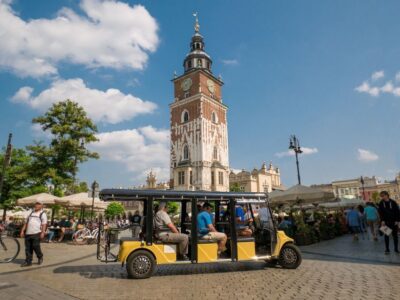 ★ 4.5City Sightseeing Tour by Electric Golf CartFrom $133,264 reviews
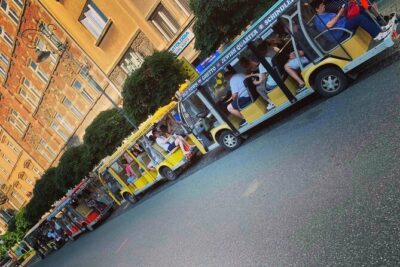 ★ 4.7City Sightseeing Tour Eco Electric Buggy Golf CartFrom $133,143 reviews
 ★ 4.6E-Car Tour and Audio GuideFrom $161,738 reviews
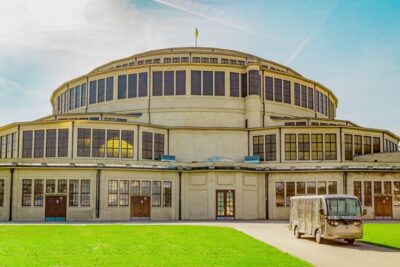 ★ 4.82-Hour Private Guided Tour by Electric CarFrom $38805 reviews
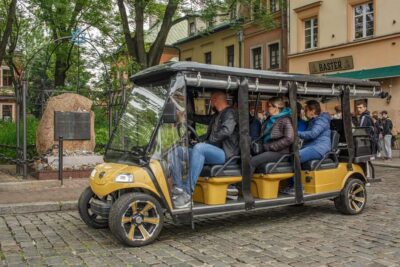 ★ 4.7Extended City Sightseeing Tour – Eco Buggy Golf CartFrom $13794 reviews
 ★ 4.9City Sightseeing Tour by Golf Cart/Buggy Guided TourFrom $40510 reviews
 ★ 4.4Electric Car Sightseeing TourFrom $25450 reviews
 ★ 5.0Guided City Tour by Golf Buggy (with hotel pickup)From $53426 reviews
Also on these Poland lists