
REVIEW · KAZIMIERZ JEWISH QUARTER TOURS
Krakow Jewish Quarter and Ghetto Tour by Electric Golf Cart
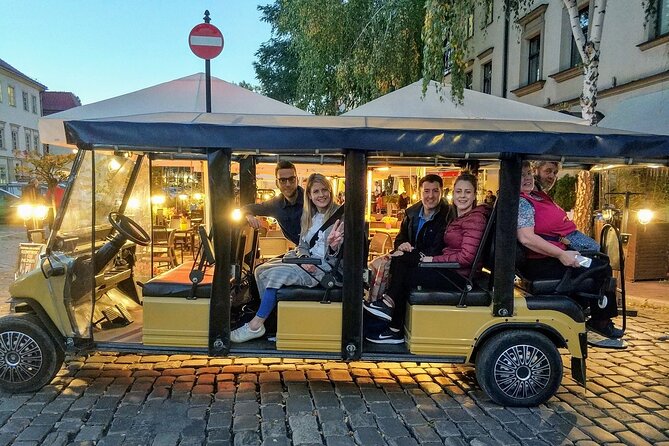
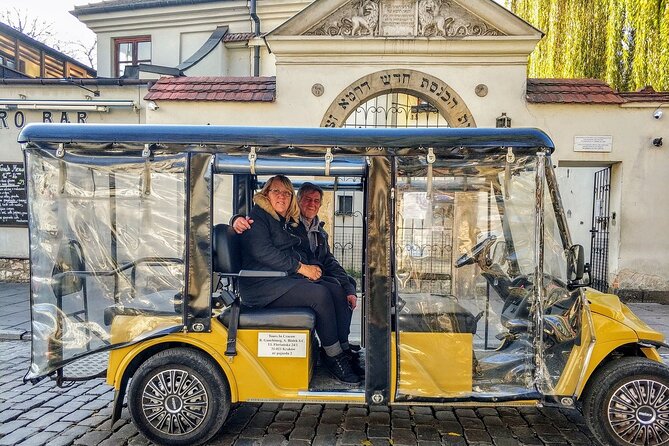
Kazimierz in 90 minutes, and you feel it. I love the electric golf cart format, because it gets you quickly between major Kazimierz sights without turning the day into a marathon. I also like that the route doesn’t stop at pretty streets, it brings you to Umschlagplatz and the surrounding reminders of deportations. The one drawback to think about is the balance of stops: some entries lean more Christian than Jewish, so if you want only synagogue and Jewish cemetery time, you may wish you had a dedicated walking day too.
This is an easy, time-friendly way to understand both past and present Kazimierz. Expect about 1 hour 30 minutes, an English-speaking driver, and an audio guide, plus a mobile ticket that keeps things simple when you arrive. If you’re short on time, this format is built for getting your bearings fast.
One more practical note: there’s no hotel pickup, and the tour starts at Mikołaja Zyblikiewicza 2 and ends at Mikołaja Kopernika 3. That means you’ll want to plan how you’ll get to the first point and where you’ll go after the last stop.
In This Review
- Key things to know before you go
- Why the electric golf cart works in Kazimierz and Podgórze
- Your route: starting at Zyblikiewicza, finishing near Kopernika
- Szeroka Street: where Kazimierz lived and four synagogues once stood
- Old synagogue stop: one of Poland’s oldest, preserved
- St Joseph Church and Podgórze Market Square: a landmark you can’t miss
- A preserved ghetto wall fragment and plaque: the moment the past turns physical
- Plac Zgody to Umschlagplatz: the square tied to deportations
- The wartime pharmacy story: shelter, messages, and packages
- Audio guide, headsets, and how to make the story stick
- Guide quality: when names like Matt, Natalie, Olivia, Martina, and Michael show up
- Price and value: what $34.75 gets you in 90 minutes
- Who should book this tour, and who might prefer walking instead
- Should you book the Krakow Jewish Quarter and Ghetto Tour by Electric Golf Cart?
- FAQ
- How long is the Krakow Jewish Quarter and Ghetto Tour by Electric Golf Cart?
- How much does the tour cost?
- Is the tour in English?
- What is included in the tour price?
- Is hotel pickup or drop-off included?
- Where do I meet, and where does the tour end?
- How many people are on the tour?
- Do I get a mobile ticket?
- What is the cancellation policy?
Key things to know before you go
- Electric golf cart touring helps you cover more Kazimierz streets in less time than walking.
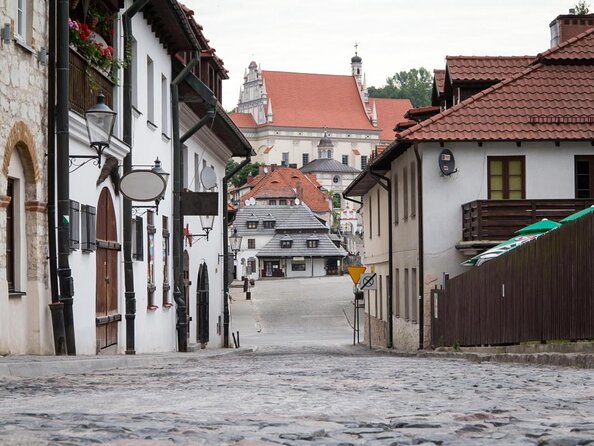
- Szeroka Street’s former synagogue cluster is a standout story, with multiple synagogues once along the same street.
- An especially old synagogue is included, preserved in very good condition.
- St Joseph Church at Podgórze Market Square anchors the route as a recognizable landmark.
- Ghetto reminders include a preserved wall fragment with a commemorative plaque.
- Plac Zgody and Umschlagplatz connect the area to the deportation process during Nazi occupation.
Kazimierz on foot, by cart and after dark. Our other write-ups
- Krakow: Jewish Quarter and Former Ghetto Tour
★ 4.9 · 1,441 reviews - Krakow: Bike Tour of Old Town, Jewish Quarter and the Ghetto
★ 4.9 · 1,155 reviews - Krakow: Kazimierz Jewish Quarter Walking Tour
★ 4.8 · 571 reviews - Krakow: Kazimierz, Schindler’s Factory & Ghetto Guided Tour
★ 4.8 · 460 reviews
Why the electric golf cart works in Kazimierz and Podgórze
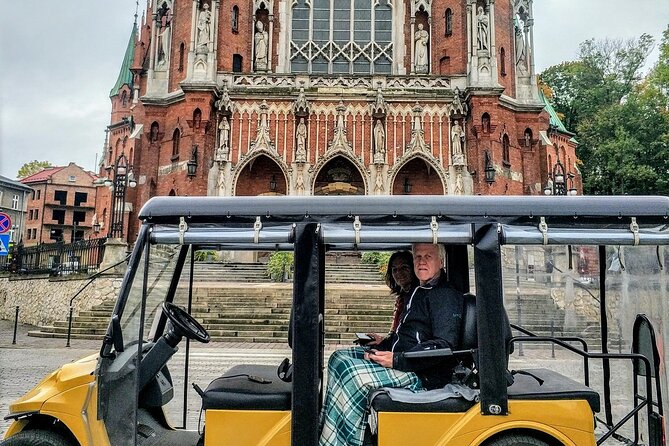
Kazimierz is compact, but it still takes time to move between neighborhoods, squares, and church and synagogue stops. The electric golf cart solves that. In about 90 minutes, you get a guided sweep that would be harder to replicate on your own if you also want quick entry moments inside some buildings.
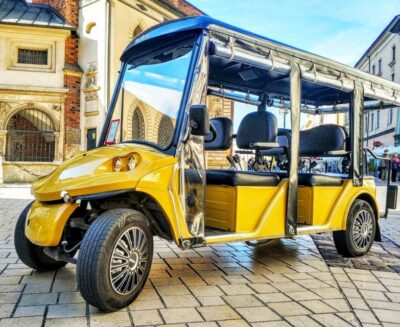
I also appreciate how the cart changes the feeling of the tour. You’re not just staring out a window. You’re moving close to the sights, then getting short pauses to step into places when allowed. One review noted the cart was toasty in a winter month, which is exactly the kind of small comfort that matters when the weather turns.
Because this is a shared tour (up to 50 people), it won’t feel like a private tour. Still, the cart format keeps you from spending your energy purely on transit. That’s a big deal in Krakow, where you might want to do other things the same day.
Your route: starting at Zyblikiewicza, finishing near Kopernika
You’ll meet at Mikołaja Zyblikiewicza 2 and end at Mikołaja Kopernika 3. Since there’s no hotel pickup or drop-off, you’ll want to be on time and ready at the start point. The tour runs to time in the way you hope it does, which is not always true for walking-heavy city tours.
The route covers two different storylines in one go. First is Kazimierz, the longtime center of Jewish life in Krakow. Then you shift toward Podgórze, where the ghetto’s traces are still visible in fragments, plaques, and place names.
You should expect the pacing to be “short stop, quick look, keep moving.” In fact, some people praised the chance to pop in for a few minutes at multiple locations. Others wished for more time in Jewish buildings specifically. So think of this as a focused orientation tour, not a slow, museum-style day.
Szeroka Street: where Kazimierz lived and four synagogues once stood
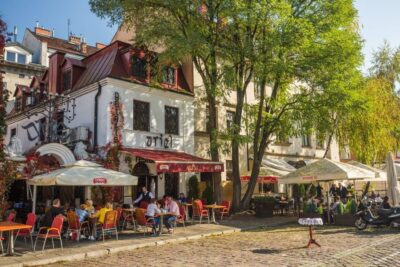
Szeroka Street is the heart of Kazimierz, and the tour gives you the context you need to understand why locals and visitors still mention it so often. The key detail is the former density: four synagogues used to stand on Szeroka Street, a concentration unheard of elsewhere in Europe. That one fact helps you “see” the street differently, even if you’ve already walked through the area.
During your stop, you’ll also get the sense that Szeroka Street was not a backdrop. It was the stage of daily religious and community life. The tour uses the street’s role today as a launching point, then ties it back to centuries of Jewish presence.
A practical tip: when you get out at Szeroka Street, take a breath and look down the street before you move again. It’s the kind of street where your brain quickly fills in old patterns when you’re given the right anchor details.
Old synagogue stop: one of Poland’s oldest, preserved
The tour includes a visit at a site described as one of the oldest synagogues in Poland preserved in such good condition. That’s a major value point, because it’s not just a photo stop. You’re there to look at the physical structure and understand what “preserved in good condition” really means.
This is also one of the stops that can set expectations. A few people later said they wanted more Jewish building time and less time inside churches. If you’re specifically chasing synagogue interiors and cemetery area detail, this is the moment where you want to pay attention and take your time while you have access.
If the group timing feels tight, don’t panic. You’ll still have the walking option afterward. The tour is helpful for pointing out what you’ll want to return to on your own schedule.
Further Jewish heritage and ghetto routes documented in Krakow
- Krakow: Schindler’s Factory & Ghetto Guided Tour★ 4.7 · 1,694 reviews
- Krakow: Bike Tour of the Old Town, Kazimierz, and the Ghetto★ 4.9 · 350 reviews
- Krakow: Jewish Ghetto Walking Tour★ 4.6 · 349 reviews
- Krakow: Jewish Quarter and Ghetto Electric Golf Cart Tour★ 4.6 · 348 reviews
- Krakow: Schindler’s Factory and Jewish Ghetto Guided Tour★ 4.6 · 124 reviews
St Joseph Church and Podgórze Market Square: a landmark you can’t miss
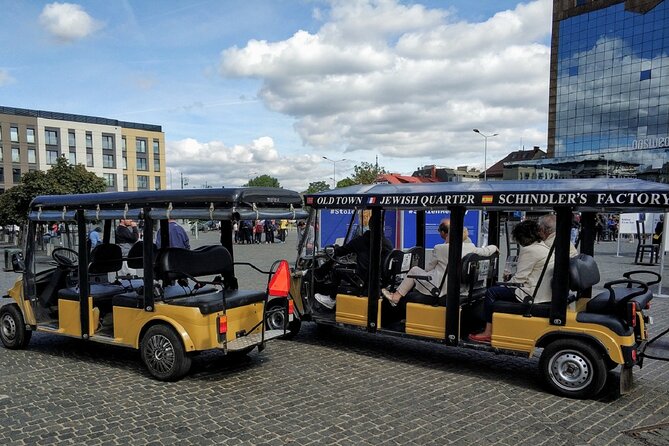
From Kazimierz, the tour shifts toward Podgórze and uses St Joseph’s Church as a clear landmark. It’s described as the distinctive, widely recognizable site of devotion that dominates over the Podgórze Market Square.
This stop matters because it helps you translate what you’ve learned from earlier Jewish-centered context into the modern city map. The tour also notes Podgórze only became incorporated into Krakow in the 20th century. That adds a layer you might not catch if you’re only following the most famous sights.
Why I think this stop is useful: when you’re moving between sensitive historical sites, you need orientation. A major church in a public square gives you a reference point for where you are, where you’ve been, and where the story is heading next.
A preserved ghetto wall fragment and plaque: the moment the past turns physical
At one point, you’ll see a small fragment of the original ghetto wall preserved to our times, with a plaque commemorating the fate of the inhabitants. Even “small fragment” matters, because it turns an abstract chapter into something you can point at and understand.
This stop can feel heavy in a good way, because the physical reminder is right there. You don’t need special imagination to grasp what the boundary meant. The plaque helps you connect it to people, not just an event.
If you’re someone who prefers calm, reflective pace, take a few extra seconds here even if the cart schedule feels strict. This is one of the best places on the route to slow down.
Plac Zgody to Umschlagplatz: the square tied to deportations
The tour then brings you to Podgórze’s former Plac Zgody, also described as Concord Square. Under Nazi occupation, this location was designated Umschlagplatz, the place where Jews had to congregate before deportation.
This is the stop where place names become the lesson. You’re not only learning what happened. You’re learning how the city’s geography was used as part of the machinery of persecution.
If you’re visiting Krakow for the first time, this is where the tour earns its name. You leave the emotional weight of the ghetto edge and enter the specific process point tied to deportations. The tour frames it as one symbolic bright spot on the map of tragedy, which is a reminder that even in the darkest contexts, people tried to protect one another.
The wartime pharmacy story: shelter, messages, and packages
Another stop you’ll likely remember is the wartime pharmacy connection. The tour describes it as a small symbolic bright spot: the then Polish pharmacy acted as an asylum or embassy, providing shelter during deportation and delivering messages or packages inside and outside the ghetto.
That detail is valuable because it doesn’t reduce the story to only loss. It shows how survival networks worked in everyday ways. A pharmacy is a very specific setting, so the story lands more clearly than a generic description.
This part also helps you understand the moral complexity of occupied cities. There were places where brutality ruled, and there were small corners where people tried to help. Hearing it explained while you stand at the relevant spot makes the history feel grounded rather than distant.
Audio guide, headsets, and how to make the story stick
The tour includes an audio guide, and the format can affect your experience. One review specifically noted it was a headset tour rather than loudspeaker audio, which limited interaction within the group. If you care about hearing your guide through the cart experience in real time, headsets are still fine, but you’ll want to be ready for a more individual listening style.
Another reported detail: seating can matter. One person mentioned being allocated seats in the back with two seats facing backward, and they would have preferred front seating. If your cart assignment is not first come first served, you still can reduce frustration by arriving early and being ready to ask which side gives the best view.
My practical advice: listen actively during the driving segments. Most of the meaningful context is delivered while you’re moving between areas. Then, use your short entry time to ask yourself what you want to see more of later on foot.
Guide quality: when names like Matt, Natalie, Olivia, Martina, and Michael show up
This tour depends on the guide for pacing and interpretation, and the good news is the English-speaking drivers get praise for being engaging and respectful. Names mentioned in positive feedback include Matt, Natalie, Olivia, Martina, Phillips, and Michael.
What I take from that pattern is not just that they were friendly. It’s that they managed to keep people listening through sensitive material. One review described the day as emotional, with the guide explaining everything clearly and respectfully. Another praised the combination of commentary plus recorded audio for a rewarding experience.
If you want the tour to feel less like a checklist, choose your guide style. If you see a guide known for clear explanations and respectful wording, you’ll probably get more out of the shorter stops.
Price and value: what $34.75 gets you in 90 minutes
At $34.75 per person for about 1.5 hours, the value comes from three built-in pieces: transport by electric golf cart, an English-speaking driver, and the audio guide. You’re paying for time saved and for access to multiple key areas without having to plan every route segment yourself.
Is it cheap? Not exactly. One review called it easy but expensive for the short duration. That’s a fair criticism if you want depth in a single building. But if you’re time constrained, the price starts to look more reasonable because the cart helps you cover many important monuments in Kazimierz and connect them to the ghetto story in Podgórze.
A good way to decide if this price fits you: think about what you’ll do afterward. If you plan to return on your own to the places that stood out, then the tour becomes a high-quality primer. It helps you choose what to revisit rather than wandering and hoping you guessed right.
Who should book this tour, and who might prefer walking instead
This is a smart choice if you want an orientation to Kazimierz and the ghetto edge, with enough structure to understand what you’re seeing. It’s also a good fit if you want to step inside multiple places without spending most of your energy walking between them.
It may not be the best fit if your priority is Jewish interiors only. Some people felt the tour spent too much time in Christian churches when the title suggests a Jewish focus. Another person would have preferred a walking tour to match their own pace and interests.
If you’re on the fence, use this rule of thumb. Book this for context and speed, then plan one follow-up hour on foot where your interests are strongest, such as the synagogue areas or the cemetery area referenced in feedback. That combo gives you both the guided story and the freedom to linger.
Should you book the Krakow Jewish Quarter and Ghetto Tour by Electric Golf Cart?
Book it if you want a practical way to see a lot of important Kazimierz and ghetto-related sites in about 90 minutes, with an English-speaking driver and audio guide doing the heavy lifting on context. The preserved ghetto wall fragment with its plaque and the route to Umschlagplatz are the parts that give this tour real weight.
Skip it or add a walking alternative first if you strongly prefer Jewish building time over church interiors. Also consider that the audio format may be headset-based and group seating can vary.
For most first-timers, this tour is a solid choice because it helps you understand what you’re looking at, not just where you’re standing. Then you can go back on your own and turn the highlights into a deeper, slower day.
FAQ
How long is the Krakow Jewish Quarter and Ghetto Tour by Electric Golf Cart?
The tour lasts about 1 hour 30 minutes.
How much does the tour cost?
It costs $34.75 per person.
Is the tour in English?
Yes, it is offered in English.
What is included in the tour price?
The tour includes an audio guide, transport by golf cart during the tour, and an English-speaking driver.
Is hotel pickup or drop-off included?
No. Hotel pickup and drop-off are not included.
Where do I meet, and where does the tour end?
The tour starts at Mikołaja Zyblikiewicza 2, 31-029 Kraków, and ends at Mikołaja Kopernika 3, 31-034 Kraków.
How many people are on the tour?
The tour has a maximum of 50 travelers.
Do I get a mobile ticket?
Yes, it includes a mobile ticket.
What is the cancellation policy?
You can cancel for a full refund up to 24 hours in advance of the experience start time. If you cancel less than 24 hours before, you will not be refunded.
Sightseeing Without the Walking
Jewish Heritage and Ghetto Routes in Krakow

Kazimierz, Keep Going
Recently written up around Krakow

More Kazimierz Jewish Quarter Tours.
 ★ 4.9Jewish Quarter and Former Ghetto TourFrom $191,441 reviews
 ★ 4.9Bike Tour of Old Town, Jewish Quarter and the GhettoFrom $371,155 reviews
 ★ 4.8Kazimierz Jewish Quarter Walking TourFrom $27571 reviews
 ★ 4.8Kazimierz, Schindler’s Factory & Ghetto Guided TourFrom $81460 reviews
 ★ 5.0Full Bike Tour – the Old Town, Jewish Qtr & the Ghetto NEW BIKESFrom $35437 reviews
 ★ 4.9Bike Tour of the Old Town, Kazimierz, and the GhettoFrom $26350 reviews
 ★ 4.6Jewish Quarter and Ghetto Electric Golf Cart TourFrom $34348 reviews
 ★ 5.0Jewish Krakow Walking TourFrom $26307 reviews
Also on these Poland lists