
REVIEW · KAZIMIERZ JEWISH QUARTER TOURS
Krakow: Old Town, Jewish Kazimierz and Ghetto Sightseeing by Electric Golf Cart
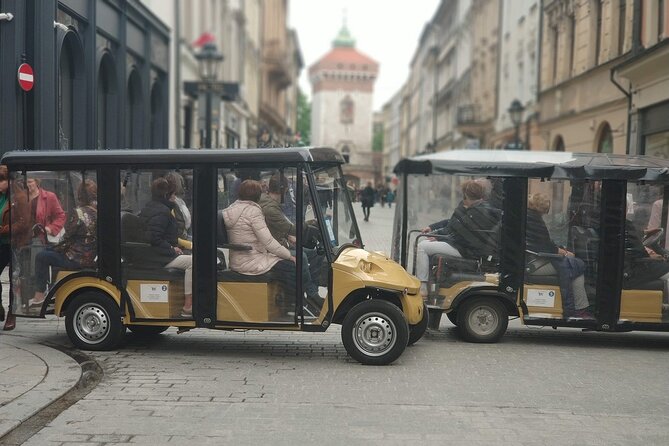
Old Town in one clean loop. This electric golf cart ride strings together Krakow’s key sights with narration in English, plus stops that shift from medieval center to Jewish Kazimierz and onward to the ghetto area. It is a smart fit when your days are tight and you still want an organized overview without spending hours in transit.
I especially like how the route gives you fast context at the Main Market Square, the Cloth Hall, and the Town Hall Tower, so you understand what you are looking at. I also like that Kazimierz is treated as more than a photo stop, with synagogue variety, Szeroka Street, and major sites tied to the WWII Krakow Ghetto story. One drawback to plan for: time is limited at each stop, and Old Town can get crowded, so you may wish for a bit more time for photos and lingering.
In This Review
- Key things I’d watch for
- Why the electric golf cart is a smart way to cover Krakow fast
- Main Market Square, Cloth Hall, and Town Hall Tower
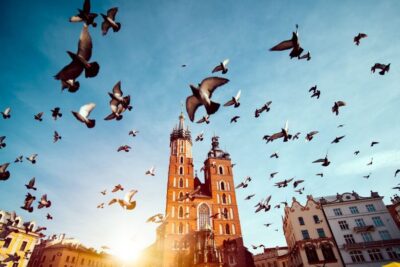
- St. Mary’s Basilica: Veit Stoss, Jan Matejko, and the “why it matters” stop
- Juliusz Słowacki Theatre and the Barbican’s defensive legend
- Kazimierz Jewish Quarter: the shift from Old Town to centuries of life
- Tempel Synagogue and Szeroka Street: stained glass and a non-orthodox note
- The smallest synagogue stop and why modest can be powerful
- St Joseph Church in Podgórze, plus the view before the ghetto story
- Krakow’s ghetto wall fragment and Plac Zgody, from memory to place
- Tadeusz Pankiewicz and the human thread through the facts
- How long each stop feels, and how to get more out of short photo moments
- Price and value for $56.47 over 2.5 hours
- Who should book this tour, and who might prefer a slower day
- Should you book the Old Town, Kazimierz, and ghetto electric cart tour?
- FAQ
- What is the duration of the Krakow Old Town, Jewish Kazimierz and ghetto tour by electric golf cart?
- How many people are on the tour?
- Is the tour offered in English?
- Does the tour include an audio system?
- Where do I meet and where does the tour end?
- Is it a mobile ticket?
- Do I need to bring small luggage only?
- How far in advance is it typically booked?
- What is the cancellation policy?
Key things I’d watch for
- Small group (max 8) means less waiting around and a more personal rhythm when the guide handles questions.
- Electric cart + audio in English helps you keep moving while still getting explanations.
- Old Town congestion can affect sightlines, especially if you arrive later in the day.
- Short photo windows are built in, so ask early if you want to step off for a quick look.
- A second theme shift into Kazimierz and the ghetto area makes the tour feel like two focused chapters, not one long blur.
Kazimierz on foot, by cart and after dark. Our other write-ups
- Krakow: Jewish Quarter and Former Ghetto Tour
★ 4.9 · 1,441 reviews - Krakow: Bike Tour of Old Town, Jewish Quarter and the Ghetto
★ 4.9 · 1,155 reviews - Krakow: Kazimierz Jewish Quarter Walking Tour
★ 4.8 · 571 reviews - Krakow: Kazimierz, Schindler’s Factory & Ghetto Guided Tour
★ 4.8 · 460 reviews
Why the electric golf cart is a smart way to cover Krakow fast
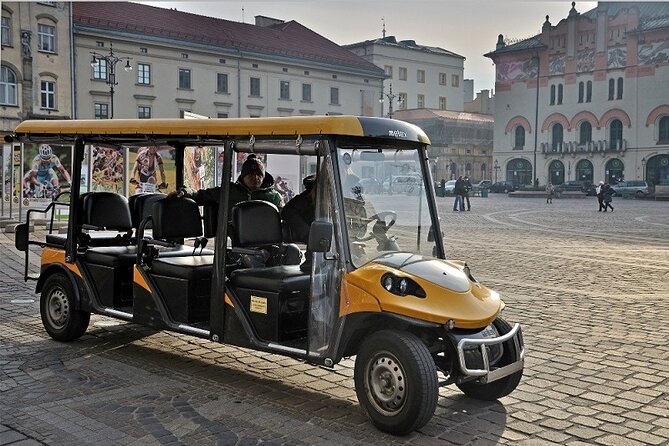
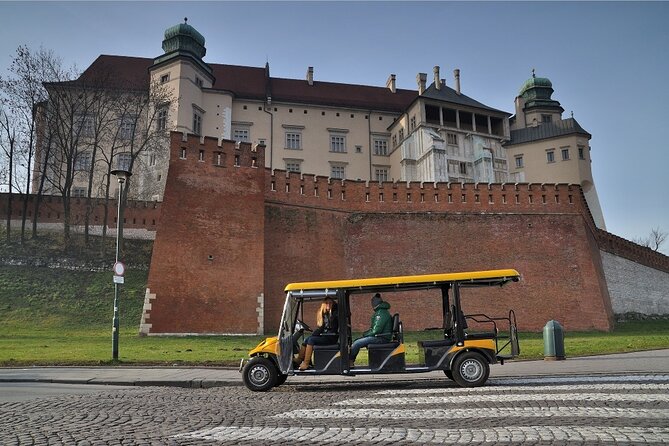
Krakow is the kind of city where the best sights are close together, yet walking still adds up. This tour helps you beat that time tax. The electric golf buggy keeps you moving between clusters, while the audio system plus live guide commentary gives you the who, what, and why behind the monuments.
The biggest value here is pacing. In about 2.5 hours, you get a guided sweep across: medieval Old Town landmarks, Jewish Kazimierz highlights, and a WWII ghetto storyline stop sequence. For many people, that is the difference between feeling like you saw the city and actually understanding it.
Practical note: the vehicles have limited room for passengers to sit, so keep baggage minimal. This is not the time for a big daypack plus extras that you cannot comfortably store.
Main Market Square, Cloth Hall, and Town Hall Tower
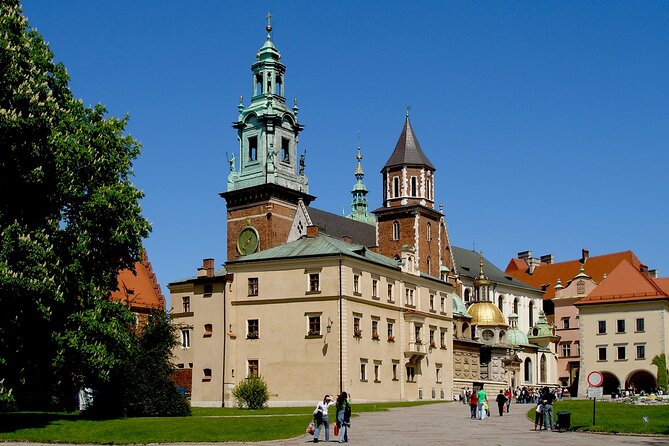
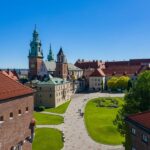
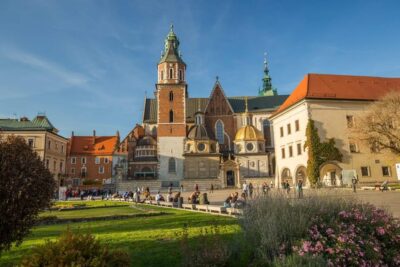
The tour centers you on Krakow’s medieval core at the Main Market Square. Even if you only stand there for a moment, the square’s scale reads fast. It is described as the most important public space in Krakow and the most expansive Market Square of medieval Europe, which is exactly why it works as your starting point. Once you see it, the rest of Old Town makes more sense.
From there, you will head to Sukiennice, also called the Cloth Hall. Think of this stop as the “commercial heart” in Renaissance clothing. The building is framed as Krakow’s oldest commercial center, and that matters because you can connect the architecture to how the square functioned as a trading hub.
Then comes the Town Hall Tower, with very tangible details: 70 meters high, 110 stone steps, and the executioner’s dungeons tied to the tower’s past. Even if you do not climb, those numbers help you picture how power and punishment were physically built into the city.
The main consideration at this stage is crowds and cart parking. One guide-led tour review flagged that Old Town can get hard to see at times when other carts are parked. If you are the type who needs a clean view for photos, pick an earlier time slot when scheduling allows.
St. Mary’s Basilica: Veit Stoss, Jan Matejko, and the “why it matters” stop
Krakow’s best church stops are rarely just about looking. They are about noticing the one or two features that make the place famous. Here, the basilica is presented in a way that helps you focus your attention.
You will hear about a high altar by Veit Stoss, and you will also get the story around a bugle call and vaulting murals by Jan Matejko. That is a lot to take in at once, but the payoff is that you can walk into the church with your eyes already pointed toward the signatures: altar, sound, and ceiling artwork.
A small practical detail that can help: if you want to step off the cart for a quick interior visit, you should tell the guide. Some stops are short, and the guide may rely on your request to time a faster entry for places like cathedrals.
Juliusz Słowacki Theatre and the Barbican’s defensive legend
Two exterior-feeling stops can still be useful if they come with context. The Juliusz Słowacki Theatre is one of those. It is framed as a stage that has operated continuously since 1893, and the building is noted as one of Europe’s precious examples of theatre architecture. Even from outside, that dates the city’s cultural life in a very concrete way.
Then you shift into medieval fortifications with the Barbican, presented as a pearl of Krakow’s defenses. The detail that makes it stick is the legend that it was never captured during a siege, and the defenders repulsed attackers with a single shot. Whether you interpret that as literal history or city legend, it sets the emotional tone. This is not just a wall, it is a story about survival.
Because these are strong monuments but often viewed quickly from the cart, it helps to arrive with one mindset: quick look first, question second. The guide’s explanations are what make these stops feel earned instead of rushed.
Further Jewish heritage and ghetto routes documented in Krakow
- Krakow: Schindler’s Factory & Ghetto Guided Tour★ 4.7 · 1,694 reviews
- Krakow: Bike Tour of the Old Town, Kazimierz, and the Ghetto★ 4.9 · 350 reviews
- Krakow: Jewish Ghetto Walking Tour★ 4.6 · 349 reviews
- Krakow: Jewish Quarter and Ghetto Electric Golf Cart Tour★ 4.6 · 348 reviews
- Krakow: Schindler’s Factory and Jewish Ghetto Guided Tour★ 4.6 · 124 reviews
Kazimierz Jewish Quarter: the shift from Old Town to centuries of life
Kazimierz is not presented as a single landmark. It is presented as a living neighborhood with deep layers. The tour describes it as once independent, positioned south of Wawel, and for centuries the hub of Jewish life in Krakow. Today it is one of Krakow’s biggest attractions.
That framing matters. If you treat Kazimierz only as a museum zone, you will miss how street life and religious life share space. The route keeps pulling you back to the idea of community places: synagogues, street centers, and key sites tied to the WWII ghetto period.
You also get a built-in change of pace. Old Town can feel like a big outdoor set. Kazimierz feels more like you are entering a smaller, more human scale of streets and worship spaces, even when you are still moving by cart.
Tempel Synagogue and Szeroka Street: stained glass and a non-orthodox note
The Tempel Synagogue stop is built around two distinctive traits. First is the stained glass windows, highlighted as among the best preserved of their kind in Poland. Second is its non-orthodox character. That second detail is helpful because it tells you to look for variation, not a single uniform story.
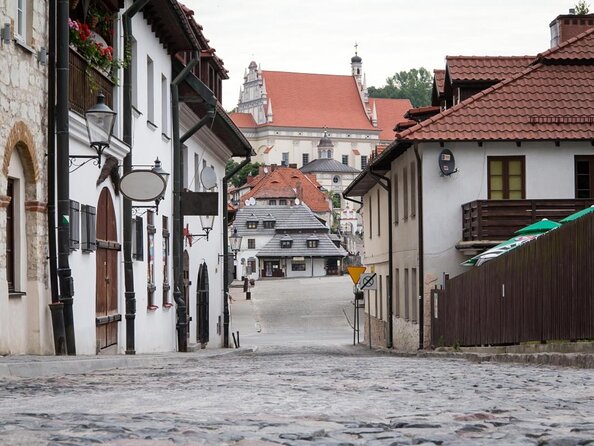
Then the tour moves you to Szeroka Street, described as the heart of Jewish Kazimierz. A particularly striking historical note here is that four synagogues once stood on the street, which is described as unheard of elsewhere in Europe. When you hear that, you start seeing Szeroka Street less as a road and more as a map of community life.
In practical terms, Szeroka Street also helps with orientation. You get a sense of where Kazimierz’s center of gravity sits, which makes any additional self-guided walking afterward feel easier.
The smallest synagogue stop and why modest can be powerful
One stop is dedicated to the smallest of Krakow’s seven synagogues, described as having more modest decor compared with the others. After renovation completed in April 2016, it is described as the main site of prayer for the Jewish community in Krakow.
This is the kind of detail that changes how you experience a religious site. The tour does not ask you to rank beauty. It suggests that function and continuity matter too. You are seeing a place where worship still lives, not just a preserved backdrop.
If you are moving quickly, take a small moment here to step back and look at the overall scale. Modest can be more moving than ornate when you connect it to the idea of ongoing community use.
St Joseph Church in Podgórze, plus the view before the ghetto story
You will then pivot to Podgórze for the parish church of St Joseph. This church is described as distinctive and widely recognizable, and it dominates over the Podgórze Market Square.
The tour also adds a timing detail that gives you more than scenery: the Podgórze area was only incorporated to Cracow in the 20th century. That small point matters because it helps you understand why different parts of Krakow feel like they came from different eras.
Use this stop as a mental reset. It sets you up for a darker sequence by shifting your geography from Kazimierz’s story to Podgórze’s WWII reality.
Krakow’s ghetto wall fragment and Plac Zgody, from memory to place
The emotional centerpiece of the tour is the transition from monuments to memorial place. You will see a small fragment of the original wall around the former ghetto, with a plaque commemorating the fate of inhabitants. This kind of stop does two things at once. It anchors history in a physical remnant, and it keeps the story from floating away as generic WWII facts.
Then you reach Plac Zgody, identified as Concord Square. This is described as the spot in the Podgórze district that, in 1941, was turned into the Krakow Ghetto. Under Nazi occupation, it is described as the Umschlagplatz, the place where Jews had to congregate for deportation.
This part is not about checking boxes. It is about noticing how everyday space can hold tragedy. The tour’s stop descriptions explicitly frame the contrast between tumultuous WWII history and daily life.
If you are sensitive to heavy topics, plan your energy here. You might not want to cram a museum visit right after. Give your mind a small pause.
Tadeusz Pankiewicz and the human thread through the facts
One stop is tied to Tadeusz Pankiewicz, described as someone who took over his father’s pharmacy and made history because of what he did there. Even without extra time inside, the tour uses this point to connect the ghetto area to individual action.
The final stop framing brings the theme home: where world war tragedy meets everyday life, with private lives affected across the whole world. That wording is what makes the ghetto section feel guided rather than purely observational.
In a short tour format, this kind of human thread matters. It gives you somewhere to put the emotional weight besides the scale of buildings and dates.
How long each stop feels, and how to get more out of short photo moments
This tour is about time efficiency. That is great, but it means you should not expect long “walk and linger” museum pacing at every site. In one guide-led experience report, a common theme was wanting more time to take pictures at each place, and noting that some interior moments can be brief unless you explicitly ask.
Here is how to get the best balance:
- When the guide announces a stop, decide quickly if you need a photo from outside, or if you want a quick step-off to enter.
- Ask for a quick entry or extra minute early, not at the last second.
- If your goal is photos, consider choosing earlier departure times. Crowds and carts parked around key areas can reduce visibility later.
On the positive side, reviews consistently praised guides who were attentive, professional, and willing to stop for questions and photo moments. Names that came up include Radic, Filip W, Michael, Peter, and Tom. That is a good sign for the overall quality of storytelling and pacing.
Price and value for $56.47 over 2.5 hours
At $56.47 per person for about 2 hours 30 minutes, you are paying for three things at once: transportation by electric cart, a narrated explanation system, and a small-group route that links multiple major zones.
If you were to do this alone, the value is in the planning. You would still need to figure out which order makes sense, and you would still lose time moving between Old Town, Kazimierz, and Podgórze. Here, the cart removes much of that friction, and the guide helps you avoid standing in front of monuments without context.
Where the price may feel tight is when you expect long visits at every stop. If you are the type who wants 30 to 60 minutes in one church or one synagogue area, you may need to pair this with extra independent time afterward.
For most time-crunched first-timers, though, it is a strong way to build a mental map quickly and then decide where you want to return.
Who should book this tour, and who might prefer a slower day
This is a good fit if:
- You want a big-picture Krakow overview without marathon walking.
- You care about both Old Town landmarks and Jewish Kazimierz, plus a WWII ghetto storyline.
- You would like your sightseeing delivered with narration in English and a guide who can answer questions.
- You prefer a small group capped at 8, which keeps the ride more manageable.
You might choose something else if:
- You want long time inside major interiors at your own pace.
- You are very photo-focused and get frustrated by short windows.
- You are going at a peak crowded time and have not planned for quick stops.
Should you book the Old Town, Kazimierz, and ghetto electric cart tour?
I think you should book this tour if you are trying to get your bearings fast, and you want the city connected by a route that makes sense. The strongest reason to pick it is how efficiently it links Main Market Square, Kazimierz synagogue areas, and the ghetto site sequence into one coherent story.
If you do book it, go in with two expectations. First, expect quick, guided stops rather than long visits at each site. Second, be ready to ask for small extra minutes if you want to enter places briefly.
If your Krakow plan is flexible for a second day, use this tour as your foundation. You will leave knowing where you want to return, whether that is for deeper church time, more Kazimierz street wandering, or simply a slower look at the places you passed through.
FAQ
What is the duration of the Krakow Old Town, Jewish Kazimierz and ghetto tour by electric golf cart?
The tour is about 2 hours 30 minutes.
How many people are on the tour?
It is a group tour with a maximum of 8 travelers.
Is the tour offered in English?
Yes. English is available.
Does the tour include an audio system?
Yes. Sightseeing in Kraków is provided in an eco-vehicle with an audio system.
Where do I meet and where does the tour end?
The start is Mikołaja Zyblikiewicza 2, 31-029 Kraków, Poland, and the end is Mikołaja Kopernika 3, 31-034 Kraków, Poland.
Is it a mobile ticket?
Yes, the tour features a mobile ticket.
Do I need to bring small luggage only?
Yes. You should not bring large baggage because the vehicles only have enough room for passengers to sit.
How far in advance is it typically booked?
On average, it is booked about 33 days in advance.
What is the cancellation policy?
Free cancellation is available. You can cancel up to 24 hours in advance for a full refund.
Sightseeing Without the Walking
Jewish Heritage and Ghetto Routes in Krakow

Kazimierz, Keep Going
Recently written up around Krakow
More Kazimierz Jewish Quarter Tours.
 ★ 4.9Jewish Quarter and Former Ghetto TourFrom $191,441 reviews
 ★ 4.9Bike Tour of Old Town, Jewish Quarter and the GhettoFrom $371,155 reviews
 ★ 4.8Kazimierz Jewish Quarter Walking TourFrom $27571 reviews
 ★ 4.8Kazimierz, Schindler’s Factory & Ghetto Guided TourFrom $81460 reviews
 ★ 5.0Full Bike Tour – the Old Town, Jewish Qtr & the Ghetto NEW BIKESFrom $35437 reviews
 ★ 4.9Bike Tour of the Old Town, Kazimierz, and the GhettoFrom $26350 reviews
 ★ 4.6Jewish Quarter and Ghetto Electric Golf Cart TourFrom $34348 reviews
 ★ 5.0Jewish Krakow Walking TourFrom $26307 reviews
Also on these Poland lists