
REVIEW · WALKING TOURS
Krakow Walking Tour with Audioguide on Your Smartphone
Medieval walls, then Jewish history, all on one route. This self-guided Krakow walk uses a smartphone audioguide to connect famous landmarks like St. Florian’s Gate and St. Mary’s Basilica with story and context. I like the simple format, you pause and restart whenever you want, and you can keep moving at your own speed. I also like the practical stuff, an offline map plus illustrated markers so you are not stuck hunting for the next stop. One thing to consider is the tour is mostly outdoors on city streets, so weather matters, and the walking can feel long in cold snaps.
You start at the Kraków Barbican and work through Krakow’s Old Town core, then head toward Kazimierz for major Jewish sites. You get 26 recordings narrated by a professional historian, in English, which makes the experience feel more guided than a random stroll. Still, it is not a hands-on tour, there is no human guide, so you need your own headphones and you need to follow the on-screen map.
If you want a low-cost way to get oriented fast, this one fits. It is priced at $8.27 per person for about 2 hours 30 minutes, and a lot of the stops are free to access. The tradeoff is that you are relying on your phone, so test your audio and GPS before you begin.
In This Review
- Key things you will notice on this route
- Starting at the Kraków Barbican, Basztowa 30-547
- St. Florian’s Gate, the Royal Route checkpoint
- Florianska Street, how Krakow moves through the middle
- St. Mary’s Basilica, towers, and Veit Stoss
- Market Square, why it still feels like the center
- Town Hall Tower, 70 meters of city views
- Jagiellonian University Collegium Maius, scholarship in stone
- Collegium Iuridicum, where the route connects to the university
- Palace of Bishop Erasmus Ciolek, Renaissance rooms and art
- Kanonicza Street, a calmer medieval lane in the Old Town
- Wawel Cathedral, coronations, and the Sigismund Bell
- Wawel Castle, state rooms and royal treasures
- Tempel Synagogue in Kazimierz, Moorish Revival detail
- Okrąglak, a market hall that still feels local
- Planty Park and the Jan Karski monument
- Szeroka Street, Jewish heritage in motion
- Old Synagogue, one of the oldest surviving in Poland
- Square of Ghetto Heroes, memory marked by 70 empty chairs
- Smartphone audioguide, what you need to make it work
- Price and value: $8.27 for a full Old Town plus Kazimierz story
- Who this tour suits best, and who should skip it
- Should you book this Krakow audioguide walking tour?
- FAQ
- Is this tour guided by a person?
- What language is the audioguide in?
- How long is the walking route?
- What do I need to use it?
- Do I need internet during the tour?
- Are entrance tickets included in the price?
- Where does the tour start and end?
- How many audio recordings are included?
Key things you will notice on this route
- Smartphone GPS with an offline map, so you can stay independent without constantly checking public Wi-Fi
- 26 historian-narrated audio tracks that explain what you are looking at, not just where to go
- A clean hit list of Krakow icons, from St. Florian’s Gate to Market Square, then Wawel, then Kazimierz
- Street-level walking between sites, with frequent stops where you can pause and reset your pace
- Illustrations to identify landmarks, helpful when buildings look similar from a distance
- Built for timing on your schedule, because you can stop for coffee or linger near views
Below are the other Krakow trips we have logged
- Old Town Krakow & Wawel Castle Walking Tour
★ 5.0 · 1,508 reviews - Creepy Krakow: 2-Hour City Walking Tour
★ 4.7 · 1,131 reviews - Krakow: The Old Town Walking Tour
★ 4.8 · 794 reviews - Krakow: Kazimierz Jewish Quarter Walking Tour
★ 4.8 · 571 reviews
Starting at the Kraków Barbican, Basztowa 30-547
You begin at the Kraków Barbican on Basztowa 30-547, and the tour ends back at that same meeting point. That makes planning easy, especially if you are pairing this with dinner afterward.
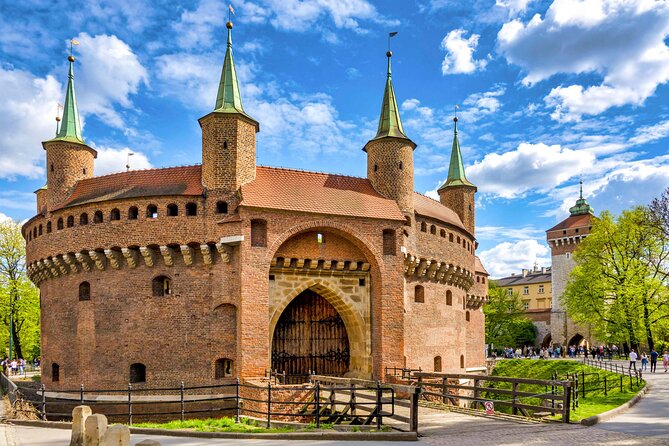
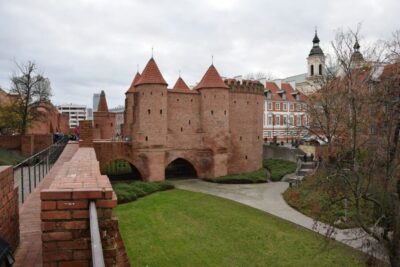
The Barbican itself is a great first move because it sets the tone. It is a medieval circular fortification, built in the late 15th century, with thick brick walls and seven tall turrets. Even if you have seen castles before, this kind of defensive architecture feels different, more practical and more urban, like the city was built to protect people walking in and out.
A practical note: since this is self-guided, there is no human guide at the start. You will need to download the app, activate your purchase, and then follow the route on the mobile map. Bring your own headphones, the tour does not include them.
St. Florian’s Gate, the Royal Route checkpoint
Next you hit St. Florian’s Gate, Krakow’s most iconic medieval gateway. It was built in the 14th century and has a Gothic structure topped with a Baroque roof. The height matters here, it rises 33.5 meters, so you get an instant sense of scale before you walk into the busy heart of town.
What makes this stop work well on an audioguide is contrast. You look at a historic gate, then you walk through it and land on the Royal Route, the procession-style corridor that connects major sights.
This is also a good “warm-up stop.” It is short, about 10 minutes, so you do not feel like you are stuck at the start. If your phone audio needs a second to load, St. Florian’s Gate is forgiving.
Florianska Street, how Krakow moves through the middle
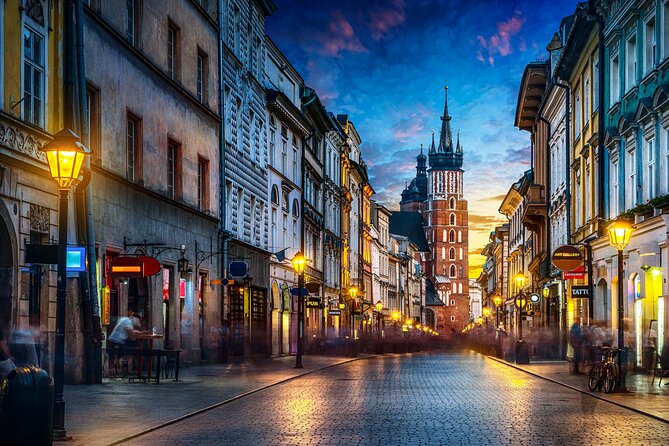
From St. Florian’s Gate, you stroll along Ulica Florianska, Florianska Street. The point is not just shopping and cafes, it is the feel of how people flow between landmarks. The street connects the gate to Krakow’s Main Market Square.
Expect a mix of medieval facades and modern life: townhouses, boutiques, and places to grab a coffee. If you like to learn the city by walking its spine, this stretch helps you do that.
Here is the small drawback to keep in mind: the more central a street is, the easier it is to lose your place if you are not paying attention to the route. Keep your phone ready and use the app map, especially at intersections.
St. Mary’s Basilica, towers, and Veit Stoss
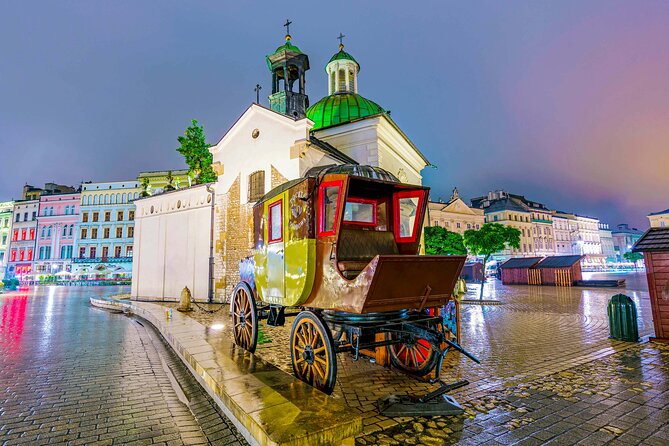
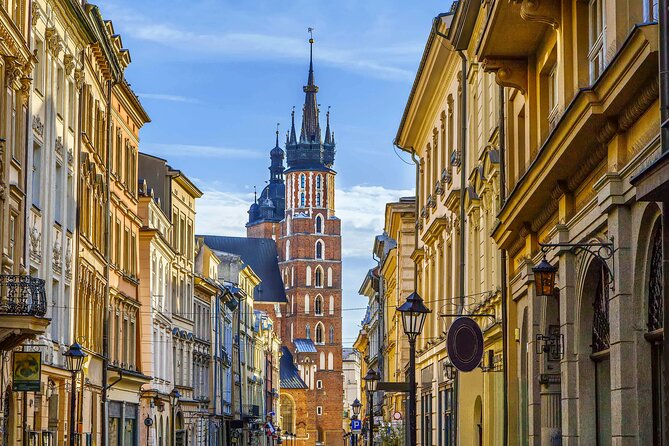
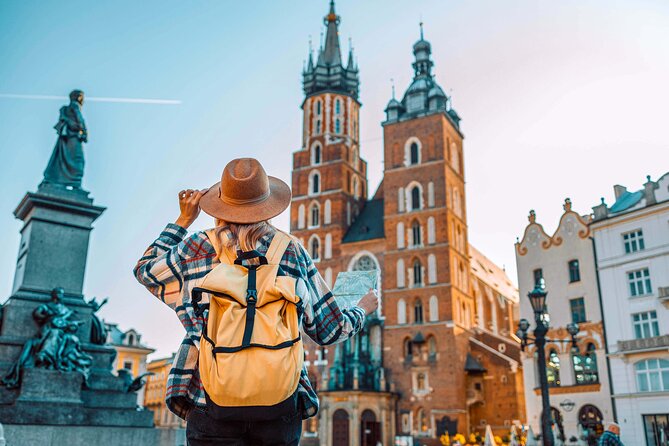
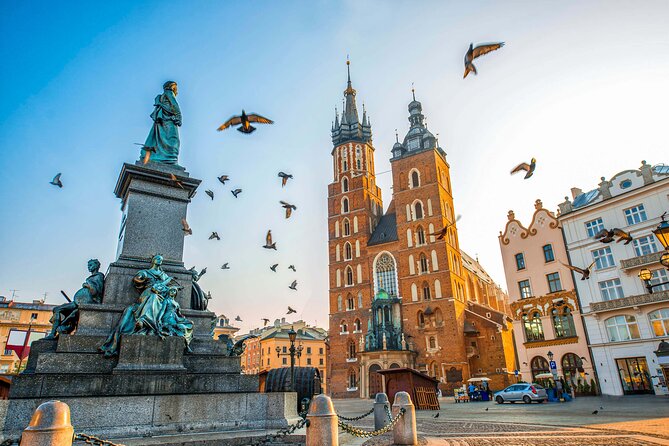
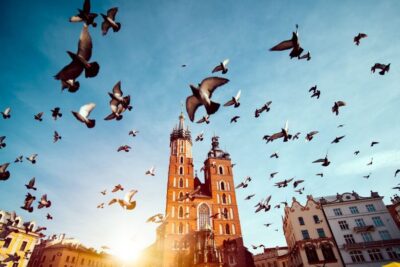
In the Main Market Square area, you get to St. Mary’s Basilica, one of Krakow’s signature Gothic churches. Built in the 14th century, it is famous for the interior, especially the wooden altarpiece by Veit Stoss.
The towers are the headline from the outside. You have the taller Bugle Tower and the shorter Bell Tower. The Bugle Tower is tied to a tradition, a trumpet call is played every hour, which can add a lived-in soundtrack to your visit.
Audio guides shine here because they can help you look past the postcard view and toward details you might otherwise miss, like the way stained glass and the decorated nave shape the whole experience. This stop is also “free ticket” based on the route notes, so you can spend time inside if the church is open without adding a separate paid admission step.
Below are the other Krakow trips we have logged
- Krakow: Vistula River Sightseeing Cruise with Audio Guide★ 4.4 · 820 reviews
- From Krakow: Auschwitz-Birkenau and Self-Guided Day Tour★ 4.1 · 576 reviews
- Krakow: Sightseeing Cruise on Vistula River with Audio Guide★ 4.4 · 480 reviews
- Krakow: Vistula River Sightseeing Cruise with Audio Guide★ 3.9 · 270 reviews
- Krakow: Vistula Night Cruise by Gondola w/ Audio Commentary★ 4.5 · 72 reviews
Market Square, why it still feels like the center
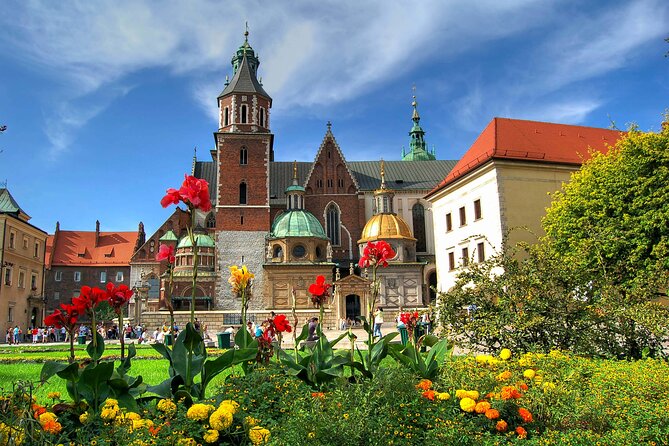
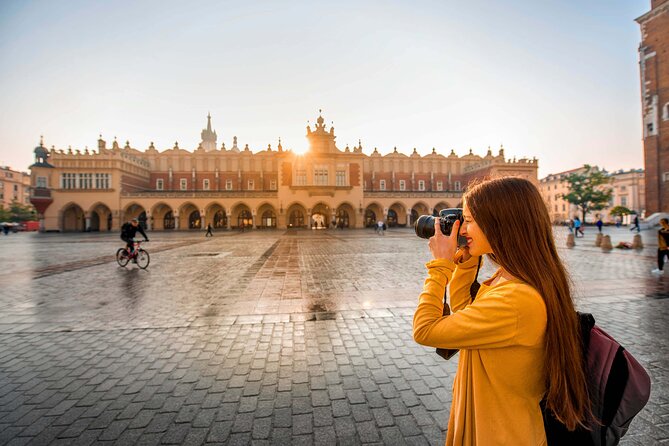
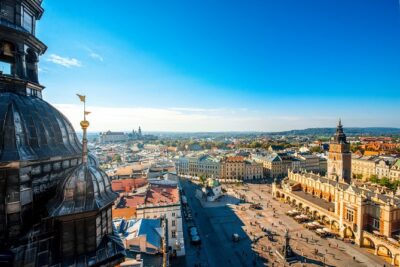
Then you reach the Market Square, Krakow’s beating heart and one of the largest medieval town squares in Europe. The surrounding buildings are part of the story, especially when you can see how the square anchors the major monuments around it.
The classic sights in this area include the Cloth Hall, St. Mary’s Basilica, and the Town Hall Tower. Even if you do not go into everything, just standing here gives you a sense of civic life, where commerce, ceremonies, and daily business used to overlap.
This is a place where you can also pause your audioguide for people-watching. One of the best review-style perks is simple: you can pause and restart the audio whenever you want, so your learning stays tied to your attention.
Town Hall Tower, 70 meters of city views
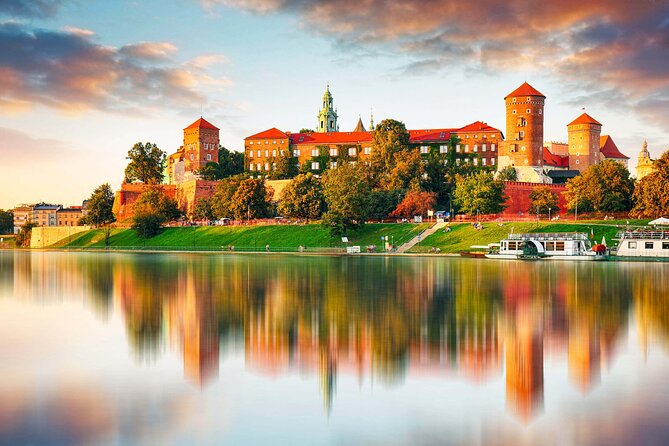
After you absorb the square, you ascend the Town Hall Tower. The tower is 70 meters tall and is described as the last vestige of the original 14th-century town hall.
If you want a practical reason to climb, here it is: you get the layout. From up high, it is easier to understand how the streets and rooftops connect, and you start picturing the route you are about to take next.
The audio focus on exhibits and history can help the climb feel more purposeful. If you have limited time or do not like stairs, you might choose to linger in the square instead, since the rest of the route still covers the key sights.
Jagiellonian University Collegium Maius, scholarship in stone
Next you head into Krakow’s academic side at Collegium Maius, the oldest building of Jagiellonian University, founded in the 14th century. You walk past courtyards with medieval arcades and explore preserved interiors like lecture halls, the library, and professors’ quarters.
One reason this stop deserves space on a walking tour is that it broadens Krakow beyond politics and churches. This is a city of ideas, and Collegium Maius is where you feel that.
The audio mentions the kind of historical weight you might expect here, including Nicolaus Copernicus as a name you associate with study. Even if you do not know all the details, the building gives you a strong sense of continuity. The tour here also helps you slow down and look at architecture instead of just moving between landmarks.
Collegium Iuridicum, where the route connects to the university
You then continue with Jagiellonian University at Collegium Iuridicum. The tour frames it as another historic part of the same long-running institution, one founded in 1364.
This segment is an easy fit because it stays central. You are already in the Old Town area, and your feet are doing what they do best here, connecting major neighborhoods without complicated logistics.
Since the tour is self-guided, you control how long you linger. If one building feels like “enough” after the first university stop, you can skim the second. If you like architecture and academic heritage, you can spend longer while the audio holds your place.
Palace of Bishop Erasmus Ciolek, Renaissance rooms and art
Now shift to culture and art at the Palace of Bishop Erasmus Ciolek. Built in the early 16th century, it is a Renaissance palace that now houses a branch of the National Museum.
The audio attention goes toward Polish art, including medieval sculptures, religious icons, and early modern paintings. This is a good stop if you like your history with artifacts you can actually see.
Because the tour notes do not include paid entrance as part of the price, treat this as a “check before you go” moment. Some sites are free to enter, and some might require tickets depending on how the museum operates that day. Your best move is to plan a minimum, exterior and key viewing, and then decide on interiors once you are there.
Kanonicza Street, a calmer medieval lane in the Old Town
After the museum-palace stop, you walk along Ulica Kanonicza, Kanonicza Street. This cobblestone street dates back to medieval times and feels quieter than the main tourist lanes.
The key idea here is that clergy and scholars once lived along these quieter streets, and the building styles reflect that. You see Renaissance and Baroque townhouses, plus the Bishop’s Palace and restored residences that now serve museums and cultural uses.
This is one of the best moments in the itinerary for unhurried walking. The audioguide can keep the meaning attached while you take in the smaller details that many guided tours skip.
Wawel Cathedral, coronations, and the Sigismund Bell
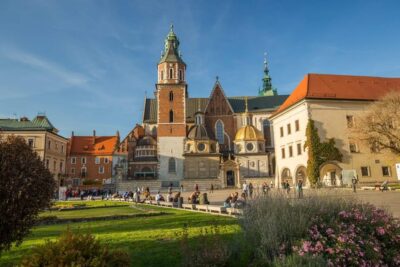
Then you reach Wawel Hill and the spiritual center: Wawel Cathedral. It dates to the 14th century and is tied to coronations, weddings, and funerals of Polish kings and queens.
Inside, you are pointed toward chapels, the Sigismund Bell, and the Royal Tombs. Stained glass and decorated altars also appear in the tour’s description, so your eyes have clear targets.
Why this matters on a self-guided route is pacing. If you are the type who likes to sit for a few minutes in quiet spaces, you can do that here without worrying about group timing. If you are not a church person, the audio helps you focus on what makes the cathedral historically important.
Wawel Castle, state rooms and royal treasures
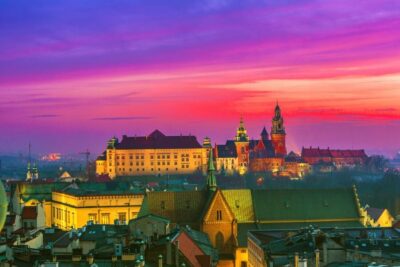
Not far from the cathedral, the route includes Wawel Castle. It is a UNESCO World Heritage site, and the tour frames it through both architecture and collections: state rooms, Renaissance courtyards, Royal Apartments, tapestries, and the Crown Treasury and Armory.
The view from Wawel Hill over the Vistula River is also part of the experience, and the audio helps you connect what you see to what you read, not just the facts on the page.
Again, since entrance fees are not included, you should expect that what you can do inside may depend on the day’s access and pricing. The good news is the walking component still delivers the core experience, and the exterior framing plus hilltop views can be satisfying even if you decide not to buy tickets for a specific interior area.
Tempel Synagogue in Kazimierz, Moorish Revival detail
Now the route changes gears and heads into Kazimierz, Krakow’s Jewish district. First stop here is the Tempel Synagogue, built in 1862.
The architecture is a major clue for what to look for. The tour notes it as Moorish Revival, and inside you are directed toward gilded stuccoes, intricate woodwork, and stained glass windows. That mix of beauty and memory is part of why this stop lands.
The audio also notes the synagogue’s role in progressive Judaism, and today it hosts concerts, cultural events, and religious services. If you want a respectful visit that still feels alive in the present, this is a good one.
Okrąglak, a market hall that still feels local
From there, you reach Okrąglak, a circular market hall in Kazimierz built in the early 20th century. The tour notes that it keeps a market feel today, with food stalls serving Polish street food, including zapiekanki, open-faced sandwiches.
This stop is not about a single landmark photo. It is about daily life. You are building texture, the kind of taste and smell memory that makes your Krakow visit feel real rather than purely historical.
If you are hungry, time this stop for a snack. If you are not, still walk through slowly. The building shape alone is interesting, and the atmosphere helps you transition from memorial sites to everyday culture.
Planty Park and the Jan Karski monument
Back near the Old Town, you pause at the Statue of Jan Karski in Planty Park. This stop is in a quieter green space and is meant for reflection.
Jan Karski was a Polish World War II resistance fighter and diplomat, and the tour’s description highlights his role as an emissary who reported the horrors of the Holocaust to the Allies. The monument shows him seated on a bench with a book in hand, an intentional stillness that invites you to slow down.
If you are traveling with teens or friends who want more than sightseeing, this stop gives you a human anchor point for the history you are seeing elsewhere on the route.
Szeroka Street, Jewish heritage in motion
Next comes Szeroka Street, the cultural and historical heart of Kazimierz. The route frames it as a broad, lively street with landmarks tied to Jewish community life, including the Old Synagogue, the Remuh Synagogue, and its adjacent cemetery.
It also mentions shopping for Judaica and the street’s role in cultural events like the annual Jewish Culture Festival. Even if you do not catch a festival, this street is a strong “sense of place” stop. You can feel the district identity through architecture, shops, and the way people use the space.
Old Synagogue, one of the oldest surviving in Poland
You then move to the Old Synagogue, dating back to the 15th century. The audio describes it as Gothic-style and positions it as one of the oldest surviving synagogues in Poland.
Inside, it is presented as a museum with artifacts, religious items, historical documents, and exhibitions on Jewish traditions and community life.
This is where the audioguide really helps you keep your focus. Without audio, it is easy to treat a historic building as just a beautiful room. With the narration, you understand what the objects and layout represent, and you can read the story at a slower pace.
Square of Ghetto Heroes, memory marked by 70 empty chairs
The last major memorial stop is the Square of Ghettos Heroes in Podgórze. The tour describes it as the heart of the Krakow Ghetto during World War II, and now a memorial site with 70 empty metal chairs symbolizing the absence of the thousands who lived there.
A small but moving memorial plaque and exhibits help connect the site to real stories and loss. This is the kind of place where you do not want to rush your audio. I like finishing this type of route with a grounded moment instead of ending on something purely scenic.
Smartphone audioguide, what you need to make it work
This tour is built around your phone. Included are 1 year access to the tour in your preferred language, 26 audio recordings narrated by a professional historian, and an app for iPhone and Android. You also get illustrations to identify landmarks and an offline map with route and GPS navigation.
Here is my practical advice so the experience stays smooth:
- Download the audio and activate GPS before you start walking, not after.
- Use your own headphones, since they are not provided.
- Keep an eye on your battery, because constant GPS and audio will drain it.
- If the weather is cold or wet, pause sooner rather than pushing through, because you want to keep enjoying the history, not just enduring the walk.
One review-style lesson from past visitors is also worth your attention: in very cold weather, a walking audioguide can feel like a test. If you travel in winter, layer up and plan for warmth.
Price and value: $8.27 for a full Old Town plus Kazimierz story
At $8.27 per person for about 2 hours 30 minutes, the value is mostly in how much ground it covers and how much context you get for that price. You are not paying for a human guide, so you are essentially buying narration plus navigation.
That is a smart deal if you like independence. You can stop for coffee, rewind, and move at your pace. It is also a low-risk way to learn a big chunk of Krakow without locking into a fixed group schedule.
The main cost to think about is what the tour does not include. Entrance fees and tickets are not included. The route notes say no routes require an entry fee, but if you want specific interiors that charge on the day, you would handle that separately.
Who this tour suits best, and who should skip it
This works especially well for:
- First-time visitors who want orientation across Old Town and Kazimierz
- Travelers who like a guided-feeling walk but hate rigid group timing
- People who enjoy learning by scanning architecture and reading details as they go
It may be a weaker match if:
- You do not like using apps and would rather have a person talk you through things
- You are traveling with limited phone readiness, like a dead battery risk or no headphones
- You cannot do long walking in outdoor conditions, since the route is street-based
Should you book this Krakow audioguide walking tour?
I would book it if you want a budget-friendly way to connect Krakow’s big landmarks with real meaning, using a system that lets you go at your pace. The combination of a clear route, illustrated landmark matching, and a historian’s audio set makes it easy to learn without constantly searching online.
If you care most about one museum or one interior experience, you might choose something more ticket-focused. But if your goal is to see Krakow as a living city, moving from medieval gates to Wawel to Kazimierz, this tour is a strong fit.
FAQ
Is this tour guided by a person?
No. It is self-guided, and there is no human guide at the meeting point.
What language is the audioguide in?
The tour is offered in English.
How long is the walking route?
The duration is about 2 hours 30 minutes.
What do I need to use it?
You need a smartphone, plus your own headphones. Smartphones and headphones are not included.
Do I need internet during the tour?
You get an offline map with the route, and the audio guide is available via the app. The tour notes date and time access, but it specifically provides an offline map to support navigation.
Are entrance tickets included in the price?
No. Entrance fee or tickets are not included.
Where does the tour start and end?
It starts at Kraków Barbican, Basztowa 30-547 Kraków, Poland and ends back at the same meeting point.
How many audio recordings are included?
You get 26 audio recordings narrated by a professional historian.
More Walking Tours in Krakow

More Tours in Krakow

More Tour Reviews in Krakow
Recently written up around Krakow

More Walking Tours.
 ★ 4.7Old Town Highlights Walking Tour in EnglishFrom $261,516 reviews
 ★ 5.0Old Town Krakow & Wawel Castle Walking TourFrom $261,508 reviews
 ★ 4.7Creepy Krakow: 2-Hour City Walking TourFrom $241,131 reviews
 ★ 4.8Gdańsk City Sights & History Guided Walking Tour in EnglishFrom $26876 reviews
 ★ 4.8The Old Town Walking TourFrom $19794 reviews
 ★ 5.0Main Town Gdańsk Walking TourFrom $26644 reviews
 ★ 4.9Old Town Guided Walking TourFrom $13599 reviews
 ★ 4.8Kazimierz Jewish Quarter Walking TourFrom $27571 reviews
Also on these Poland lists