
REVIEW · WROCLAW CITY TOURS
Wroclaw: 3-Hour Bike Tour in English
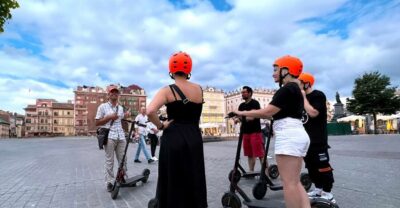
Wroclaw’s dwarfs are everywhere, even on wheels. This 3-hour English bike tour is a fast, fun way to see major sights without wasting time figuring out routes or parking. I love how much you cover compared with a walking tour, and I also like the fact that a guide handles navigation, so you can focus on the city.
One thing to think about: it’s a short, high-value loop. You will get time at each highlight, but if you want long sittings or deep wandering, you may feel a little rushed in 3 hours.
In This Review
- Key things you’ll notice on this ride
- Why a 3-hour bike loop beats a slow wander
- Meeting at Rynek 14: your launchpad for Old Wroclaw
- The ride plus a guide you can actually learn from
- Finding krasnale the fun way, street by street
- Market Square and the Old Town Hall: the historic center in one hit
- Cathedral time on Ostrów Tumski: Gothic landmark with layered meaning
- University of Wrocław: the post-war story you can feel in the timeline
- Centennial Hall: Max Berg’s big public stage
- What the price covers, and when it feels like great value
- Should you book this bike tour of Wroclaw?
- FAQ
- How long is the Wroclaw bike tour?
- What language is the tour in?
- Where does the tour start and end?
- What time does the tour begin?
- What is the price per person?
- Is there a group size limit?
- Do admission tickets include entry to the Cathedral and Centennial Hall?
- Do I get a ticket on my phone?
- What is the cancellation policy?
- What happens if the minimum number of travelers is not met?
Key things you’ll notice on this ride
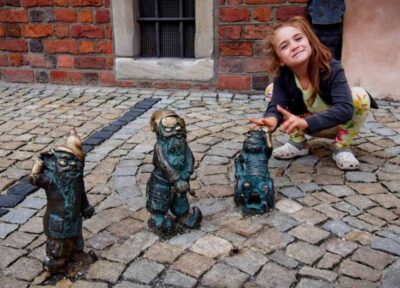
- Dwarf hunting on the move: Spot the krasnale, small street figurines that started in 2005 and kept growing.
- Easy navigation: The guide keeps the route tight, so you don’t get lost.
- Historic hits in one loop: Market Square, Old Town Hall, the Cathedral, and Centennial Hall.
- A big building moment: Centennial Hall was designed by Max Berg for concerts, theater, and sports.
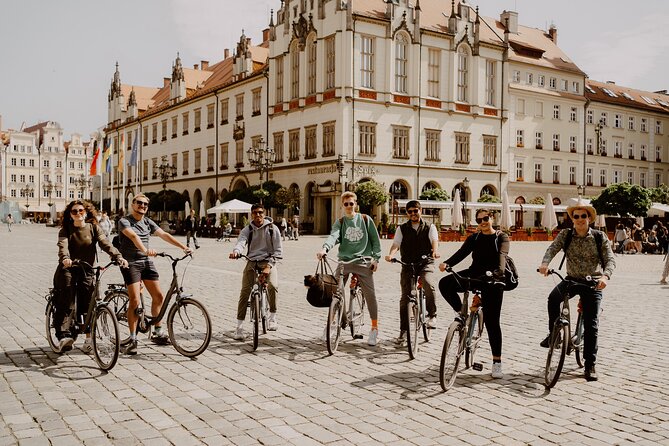
- Small group pace: Up to 20 people, which helps the ride feel controlled and social.
More of Wroclaw, dwarves and islands included
- Wroclaw: E-Car Tour and Audio Guide
★ 4.6 · 1,738 reviews - Wroclaw: 2-Hour Private Guided Tour by Electric Car
★ 4.8 · 805 reviews - Wrocław: Old Town and Ostrów Tumski Walking Tour in English
★ 4.8 · 311 reviews - Wroclaw: Private Old Town Guided Walking Tour (2 hours)
★ 4.8 · 275 reviews
Why a 3-hour bike loop beats a slow wander
Wroclaw is compact enough to feel walkable, yet big enough to eat your time if you only do sidewalks. A bike tour changes the math. In about 3 hours, you can hit multiple districts and still have energy left to look around.
I also like that this tour is built around “see it, then move on” pacing. The stops are timed, so you get key views and context without spending your whole morning searching for the next spot. It’s ideal for first-timers who want a solid orientation fast.
You’ll also get a small-group feel. With a maximum of 20 travelers, it tends to stay organized, and you are less likely to feel like you are fighting for space at busy points like Market Square.
Meeting at Rynek 14: your launchpad for Old Wroclaw
The tour starts and ends back at the same meeting point in the Rynek area, at Cultural and Tourist Information on Rynek 14. That matters more than you might think. Having one easy start point reduces stress, especially if you are new to the layout.
It also helps that the meeting area is near public transportation. If you plan to arrive a bit early, you can take a quick look at the square atmosphere before you mount up, then settle into the ride when the group is ready.
Since the tour runs in English, it’s straightforward to follow along. If you want a clean overview of what you are looking at, this is the kind of format that delivers it without you needing to research every building beforehand.
The ride plus a guide you can actually learn from
The biggest quality boost here is simple: you do not have to navigate. The guide takes care of the route, so you can concentrate on what makes each stop meaningful.
In at least one standout experience, the guide was Hubert, described as a walking encyclopedia of city knowledge. That kind of guide matters because Wroclaw has layers. You see Gothic architecture, German-era references, and post-war changes all in one ride, and a good guide helps you read those layers instead of just snapping photos.
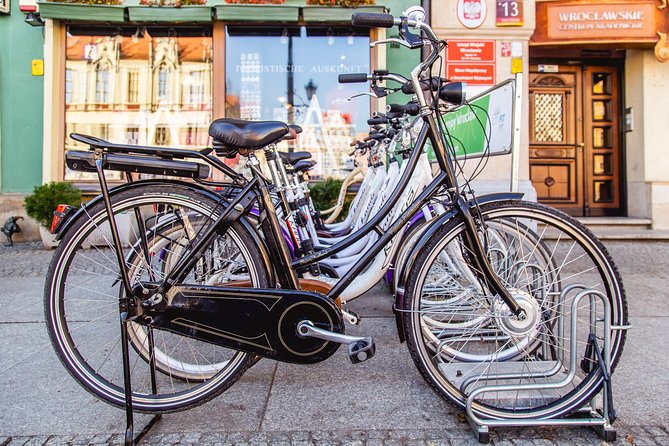
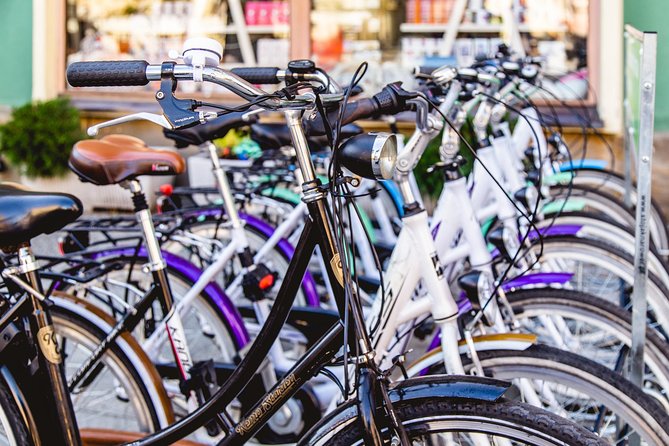
Bike comfort is also part of the value. People note the easiness of traveling by bike, and that adds up on a 3-hour outing. If you are comfortable riding, you’ll likely feel the tour’s rhythm, stop after stop, without the fatigue you can get from long walking stretches.
Finding krasnale the fun way, street by street
Wroclaw’s dwarfs, called krasnale or krasnoludki in Polish, are small figurines, usually 20 to 30 cm tall. They first appeared in 2005 and have kept multiplying since. They are not just cute decoration either. They are part of the city’s playful public identity now.
On a bike tour, dwarf spotting becomes a moving scavenger hunt. You are not forced to stop at each one for long. Instead, you catch them as you roll through streets and squares, which keeps the energy up and makes the city feel alive.
A tip for enjoying this part: look both ways. A lot of street details are placed where you only notice them if you are scanning with intention. When you are on a bike, you naturally keep your focus forward, so you have to remind yourself to glance at storefront edges, corners, and small public niches.
Below are the other Wroclaw trips we have logged
- Wroclaw: 3-Hour Bike Tour in English or Polish★ 4.8 · 66 reviews
- Wroclaw: 3-Hour Bike Tour in English★ 5.0 · 8 reviews
- Bike Tour of Wroclaw Old Town, Top Attractions and Nature★ 5.0 · 5 reviews
Market Square and the Old Town Hall: the historic center in one hit
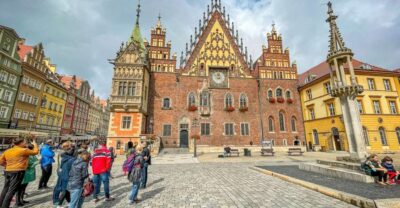
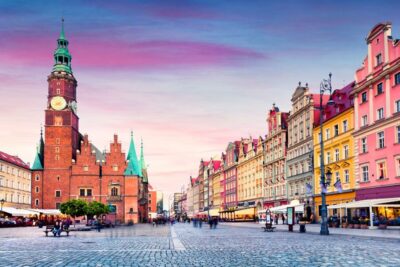
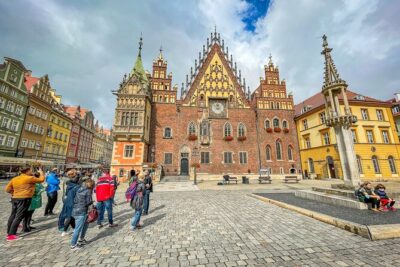
Your route feeds you into the Market Square (rynek). This space is big, medieval, and now the heart of a pedestrian zone. Even if you have seen photos, standing there helps you understand scale, because the square is rectangular, and it’s one of the largest markets in Europe. It also connects you to major civic buildings, including the town halls.
Next is the Old Town Hall (Stary Ratusz). Built in the 13th century in a Gothic style, it sits at the center of the square. This is one of those buildings where the name helps you remember what it did. It served the city and hosts civic and cultural events, and it even includes a museum and a basement restaurant.
What I like about this pairing is that it grounds the whole tour. Market Square gives you the public stage, and the Old Town Hall shows what was happening behind the scenes of civic life. You are not only looking at pretty facades, you are seeing how the city organized itself in daily life.
Cathedral time on Ostrów Tumski: Gothic landmark with layered meaning
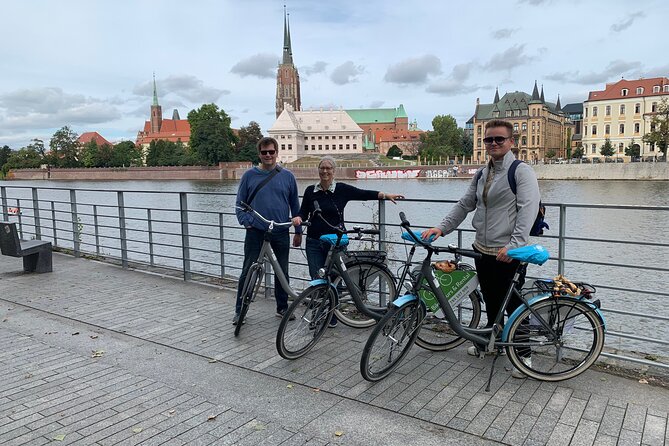
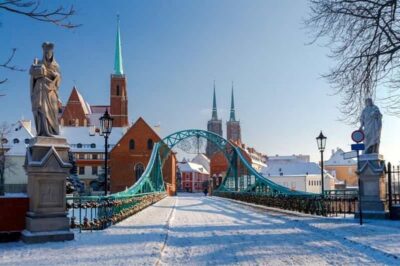
The tour also includes Wrocław Cathedral of St. John the Baptist, a landmark in the Ostrów Tumski district. It is the seat of the Roman Catholic Archdiocese of Wrocław, so it is not just a historic building, it is tied to ongoing religious life too.
Architecturally, it is Gothic with Neo-Gothic additions, and it is the fourth church built on the site. That last detail is a useful way to read what you see: you are looking at a structure that has been rebuilt or replaced over time, reflecting the city’s long continuity and interruptions.
One practical note: there is a set amount of time at the cathedral, and admission tickets are not included. So budget time and money for entry if you want to go inside and not just admire from outside.
University of Wrocław: the post-war story you can feel in the timeline
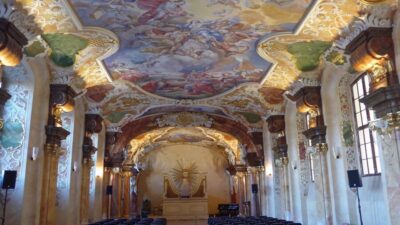
Another stop is the University of Wrocław. It is a public research university that was founded in 1945, replacing the earlier German University of Breslau. That post-war shift is a big part of Wrocław’s modern identity, and it makes this stop more than a random campus photo stop.
The university’s rebuilding story matters too. Following Poland’s border changes, academics from Jan Kazimierz University of Lwów, now in Lviv, helped restore the damaged buildings after the Battle of Breslau in 1945. Today, the university is one of the region’s most prominent educational institutions.
Why this works on a bike tour: you catch the city’s “then and now” in real geography. You are not reading history from a museum wall. You are riding past the places where major institutions were remade, which helps you understand why the city looks the way it does.
Centennial Hall: Max Berg’s big public stage
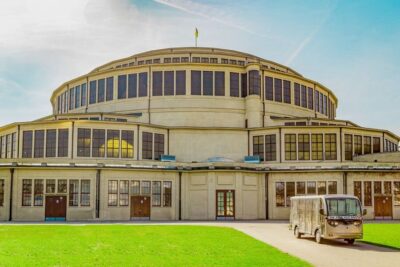
If you only remember one “wow” stop, make it Centennial Hall (Hala Stulecia). It was built from 1911 to 1913 based on plans by architect Max Berg. At the time, the city was part of the German Empire, and the building was designed as a multifunctional venue.
That word multifunctional fits what this hall was meant to do. The plan included exhibitions, concerts, theatrical and opera performances, and even sporting events. So when you look at it, you’re not just seeing an old structure. You are seeing an event machine built to pull the city together.
Like the cathedral, admission tickets are not included, and you get a limited amount of time. Still, even a short visit can be meaningful if you focus on the scale and the way the hall functioned as a public gathering space.
What the price covers, and when it feels like great value
The tour price is about $102.35 per person for roughly 3 hours in English, with a group size capped at 20 and a guide included. That might sound steep if you compare it to buying a museum ticket. But a bike tour is different. You are paying for time-saving logistics, the route planning, and the guide’s explanations tying sites together.
For me, the best value angle is the “more ground in less time” benefit. If you are trying to see Market Square, Old Town Hall, the cathedral area, the university, and Centennial Hall in one morning, you would spend a lot of energy coordinating on your own. Here, the pacing does that work for you.
You also get a mobile ticket, which is convenient if you prefer not to juggle paper confirmations. And the small group size helps the tour feel less rushed at each stop, compared with larger bus-style outings.
Should you book this bike tour of Wroclaw?
Book it if you want an efficient first taste of Wroclaw, you like biking (or at least you are comfortable enough for a 3-hour ride), and you want a guide who can explain what you are seeing as you go.
Skip it or plan differently if you are the type who wants long time at fewer sites. This tour is timed, so you’ll get highlights, not slow, deep sessions.
If you’re aiming for value, this one makes sense. You get the big names, the playful dwarfs, and a guided route that helps you actually understand the city while you are moving.
FAQ
How long is the Wroclaw bike tour?
The tour lasts about 3 hours.
What language is the tour in?
The tour is offered in English.
Where does the tour start and end?
It starts at Cultural and Tourist Information, Rynek 14, 52-007 Wrocław, Poland, and ends back at the same meeting point.
What time does the tour begin?
The start time is listed as 10:00 am.
What is the price per person?
The price is $102.35 per person.
Is there a group size limit?
Yes, the tour has a maximum of 20 travelers.
Do admission tickets include entry to the Cathedral and Centennial Hall?
No. Admission tickets are not included for the Cathedral and Centennial Hall.
Do I get a ticket on my phone?
Yes, the tour uses a mobile ticket.
What is the cancellation policy?
Cancellation is free up to 24 hours in advance for a full refund.
What happens if the minimum number of travelers is not met?
If it is canceled because the minimum isn’t met, you’ll be offered a different date or a full refund.
More Tours in Wroclaw

More Tour Reviews in Wroclaw
More of Wroclaw
Recently written up around Wroclaw
More Wroclaw City Tours.
 ★ 4.6E-Car Tour and Audio GuideFrom $161,738 reviews
 ★ 4.82-Hour Private Guided Tour by Electric CarFrom $38805 reviews
 ★ 4.8Old Town and Ostrów Tumski Walking Tour in EnglishFrom $19311 reviews
 ★ 4.8Private Old Town Guided Walking Tour (2 hours)From $164275 reviews
 ★ 5.0Old Town Wrocław Walking TourFrom $26249 reviews
 ★ 4.8City Tour Sightseeing By Golf Cart Shared Or PrivatFrom $27189 reviews
 ★ 5.0Auschwitz-Birkenau Tour from WrocławFrom $266129 reviews
 ★ 4.4Wroclaw Pub Crawl with Free DrinksFrom $25127 reviews
Also on these Poland lists