
REVIEW · NOWA HUTA AND COMMUNISM TOURS
Private Tour: Warsaw’s Communist History by Retro Fiat
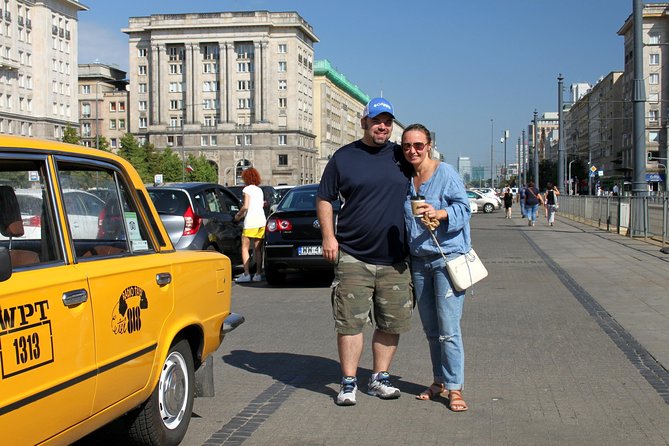
Warsaw politics hits you fast, in the best way. This private tour rolls through the city’s Communist-era landmarks, with frequent stops so the story stays clear and visual. You ride in a vintage Fiat 125p, then mix car time with short walks at major sites tied to the Soviet-influenced decades.
I like that it is truly private, so you can ask the awkward questions without watching the clock. I also love the pacing: you get quick, focused time at key buildings, then enough context to connect what you see in the street to what life was like under the regime.
The one drawback to plan for is this is not a deep museum day. The Palace of Culture and Science time is short, and admission is not included, so if you want to go inside, you’ll need to organize that separately.
In This Review
- Key things to know before you ride
- Riding in a vintage Fiat 125p, not a bus
- Palace of Culture and Science: Socialist Realism’s loudest poster
- Constitution Square and the Communist Ministerial District in concrete
- Monument of the Free Word and Charles de Gaulle: censorship and political theatre
- Praga Polnoc, Mariensztat Square, and the city’s everyday survival
- Bazar Rozyckiego: shortages, black markets, and improvisation
- How the guide turns stops into one clear story
- Timing, route rhythm, and what to expect in 4 hours
- Price and value at about $108.24 per person
- Who should book this tour, and who might skip it
- Should you book Warsaw’s Communist History by Retro Fiat?
- FAQ
- How long is the Warsaw’s Communist History by Retro Fiat tour?
- Is this a private tour?
- Do I get hotel pickup and drop-off?
- What language is the tour offered in?
- Is admission included for the stops?
- Are food and drinks included?
Key things to know before you ride
- Vintage Fiat 125p experience: the ride itself is part of the show, and it helps you see more than a walking loop would.
- English guide, private group: you get a custom pace for your interests while staying on a clear route.
- Strong focus on architecture tied to power: Socialist Realism shows up again and again, not just in passing photos.
- Short stops, smart context: most locations are quick, but you get the why behind each one.
- Black market and daily control themes: you’ll hear how shortages and censorship shaped ordinary Warsaw life.
- Hotel pickup and drop-off: you skip the hardest logistics part of getting to multiple districts.
More of the socialist-era district, reviewed
- Warsaw: Communism Tour in an Original Socialist Van
★ 4.9 · 75 reviews - Warsaw: Communist History Self-Driving Tour
★ 4.8 · 52 reviews - Warsaw: Communism Tour in an Original Socialist Van
★ 4.5 · 35 reviews - Warsaw Communism Private Tour in a Retro Fiat
★ 5.0 · 25 reviews
Riding in a vintage Fiat 125p, not a bus
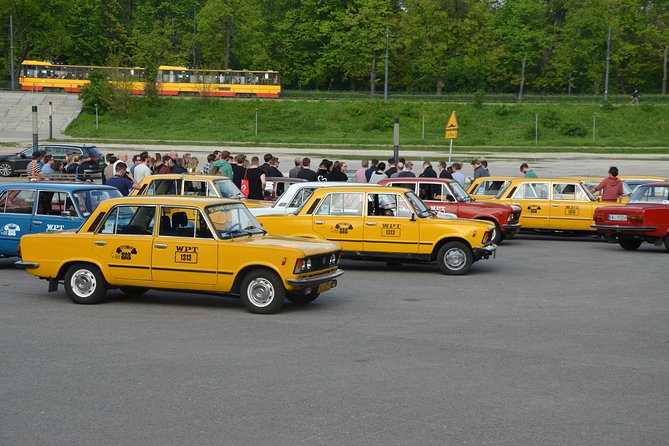
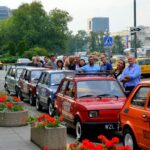
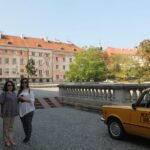
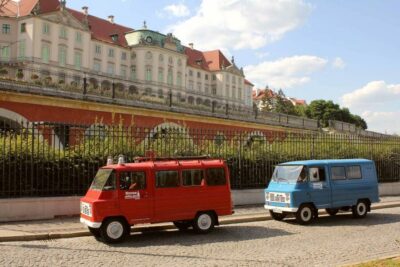
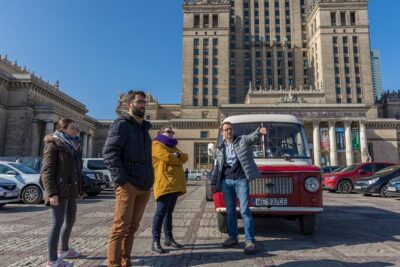
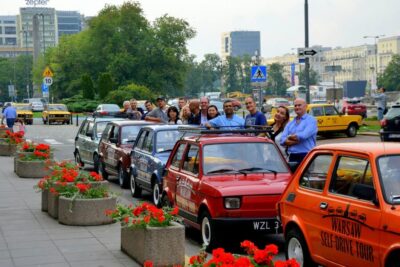
This tour is built around the Fiat 125p, a classic Polish car that makes the whole day feel more personal. Instead of feeling herded, you travel like a local moving between districts, with your guide stopping close to the points that matter.
I like that this format naturally slows you down. Even when you only spend 15 to 30 minutes at a stop, you’re not just dropping in and out. You’re also getting the in-between context, which is where communist Warsaw starts to make sense. It is the same city, but the story changes depending on what regime wanted people to see, and what it tried to hide.
Logistically, it is also easy: hotel pickup and drop-off are included. The tour meets near Dworzec Centralny, and the guide either picks you up from your hotel lobby or meets you in front of a building if your hotel is outside the pickup zone.
One practical note: you are mixing driving with brief walks and street-level viewing. Wear comfortable shoes, and treat this as a “see it and talk about it” tour, not a full-on museum sprint.
Palace of Culture and Science: Socialist Realism’s loudest poster
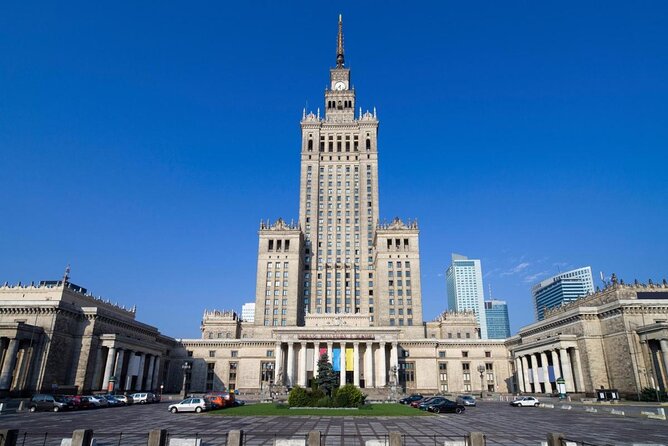
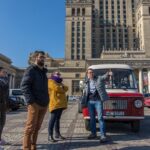
Your first stop is the Palace of Culture and Science. This is the most recognizable building in Warsaw, and it is also the clearest visual example of socialist realist architecture in the city.
Plan for a quick, high-impact look. You get about 30 minutes here, and the tour is timed for viewing and explanation, not for a long interior visit. Admission is not included, so if you want to step inside theaters, museums, or other spaces housed there, you’ll want to treat that as optional add-on time.
What I like about this stop is how much it helps you read the city. The Palace is not just a photo. Your guide ties it to how the Communist system used big public buildings as signals of authority and permanence. In one of the stories shared during the tour experience, people also refer to the building with the idea of a gift that was not really a gift, which captures the mood of the era in a way you can feel.
Even if you already know Warsaw’s skyline is shaped by more than one century, this stop makes the 20th century political layer instantly legible.
Constitution Square and the Communist Ministerial District in concrete
Next up is Plac Konstytucji, with its Stalin-era architecture. This is about what the regime wanted to be seen, and how it wanted the streets to feel when you moved through them.
You get about 30 minutes, and it is listed as free to visit. Translation for your planning: you can focus your time on understanding the design and the message, not on ticket lines.
From there, the tour also points you toward the Communist Ministerial District, built in a Socialist Realism style. This is where the architecture starts doing the work of a textbook. Long sightlines, monumental massing, and formal planning all push a very specific feeling: the state is everywhere, even when it is not in front of you.
A good way to use this segment is to pay attention to scale. When you stand near buildings meant for ministries, you start noticing how streets and plazas were shaped for public visibility. Your guide’s explanations connect those design choices to how the government organized power and daily life.
Monument of the Free Word and Charles de Gaulle: censorship and political theatre
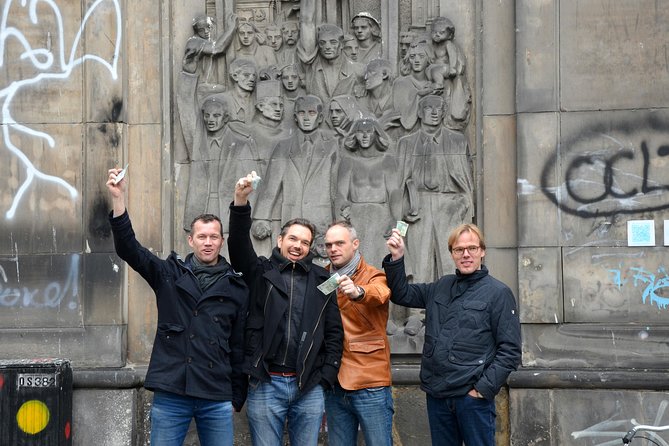
Two short stops bring a different angle. First is the Monument of the Free Word. You’re there for about 5 minutes, and it is free. That short time works well because the story is sharp: daily censorship in Communist Poland, and how control over language shaped what people could say and write.
Then you move to the Statue of Charles de Gaulle. It’s also free, with about 15 minutes allocated. Your guide uses this moment to discuss leaders connected to the Communist Party and the political theatre around them.
I like these stops because they go beyond architecture. You get the built environment, then you get the human system behind it: messaging, control, and the way authority tried to narrate reality.
If you are the type who loves Cold War details, this part usually delivers. The guide can connect censorship to everyday habits, like what people risked saying out loud and how they learned to read between official lines.
Warsaw rebuilt itself twice over. Here is how else we saw it
- Warsaw: Chopin Concert in the Old Town★ 4.8 · 2,287 reviews
- Warsaw: Traditional Galar Cruise on The Vistula River★ 4.6 · 1,640 reviews
- Warsaw: Old Town Highlights Walking Tour in English★ 4.7 · 1,516 reviews
- Warsaw Concert: Chopin – Painted by Candlelights with Wine★ 4.8 · 1,442 reviews
- Warsaw: City Sightseeing Hop-On Hop-Off Bus Tour★ 3.6 · 1,415 reviews
Praga Polnoc, Mariensztat Square, and the city’s everyday survival
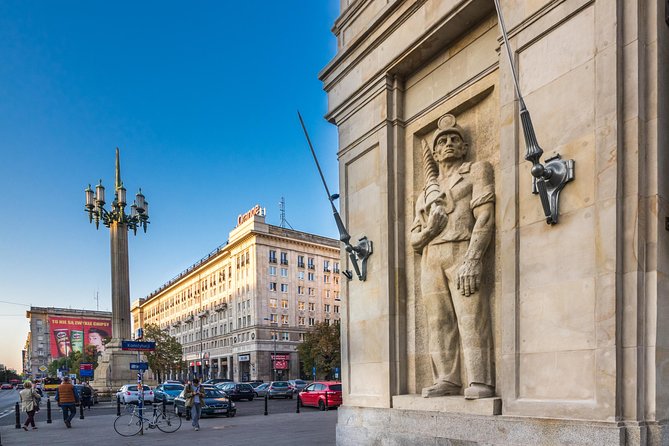
Warsaw is not one story. The tour reflects that by shifting neighborhoods and showing how Communist-era life looked in different places.
Praga Polnoc is one of the more interesting district stops, with about 30 minutes allocated and free access. The reason it matters for communist history is that it was not badly destroyed during WWII, so it offers a different visual baseline than areas rebuilt more dramatically. Your guide helps you connect what survived, what changed, and what that meant for people living through the decades.
Then you have Mariensztat Square (Rynek Mariensztacki), where the tour focuses on communist-era housing blocks. This stop is about 20 minutes and also free. Housing is where politics becomes real. You feel it in density, in layout, and in the basic promise of a system that claimed to build a better future.
I also like how these neighborhood moments add contrast to the more monumental sites. The Palace and ministerial buildings tell you what power wanted to show. Praga Polnoc and Mariensztat tell you what people had to live with.
Bazar Rozyckiego: shortages, black markets, and improvisation
One of the most memorable stops is Bazar Rozyckiego, around 15 minutes and free. This is tied to the most famous black market in Communist Poland.
Even in a short stop, this location works because it gives you a grounded look at how shortages were handled. Communist systems promised fairness and supply, but daily reality often forced people into side economies. The black market story is not just gossip. It explains how people survived, and what that survival cost them socially and morally.
If you want the tour to feel more human, this is the segment to slow down a bit in your head. Picture what it means to trade for essentials, to find goods through informal networks, and to live under constant limits.
How the guide turns stops into one clear story
The best part of this tour is how the route adds up. It is not just a checklist of communist sites. The guide connects architecture, censorship, neighborhood life, and everyday improvisation into one narrative line.
That storytelling style is backed up by the way guides have shared personal context in past departures. In the experience notes, you can see examples of guides like Jacob, Karol, Konrad, Marcin, Olga, Pawel, Adam, and Martin, each bringing a strong command of English and, in some cases, personal perspective on what life was like as the era receded. When that personal layer shows up, the tour stops feeling like a history lecture.
Two other details I’d highlight for you:
- The itinerary is flexible. In the experience record, guides adapt when interests shift, which can make a big difference if you care more about daily life than buildings, or vice versa.
- The tour often leaves space for questions. Several guide stories emphasize that they handled off-the-wall questions and answered in a way that sparked discussion, not just recitation.
One watch-out: because the stops are time-boxed, you need to choose what you want to do with your attention. If you want maximum time at one building, ask early. Otherwise you will get a satisfying sweep, but not long stays everywhere.
Timing, route rhythm, and what to expect in 4 hours
This is listed as about 4 hours, and the stop timings add up to a half-day loop with multiple brief stops.
Here is the rhythm you can expect, based on the planned durations:
- Start with Palace of Culture and Science (about 30 minutes).
- Move through Constitution Square (about 30 minutes).
- Continue on to the Communist Ministerial District and then monuments and statues in shorter chunks.
- Hit Praga Polnoc (about 30 minutes) and neighborhood housing areas (Mariensztat Square about 20 minutes).
- Finish with the black market stop (Bazar Rozyckiego about 15 minutes).
For you, that means it is a great choice when you want context without giving up a full day. If your schedule is tight, you will still come away with a mental map of communist Warsaw: where power sat, where censorship hit, and where daily life had to improvise.
Price and value at about $108.24 per person
At $108.24 per person for a private 4-hour tour, you’re not paying for a bus ride. You’re paying for a custom guide plus private transport in the Fiat 125p, along with hotel pickup and drop-off.
Here’s the value logic I use:
- Private tours cost more, but they also save time. You are not coordinating multiple transit legs across districts.
- The car time matters in this particular theme. Communist-era Warsaw is spread out, and short stops work better by vehicle.
- The guide is doing heavy lifting. You’re paying for interpretation that makes the architecture and monuments meaningful, not just scenic.
The one fairness check: this price is usually worth it if you want guided storytelling and organized stops. If you only want a quick photo route, you could replicate some parts on your own. But if you want the “why” behind each stop, this format is built for that.
Who should book this tour, and who might skip it
This is a strong fit for you if:
- You like history that connects politics to real streets and real routines.
- You enjoy architecture as evidence, not just as decoration.
- You want a half-day plan with hotel pickup that still feels flexible.
- You appreciate a small-group feel, even though the tour is private.
You might skip it if:
- You want long museum time, since the Palace is short and admission is not included.
- You prefer purely indoor stops, because a lot of the tour is built around outdoor monuments and street-level districts.
- You expect included meals or vodka as a guaranteed part of the tour, because food and drinks are listed as not included unless specified.
In other words, treat it as a political city walk with a vintage car, not a catered experience.
Should you book Warsaw’s Communist History by Retro Fiat?
If your goal is to understand communist Warsaw in a way that feels specific and practical, I’d book it. The vintage Fiat 125p adds charm, but the bigger win is the structure: you see the major architectural signals, then you hear about censorship and daily life, and you get neighborhood contrast across districts like Praga Polnoc and Mariensztat.
Two final tips to help you get the best experience:
- Bring questions in advance. Ask how the architecture shaped public life, or how censorship affected ordinary communication.
- If you are drawn to the Palace of Culture and Science interior, plan for the fact that admission is not included, and ask your guide how much time you might need.
Overall, this is a smart way to spend a half-day in Warsaw if you want more meaning than a drive-by photo set.
FAQ
How long is the Warsaw’s Communist History by Retro Fiat tour?
The tour lasts about 4 hours.
Is this a private tour?
Yes. It is a private tour, and only your group will participate.
Do I get hotel pickup and drop-off?
Yes. Hotel pickup and drop-off are included, and the guide will meet you at your hotel lobby or in front of a nearby building if your hotel is outside the pickup area.
What language is the tour offered in?
The tour is offered in English.
Is admission included for the stops?
Admission is not included for the Palace of Culture and Science. The other listed stops in the itinerary are free.
Are food and drinks included?
Food and drinks are not included unless specified.
Vintage Rides Around Warsaw

Warsaw, Keep Looking
Nowa Huta, the Rest of Our Notes
Recently written up around Warsaw


More Nowa Huta and Communism Tours.
 ★ 4.9Nowa Huta Guided Tour in Vintage CarFrom $75277 reviews
 ★ 5.0Legendary Private Nowa Huta Communism Tour with Crazy GuidesFrom $131262 reviews
 ★ 4.9Nowa Huta: Steelworks Administration Buildings/Shelters TourFrom $24160 reviews
 ★ 4.9Private Nowa Huta Adventure Tour in Communist CarsFrom $108114 reviews
 ★ 4.93.5-Hour Communism Deluxe Tour by TrabantFrom $21584 reviews
 ★ 4.9Communism Tour in an Original Socialist VanFrom $7875 reviews
 ★ 4.8Communist History Self-Driving TourFrom $6952 reviews
 ★ 5.0Trip Around Nowa Huta – KrakowFrom $10250 reviews
Also on these Poland lists