
REVIEW · WARSAW CITY TOURS
Private Warsaw Old Town & Royal Route Walking Tour – Bestseller
Warsaw’s Old Town has a way of sticking. This private walking tour connects major landmarks with the stories behind them, from Chopin’s heart to how Warsaw was rebuilt after WW2. You walk a smart loop along the Royal Route, with plenty of stops that explain not just what you see, but why it matters.
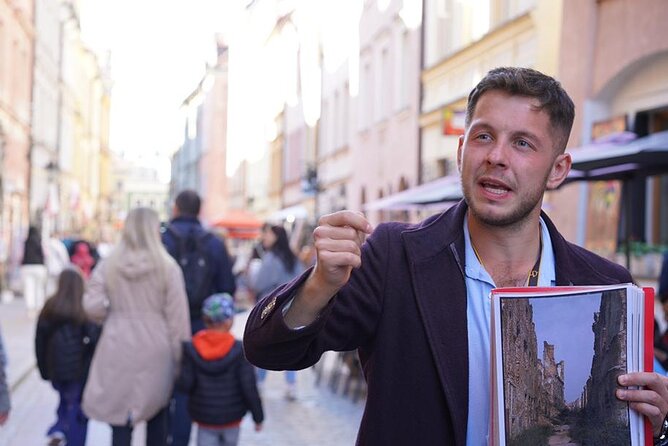
I especially like the storytelling focus. Your guide, Łukasz Benedykciński, ties together music, coffee history, war timelines, and symbolism in a way that makes the places feel usable, not like they are just for photos. I also like the fact it is private and up to 15 people, so you are not stuck blending into a giant crowd.
The main thing to consider is time and walking. It is about 2 hours 30 minutes, and it moves through several key sites, so plan to wear comfortable shoes and keep breaks short if you want to stay on schedule.
In This Review
- Key highlights you should care about
- Where this tour fits best in your Warsaw plans
- Start at the Nicolaus Copernicus Monument: Holy Cross Church and Chopin’s heart
- Krakowskie Przedmieście: coffee history and how the capital got its shape
- Plac Marszalka Józefa Pilsudskiego: skyline views with a reason
- The Presidential Palace spared, the Royal Castle hit hard, and the long rebuild
- The most important church built twice, and why that matters
- Tomb of the Unknown Soldier: remembrance you can stand inside
- Kanonia: the small Amsterdam, a wishing bell, and a cemetery past
- Rynek Starego Miasta: the market square and the before-and-after story
- Barbakan on the city walls: built for reasons that surprise people
- Gnojna Góra: romance with a history warning sign
- Old Town finale: Piwna Street, the pigeon lady, the Mermaid, and WWII you can place
- Price and group size up to 15: what you really get for $258.88
- Practical tips for making this walk feel easy
- Should you book this private Warsaw Old Town and Royal Route tour?
- FAQ
- Where does the tour start and where does it end?
- Is hotel pickup available?
- How long is the walking tour?
- What group size is this private tour for?
- What language is the tour offered in?
- Are admission tickets needed for the listed stops?
- Do I get a mobile ticket?
- Are service animals allowed?
- What are the tour’s operating hours?
- What is the cancellation policy?
- When will I receive confirmation after booking?
Key highlights you should care about
- Chopin’s heart at Holy Cross Church, plus the story of how it returned to Warsaw
- Krakowskie Przedmieście, with explanations on why Warsaw became the capital and even coffee connections
- WW2 survival and delay stories, including why some major buildings were spared and others took decades to rebuild
- Tomb of the Unknown Soldier and how Warsaw remembers its losses
- Kanonia Square, known locally as the small Amsterdam, with the wishing bell and a cemetery past
- Old Town stops like Piwna Street and the Mermaid, with WW2 then-and-now context
Warsaw rebuilt itself twice over. Here is how else we saw it
- Warsaw: Chopin Concert in the Old Town
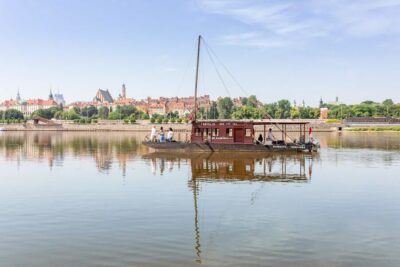
★ 4.8 · 2,287 reviews - Warsaw: Traditional Galar Cruise on The Vistula River
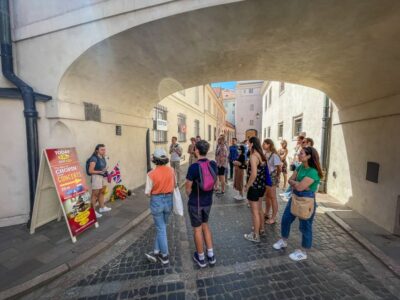
★ 4.6 · 1,640 reviews - Warsaw: Old Town Highlights Walking Tour in English
★ 4.7 · 1,516 reviews - Warsaw Concert: Chopin – Painted by Candlelights with Wine
★ 4.8 · 1,442 reviews
Where this tour fits best in your Warsaw plans
This is a very practical kind of sightseeing. You are not just ticking off famous names, you are learning the threads that connect them. Warsaw can feel confusing at first, because it was heavily damaged and later rebuilt. This walk gives you a storyline you can hold in your head while you look around.
It also works well if you like history told through human details. Chopin’s personal story, the symbolism of monuments, and the way streets got their names are the kind of things that make a city feel real fast.
And since it is private (up to 15), you can get a more direct back-and-forth with your guide than you would on a big group bus tour. If you enjoy asking questions, this format tends to feel more relaxed.
Start at the Nicolaus Copernicus Monument: Holy Cross Church and Chopin’s heart
You begin at the Nicolaus Copernicus Monument on Krakowskie Przedmieście. If you are getting pickup, you meet your guide at your hotel reception first. Either way, you are set up for a walk that starts with a strong emotional hook.
Stop 1 is Holy Cross Church, where the tour focuses on Chopin’s heart. The key idea is simple and compelling: Chopin died abroad, and he asked for his heart to be brought back to Warsaw. Your guide explains how his sister helped make that happen and where the heart is located today. Even if you are not a classical music superfan, this stop gives you a direct connection between Polish identity and personal longing.
Practical note: this stop is listed with admission ticket free. So you can focus on the story and the moment without budgeting extra entry fees.
Krakowskie Przedmieście: coffee history and how the capital got its shape
After Holy Cross Church, you walk along Krakowskie Przedmieście, one of Warsaw’s most representative streets. This is a great segment for anyone who likes “city logic,” meaning how places earned their roles over time.
Here your guide covers three things you might not expect to find on a walking tour:
- Why Warsaw became the capital of Poland
- Where the oldest coffee place in Warsaw is, and how Polish people connect to European coffee history
- Why the street’s name points to Kraków, the suburbs of Kraków
This part matters because it explains why Warsaw looks the way it does, and why the city’s story is tied to everyday culture. Coffee sounds small, but it is actually a good shortcut into the broader European connections the city had over time.
Stop 2 is also listed as admission ticket free. So again, the tour keeps the emphasis on guided walking and interpretation rather than ticket logistics.
Plac Marszalka Józefa Pilsudskiego: skyline views with a reason
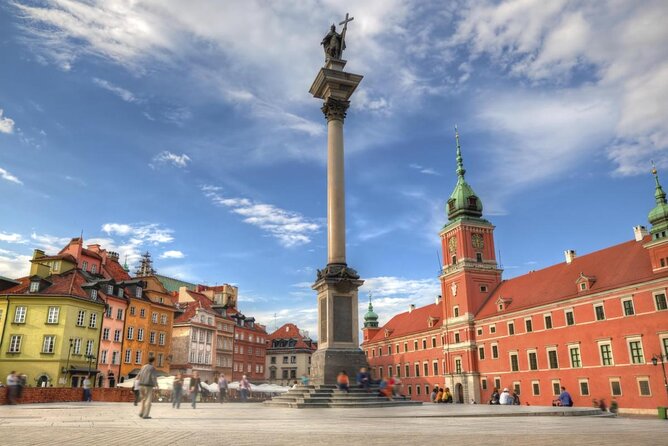
Next you reach Plac Marszalka Józefa Pilsudskiego, the main square with a magnificent Warsaw skyline view. This is one of those spots where it helps to pause. Squares are made for standing, looking, and getting oriented, and this one does that job well.
The tour uses this view as a reset point before moving into the heavier WWII chapters. It is a good moment to notice what buildings remain, what was rebuilt, and how the city’s layout was reshaped.
Admission is listed as ticket free for this stop too, so you are not paying just to stand in a good place.
Below are the other Warsaw trips we have logged
- Warsaw: Old Town Guided Walking Tour★ 4.9 · 599 reviews
- Half-Day Polish Food Walking Tour with Guide and Dinner★ 4.5 · 381 reviews
- Warsaw: Warsaw Ghetto Private Walking Tour with Hotel Pickup★ 4.9 · 369 reviews
- Old Town Warsaw Walking Tour★ 4.5 · 333 reviews
- Warsaw: Jewish History Guided Walking Tour in English★ 4.7 · 324 reviews
The Presidential Palace spared, the Royal Castle hit hard, and the long rebuild
After the square, the tour shifts into WWII survival and destruction, with explanations that aim to make the timeline easier to understand.
The experience highlights the fact that after WWII destroyed about 70 percent of Warsaw, some major buildings were still spared. The Presidential Palace of Poland is one example you will hear about, and your guide explains why it survived when so much else did not.
Then comes a deeper Royal Castle story. Adolf Hitler ordered soldiers to blow up the Royal Castle in Warsaw (Zamek Królewski). The account includes an unusual detail: holes were drilled for dynamite in 1939, but explosives were filled in later, in 1944. Your guide also explains why it took so long and why rebuilding the Royal Castle took additional decades, described as 40 years to restore.
These are not just dramatic facts. They help you understand how wartime decisions can drag on, how plans change, and how rebuilding is often slow, political, and complicated. If you have ever looked at a restored historic building and wondered what it cost in time and effort, these explanations give context.
One drawback to keep in mind: because this part of the tour focuses on wartime chronology, it can feel intense if you are trying to keep things light. Still, it is handled as story-based interpretation, not doom-and-gloom.
The most important church built twice, and why that matters
The itinerary includes another major church stop described as Warsaw’s most important church, built twice. Your guide explains why it needed to be rebuilt and how that fits into the broader Warsaw story.
Even without extra technical details in the listing, this kind of stop is valuable because it turns architecture into evidence. Buildings built twice are physical proof that history interrupted daily life, and that rebuilding was a long, deliberate process.
This is also a moment where you might slow down and look at the overall feel of the building rather than chasing every detail. Let the guide’s explanation give you a frame, then you can see the place with fresh eyes.
Tomb of the Unknown Soldier: remembrance you can stand inside
Stop 4 is the Tomb of the Unknown Soldier. You will see the monument and listen to the history behind it.
This works well right after the WWII buildings discussion. It shifts you from the destruction and restoration timeline into how nations memorialize loss. That contrast helps keep the story balanced. Instead of only focusing on what was broken, you see what was honored.
The tour lists this stop as ticket free. So you are paying for interpretation, not entry.
Kanonia: the small Amsterdam, a wishing bell, and a cemetery past
Stop 5 is Kanonia, described by locals as the small Amsterdam. There is even a wishing bell at Kanonia Square. But the tour does not leave it at romantic postcards.
Your guide explains that for hundreds of years there was a cemetery located here, and tells you what happened. This stop is a reminder that “pretty” places often have layers you do not see at first glance.
One practical tip: if you like taking photos, this is a good place to do it quickly, then listen first. The story can change the mood of what you are photographing.
Admission for Kanonia is listed as ticket free as well.
Rynek Starego Miasta: the market square and the before-and-after story
Stop 6 is Rynek Starego Miasta, Warsaw’s Old Town Market Square. It is one of the loveliest places in the area, and the tour uses that setting to explain how Warsaw was rebuilt after WWII.
You will see and hear about photos of the square before and after the war, and the process of rebuilding. The best part of this segment is that it gives you a sense of what restoration can mean beyond making things look nice again. Rebuilding is about identity, memory, and the decision to keep going.
This stop is also listed as ticket free. So you are getting the context built around the place, not a separate paid attraction.
Barbakan on the city walls: built for reasons that surprise people
The tour includes Barbakan, described as part of Warsaw’s City Walls. But your guide points out something that often surprises first-time visitors: when it was built, it had no military importance.
Your guide explains who built it, why, and who used it. Even if you do not consider yourself a fortifications person, this is a useful correction to the usual assumption that old walls were purely for fighting.
It is another way the tour balances entertainment with understanding.
Gnojna Góra: romance with a history warning sign
Stop 7 is Gnojna Góra hill, now a romantic place where people come and lock their love with padlocks in scenic views. The tour includes that tradition, but with an important twist.
The guide specifically warns you not to do the padlocks, because the place has history. You will hear the story behind Gnojna Góra and why it is better treated thoughtfully.
That is the kind of tour detail I like: it does not just say what to do, it gives you context so you understand what you are participating in. If you are the type who wants to follow the local vibe, this helps you do it with your eyes open.
This stop is listed as ticket free.
Old Town finale: Piwna Street, the pigeon lady, the Mermaid, and WWII you can place
Stop 8 is the Old Town area, where you discover hidden treasures and get multiple quick-hit stories in one final stretch.
You will hear about:
- Piwna Street, also known as the beer street
- The Pigeon Lady
- The Mermaid of Warsaw
- WWII in Warsaw
And the tour includes many other interesting stories around the streets. The finale lines you up perfectly with the meeting end point: the Warsaw Mermaid Statue at Rynek Starego Miasta 18i. That means when the tour ends, you are not stuck far from the most classic Old Town loop.
This is also a strong segment for first-time visitors, because it pulls together earlier themes. You have heard about restoration, survival, memorials, and daily-life history. Now you see those ideas living in the street names and small symbols.
Price and group size up to 15: what you really get for $258.88
The price is $258.88 per group, for up to 15 people, for about 2 hours 30 minutes. That is not cheap if you are traveling solo. It becomes more reasonable when the group is fuller.
If your group is small, think of it as paying for quality guidance and a private pace. If you do get close to the maximum group size, the cost per person drops a lot, because it is priced per group, not per ticket.
The value comes from three places:
- You get a focused walking route rather than random wandering
- Your guide, Łukasz Benedykciński, connects major landmarks with clear story threads
- The stops listed as admission ticket free help you avoid surprise add-on costs
Another value point is communication and planning. The experience is set up with confirmation within 48 hours of booking (subject to availability), and the guide is ready to coordinate pickup at your hotel reception. You also get a mobile ticket. For many people, that reduces stress in a city where meeting points matter.
One more timing note: this tour is booked about 128 days in advance on average. That is a hint that popular guide availability can move quickly, especially for the best times of day.
Practical tips for making this walk feel easy
- Use the pickup option if you want a low-stress start. Your guide can meet you at your hotel reception and then walk from there, or use transport or taxi to reach the official starting point.
- If you start at the official meeting point, plan to arrive a few minutes early at the Nicolaus Copernicus Monument on Krakowskie Przedmieście.
- Bring comfortable walking shoes. This is a walking itinerary through squares and Old Town streets, and it is about 2 hours 30 minutes.
- Expect lots of story. If you prefer quiet tours, this may feel like you are always listening, but if you like interpretation, it is a strong fit.
- If you have mobility constraints, the listing says most travelers can participate, but you should still think honestly about how much walking you can do.
Should you book this private Warsaw Old Town and Royal Route tour?
I would book it if you want Old Town to make sense fast. The route hits the big landmarks, but the real win is the way your guide turns them into a connected narrative, especially the WWII survival and rebuilding stories, plus Chopin’s heart and the personal details around monuments.
You should also book it if you care about practical guidance, like clear meeting coordination, hotel pickup options, and a mobile ticket. The tour is designed to be straightforward to use.
Skip it only if you want a mostly self-guided experience with minimal talking. This one is built around guided explanation at each stop.
If you want a Warsaw walk where you understand what you are looking at, this is a very solid choice.
FAQ
Where does the tour start and where does it end?
The tour starts at the Nicolaus Copernicus Monument on Krakowskie Przedmieście, 00-333 Warszawa, Poland. It ends at the Warsaw Mermaid Statue at Rynek Starego Miasta 18i, 00-272 Warszawa, Poland.
Is hotel pickup available?
Yes. The guide can meet you at the reception of your hotel. From there, you can walk, use public transport, or take a taxi to reach the starting point, or you can begin the tour at your hotel with a few extra stops.
How long is the walking tour?
The duration is about 2 hours 30 minutes.
What group size is this private tour for?
It is a private tour/activity for only your group, with a maximum group size of up to 15 people.
What language is the tour offered in?
The tour is offered in English.
Are admission tickets needed for the listed stops?
The itinerary lists admission ticket free for the stops included in the walking tour.
Do I get a mobile ticket?
Yes, a mobile ticket is included.
Are service animals allowed?
Yes, service animals are allowed.
What are the tour’s operating hours?
The tour is listed as available Monday through Sunday from 7:00 AM to 9:00 PM, within the stated operating dates.
What is the cancellation policy?
Free cancellation is available. You can cancel up to 24 hours in advance for a full refund, and cut-off times are based on local time. If you cancel less than 24 hours before the experience starts, the amount paid is not refunded.
When will I receive confirmation after booking?
You should receive confirmation within 48 hours of booking, subject to availability.
More Tours in Warsaw


More Tour Reviews in Warsaw

Warsaw, Keep Looking
Recently written up around Warsaw

More Warsaw City Tours.
 ★ 4.8Chopin Concert in the Old TownFrom $262,287 reviews
 ★ 4.6Traditional Galar Cruise on The Vistula RiverFrom $201,640 reviews
 ★ 4.7Old Town Highlights Walking Tour in EnglishFrom $261,516 reviews
 ★ 4.8Warsaw Concert: Chopin – Painted by Candlelights with WineFrom $251,442 reviews
 ★ 3.6City Sightseeing Hop-On Hop-Off Bus TourFrom $411,415 reviews
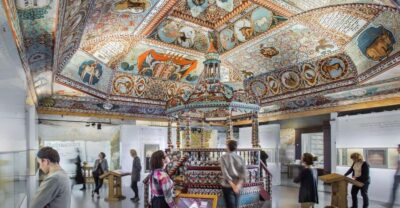 ★ 4.7POLIN Museum of the History of Polish Jews TicketFrom $121,142 reviews
 ★ 5.0#1 Pub Crawl Warsaw with Optional Premium 1 Hour Open BarFrom $28790 reviews
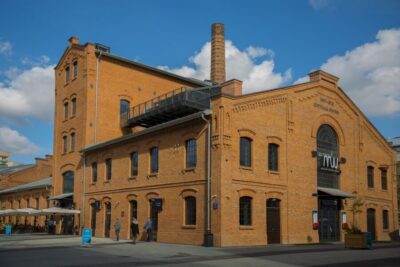 ★ 4.6Polish Vodka Museum Tour with TastingFrom $22788 reviews
Also on these Poland lists