
REVIEW · POZNAN CITY TOURS
The Birthplace of Poland: A Self-Guided Audio Tour of Poznań
Poznań’s big story fits one walk. This self-guided VoiceMap audio tour strings together Cathedral Island sights in an easy, feet-on-stone way, with offline audio and English narration built in. It’s a smart use of time if you want major history without booking a guided group.
I also like that the route feels designed for wandering, not rushing. You move stop to stop across the river and through key landmarks that shaped the city for centuries. The one thing to keep in mind is that you bring your own smartphone and headphones, and museum entry fees are not included.
In This Review
- Key things to know before you start
- Cathedral Island in Poznań: why this walk makes sense
- Price and timing: getting value from $8.99
- Starting at Makieta Ostrowa Tumskiego: use the scale model to get bearings fast
- Church of Our Lady in Summo and the palace chapel connection
- Poznań Cathedral and the Archbishop’s Palace: what you see, and why it matters
- Crossing Jordan Bridge: built, destroyed, and rebuilt into a connection
- Śródka District and the old wall-art moment
- Saint Margaret Church: another stop that keeps the story coherent
- Brama Poznania and the “museum stop” that you can actually use
- Cathedral Lock and Prussian fortification traces
- Genius Loci: walls, 3D films, and why modern tech belongs on this route
- Ending at the Archdiocese Museum area near the Lubrański Academy
- What to bring, so the audio tour feels effortless
- Should you book this Poznań Cathedral Island audio tour?
- FAQ
- Where do I start and where does the tour end?
- How long is the audio tour?
- How much does the tour cost?
- Is the tour available in English?
- Does it work offline?
- Are museum tickets included for stops along the route?
- Can I get a refund if I cancel?
Key things to know before you start
- Offline audio and maps so you can keep moving even with sketchy signal
- GPS-based playback in the VoiceMap app, so you get prompted as you walk
- Cathedral Island focus with major sites tied together into one historical path
- Mieszko’s story underground, linked to what you can see at Church of Our Lady in Summo
- Jordan Bridge’s rebuild history, right when you cross between neighborhoods
- Genius Loci and Brama Poznania appear on the route, with modern exhibits described along the way
Other Poznan walks we have sat through and rated
- Poznań Experience 2-Hours Guided Walking Tour
★ 5.0 · 155 reviews - Undercover City Games: Poznan
★ 5.0 · 88 reviews - Old Town Poznan: Guided Walking Tour in English
★ 4.6 · 78 reviews - Poznań: Private or Public Highlights Tour with a local guide
★ 5.0 · 66 reviews
Cathedral Island in Poznań: why this walk makes sense
Cathedral Island, or Ostrów Tumski, is where Poznań feels oldest and most layered. Instead of jumping between far-flung attractions, this audio route keeps you in one compact zone and builds a clear story as you go. You’ll start with a scale model of the island, then shift into the real sites, including church after church, palace buildings, bridges, and museum stops.
What I find especially useful is that the audio doesn’t treat the landmarks like isolated postcards. It connects them to the larger political and religious changes that shaped the city. You’ll hear why certain spots matter, not just what they look like, which makes even a short pause in front of Poznań Cathedral feel like you’re collecting pieces of a puzzle.
And because it’s self-guided, you can pace it like a traveler, not like a schedule. If you linger near a church detail, great. If you want to power-walk to the next bridge, you can do that too.
Price and timing: getting value from $8.99
At $8.99 per person for roughly 45 minutes to 1 hour 15 minutes, this is a budget-friendly way to earn context before you start exploring on your own. The best value comes from how many major stops are packed into that short window. You’re covering a cluster of big-name sites like the oldest Polish cathedral and the river crossing that reconnects Cathedral Island with Śródka.
This isn’t a long, all-day tour. It’s a focused walk that helps you understand what you’re already seeing, and it costs less than a typical museum ticket in many places. If you only have a morning or a quick afternoon window in Poznań, this fits well.
Starting at Makieta Ostrowa Tumskiego: use the scale model to get bearings fast
The tour begins at Makieta Ostrowa Tumskiego (Ostrów Tumski 9). Before you head into the medieval core, you’ll stand in front of a scale model of the island. This matters more than it sounds. When you can picture the island’s shape and how the neighborhoods connect, the walking route later feels obvious.
Right from the start, the audio also explains how VoiceMap works. That’s a big deal for an app-based tour, because it sets expectations: you’re not following a person in real time. You’re following the phone’s GPS cues. If you’re the type who hates fiddling, this early guidance can save stress.
Practical tip: give your phone a moment outside under open sky to lock onto GPS before you begin, then start the audio. It often prevents that annoying start-up hesitation.
Church of Our Lady in Summo and the palace chapel connection
One of the standout stops is the Church of Our Lady in Summo. The audio tells you about the church, and specifically points you toward a hidden layer beneath it: a vast relic of Mieszko’s palace and palace chapel.
This is the kind of detail that turns an ordinary exterior stop into a “wait, what?” moment. Instead of only thinking of churches as buildings for worship, you’re reminded that in early Poznań, power, religion, and royal life were tightly linked. Hearing that before you look around makes the architecture feel tied to real lives and real decisions.
A quick consideration: you’re outside and walking between stops, so you’ll be absorbing this information as you go rather than spending extra time inside. If you want to see interiors or specific artifacts, you might need separate tickets or visiting time at the sites themselves.
Below are the other Poznan trips we have logged
- The Birthplace of Poland: A Self-Guided Audio Tour of Poznań★ 4.5 · 13 reviews
- The Best of Poznan 4 Hour Guided Private Walking Tour★ 5.0 · 7 reviews
- Palace, Castle and Ancient Oaks – Rogalin and Kórnik guided tour from Poznan★ 5.0 · 4 reviews
Poznań Cathedral and the Archbishop’s Palace: what you see, and why it matters
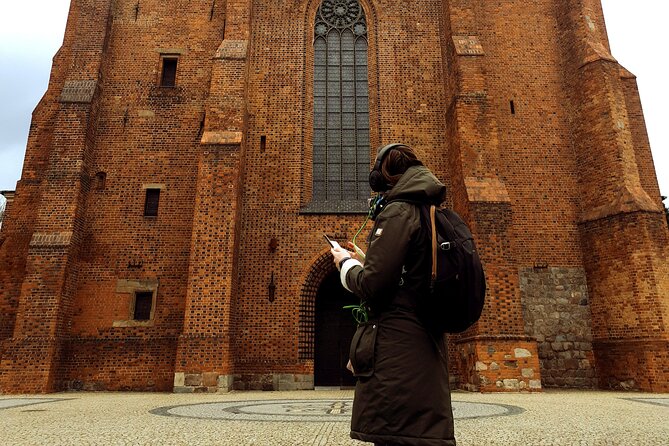
Next up, the route passes by Poznań Cathedral, described as the oldest Polish cathedral. As you walk, you’ll learn about the cathedral while moving along the frontage. This is one of the main reasons to do this audio first. It gives you a mental framework for what you’re looking at, so your attention lands on the right features.
After that, you’ll pass the Archbishop’s Palace. The audio explains how the building has gone through many iterations over time. That phrasing is useful, because it stops you from expecting a single, frozen “original” palace. In a place like this, buildings often become records of rebuilding, expansion, and changing priorities.
What I’d do: pause for a minute at each of these larger monuments, even if you don’t go inside. With audio narration in your ears, it’s easier to spot details and connect them to what you just heard.
Crossing Jordan Bridge: built, destroyed, and rebuilt into a connection
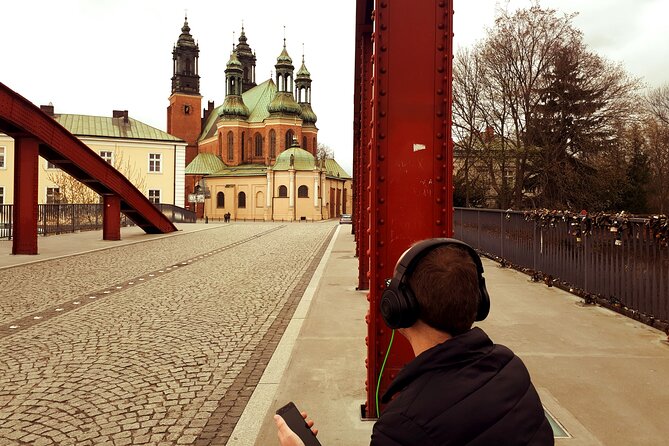
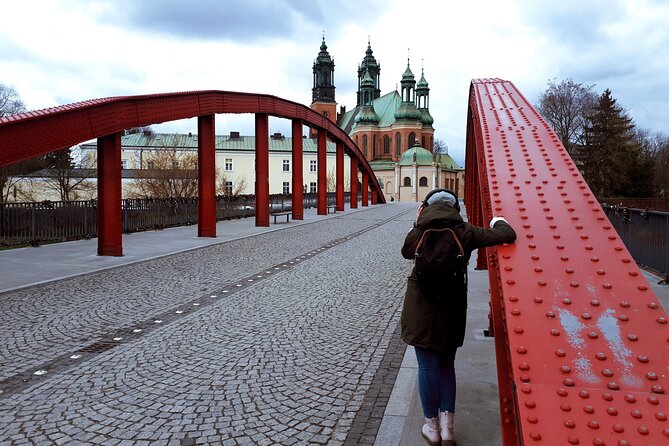
Then comes a highlight on the physical route: the walk over Jordan Bridge. The audio explains how the bridge was built, later destroyed, and finally rebuilt so it reconnected Cathedral Island with the Śródka District.
Bridges are more than shortcuts in old European cities. They are political and economic glue. Hearing the rebuild story adds weight to what would otherwise be just a nice walking crossing. You’re moving between neighborhoods that once had different identities, and the bridge is part of how that relationship changed.
If you’re sensitive to wind or cold, plan for it here. River crossings can feel harsher than the street level, especially in shoulder seasons.
Śródka District and the old wall-art moment
Once you reach Śródka District, the audio continues by placing it in a broader historical context, including the fact that at one stage it was independent from the rest of Poland. That’s a key piece of the emotional geography of Poznań. You aren’t only seeing monuments, you’re noticing how power and borders played out street by street.
Then you’ll pass the Srodka mural, described as one of the first wall paintings of this type in Poland. This is a nice tonal shift in the tour because it brings you from medieval and early-modern themes into something modern and cultural. It also helps you see that Poznań didn’t stop being creative after the old stones were set.
A practical note: murals and public art can be affected by weather and maintenance. If the mural is partly blocked by scaffolding or construction, you may not see as much as you expect, but the narration still gives you context.
Saint Margaret Church: another stop that keeps the story coherent
The tour continues past Saint Margaret Church. Like the other church stops, you’ll hear about it while walking. This kind of repeated church-and-commentary structure does something smart: it prevents Cathedral Island from turning into random sightseeing.
Instead, you start to sense patterns. Religious buildings are popping up because that was how community, governance, and memory worked together in the city’s early centuries.
If you like photography, this is a good stretch to slow down. You’ll be walking through a corridor of architecture, not a single viewpoint.
Brama Poznania and the “museum stop” that you can actually use
As you approach Brama Poznania (Porta Posnania Heritage Center), the audio highlights it as a state-of-the-art museum created in 2014. It focuses on issues connected with Cathedral Island and Śródka District.
Even though the audio tour itself does not include museum tickets, this is still a valuable pass-by. You’ll understand what the museum is built to explain, and you’ll have an informed choice about whether it’s worth paying for. If you’re the kind of person who likes to see artifacts after reading about them, this is one of the best “possible add-on” stops.
Cathedral Lock and Prussian fortification traces
Next, you pass the Cathedral Lock, described as a 19th-century element of the Prussian fortification system. That detail is a great reminder that Poznań’s story did not only unfold in medieval times. Later powers left physical marks too, and water control structures can be part of that military history.
This stop is one of the reasons the audio tour feels worth doing even if you don’t enter a single museum. It gives you a bridge between time periods, and you notice the city as a layered engineering project, not only a collection of old churches.
Genius Loci: walls, 3D films, and why modern tech belongs on this route
Toward the end of the walk, you pass Genius Loci, a modern museum that the audio describes as showing relics of the one thousand-year-old borough walls, plus 3D immersive films.
This is a clever pairing for an audio tour like this. After walking streets and viewing architectural clues, you’re offered the chance to upgrade from “seeing from the outside” to “understanding with media.” If you do plan to enter, you’ll likely feel the connection more strongly because the tour already primed your attention on what the walls meant.
The tour does not include tickets, so if you go in, budget for it separately. But even without entry, the stop’s mention can help you decide if it’s your kind of museum.
Ending at the Archdiocese Museum area near the Lubrański Academy
The tour ends in front of the archdiocese Museum in Poznań, pointing you to Jana Lubrańskiego 1 near the Lubrański Academy. The audio notes that this area played an important role not only in the city but across Poland from the 1500s until the 1700s.
I like the way the route finishes: it doesn’t end at a random point. It brings you back to a place tied to education, church power, and national influence. After all the bridges and churches, it feels like a final “and here’s why it all mattered” stop.
If you still have energy, you’re in an area where it’s easy to continue exploring nearby on foot, using what you learned on the audio to guide your choices.
What to bring, so the audio tour feels effortless
This experience is app-based, so the biggest thing you need is your own gear. The tour does not include a smartphone and headphones, so plan to travel with:
- Your phone with enough battery
- Headphones you like using outdoors
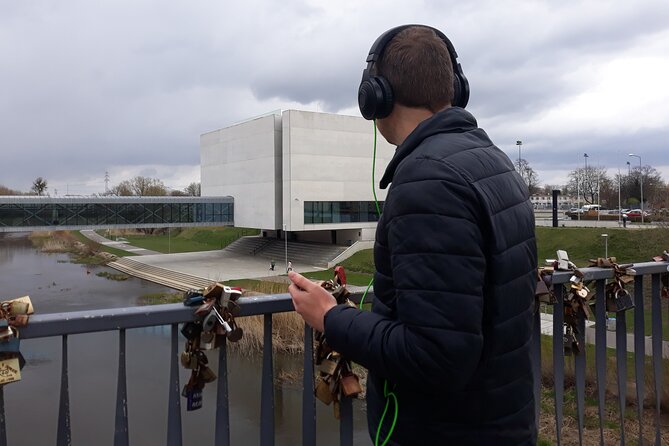
Good to know: the tour includes offline access to audio, maps, and geodata. That’s ideal for saving battery and reducing the chances of a GPS struggle. It also means you can download ahead of time and stop thinking about signal.
Also remember: the tour includes narration and route guidance, but tickets or entrance fees are not included for museums or attractions along the way. If you want to go inside Brama Poznania, Genius Loci, or any other venue you encounter, check hours and plan extra time.
Should you book this Poznań Cathedral Island audio tour?
Book it if you want a low-cost, high-context way to understand Cathedral Island without committing to a full guided day. At $8.99 and under about 75 minutes, it’s great for first-timers who want the “why” behind what they’re seeing, especially around Poznań Cathedral, the Jordan Bridge crossing, and the modern add-ons like Brama Poznania and Genius Loci.
Skip it or think twice if you hate walking, want a lot of indoor time without ticket planning, or you’re traveling with limited phone battery and no headphones. Because it’s self-guided, your experience depends on having the basics ready.
If you like independent travel and you want your time in Poznań to feel purposeful, this is an easy yes.
FAQ
Where do I start and where does the tour end?
The tour starts at Makieta Ostrowa Tumskiego, Ostrów Tumski 9, 61-109 Poznań, Poland. It ends in front of the Archdiocese Museum in Poznań, Jana Lubrańskiego 1, 61-003 Poznań, Poland (near the Lubrański Academy).
How long is the audio tour?
Plan on about 45 minutes to 1 hour 15 minutes.
How much does the tour cost?
The price is $8.99 per person.
Is the tour available in English?
Yes, it’s offered in English.
Does it work offline?
Yes. The tour includes offline access to audio, maps, and geodata through the VoiceMap app.
Are museum tickets included for stops along the route?
No. Tickets or entrance fees for museums or other attractions are not included.
Can I get a refund if I cancel?
No. The experience is non-refundable and cannot be changed for any reason, and the amount you paid will not be refunded.
More Tours in Poznan



More Tour Reviews in Poznan

Poznan, Other Walks
Recently written up around Poznan



More Poznan City Tours.
 ★ 5.0Poznań Experience 2-Hours Guided Walking TourFrom $39155 reviews
 ★ 5.0Undercover City Games: PoznanFrom $2288 reviews
 ★ 4.6Old Town Poznan: Guided Walking Tour in EnglishFrom $2678 reviews
 ★ 5.0Private or Public Highlights Tour with a local guideFrom $3066 reviews
 ★ 4.5Poznan Private City Walking Tour from Cathedral IslandFrom $1624 reviews
 ★ 4.8Poznan Old Town and Top Attractions Private Walking TourFrom $10324 reviews
 ★ 5.0Private Icons of PoznańFrom $5417 reviews
 ★ 4.0Old Town Poznan Walking TourFrom $2616 reviews
Also on these Poland lists