
REVIEW · NOWA HUTA AND COMMUNISM TOURS
Communist Warsaw: private tour by retro minibus with hotel pickup
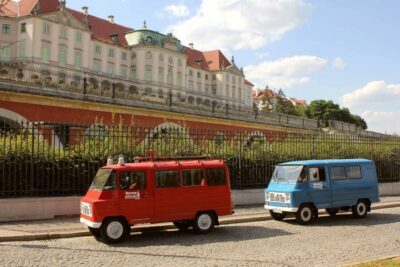
Soviet-era Warsaw, without the slog. This private 3-hour tour pairs hotel pickup with a retro communist minibus, so you can see more ground without wearing yourself out. I also like that your English-speaking guide explains what you are looking at, not just names it, and the ride between stops makes the whole thing feel relaxed. One thing to plan around: classic minibuses may lack air conditioning, and some may not have seat belts since they are historic vehicles.
You start at one of Warsaw’s most talked-about landmarks, the Palace of Culture and Science, then move through neighborhoods shaped by postwar reconstruction and state power. You will do short walking segments at each stop, so comfy shoes matter. Also, the time spent transferring from your hotel counts toward the tour total, so if your hotel is far out, consider meeting closer to the center.
If you want a readable, human scale way to understand how communism reshaped buildings, neighborhoods, and daily life, this tour is a strong match. It is also capped small, with each minibus carrying up to 8 people, and the experience is private for your group.
In This Review
- Key points to know before you go
- Entering Warsaw’s communist story by minibus, not by map pin
- Palace of Culture and Science: the symbol that still divides opinions
- Muranów: rebuilding neighborhoods as an idea about society
- Old Town under reconstruction energy, then toward Praga
- Praga Polnoc: when communism meets neglect and informal survival
- Śródmieście: government district modernism and the awkward joke
- Price and logistics: what $134.43 buys you
- Who this tour suits best, and who should choose another day plan
- Should you book Communist Warsaw with retro minibus pickup?
- FAQ
- How long is the Communist Warsaw private tour?
- Is hotel pickup and drop-off included?
- Is the tour private?
- Is the tour offered in English?
- Do you visit the Palace of Culture and Science terrace?
- Is admission included for the stops?
- What about air conditioning on the minibus?
- How many passengers can each minibus carry?
- Is free cancellation available?
- Are children allowed, and are boosters needed?
Key points to know before you go
- Private group with full guide attention, so questions are easy and the pacing stays comfortable
- Retro minibus + hotel pickup means less navigating and more time looking at the city
- No Palace terrace stop, so you keep your time focused on the city’s political symbolism
- Short, purposeful walks at each location, with most of the transit handled by vehicle
- Praga Polnoc is about survival, where neglect and informal trade shaped everyday life
- Historic vehicles can be warm or cool, since air conditioning may not be available
More of the socialist-era district, reviewed
- Private Tour: Warsaw’s Communist History by Retro Fiat
★ 5.0 · 115 reviews - Warsaw: Communism Tour in an Original Socialist Van
★ 4.9 · 75 reviews - Warsaw: Communist History Self-Driving Tour
★ 4.8 · 52 reviews - Warsaw: Communism Tour in an Original Socialist Van
★ 4.5 · 35 reviews
Entering Warsaw’s communist story by minibus, not by map pin
Warsaw can be a lot if you are trying to stitch together sights on your own. This tour solves that with transportation built into the experience. You get pickup and drop-off, then hop between key locations where the city’s communist era still shows up in plain view.
That matters because the tour is really about interpretation. The buildings and streets here are not just scenery, they are physical arguments from a political system. When you move by vehicle, your guide can point out how one area’s purpose changes, how neighborhoods were planned, and why certain forms of architecture were used to send messages. You get to keep your eyes up instead of constantly checking where you are supposed to turn next.
The private format is another advantage. Even if you are traveling with a couple of friends or family, you avoid the feeling of joining a rushed moving group. You can take an extra minute at a statue or building detail without losing the whole schedule. And since each minibus holds up to 8 passengers, you are not packed in like a shuttle.
The only practical catch is comfort. Classic vintage minibuses may have heating for winter, but they are not always air-conditioned, and some may not include seat belts. Wear layers and plan to sit comfortably for a few short hops. If you are sensitive to heat, time your tour for a cooler part of the day.
Palace of Culture and Science: the symbol that still divides opinions
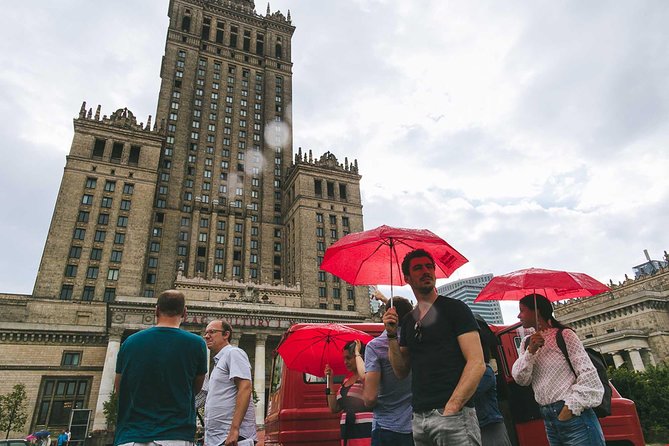
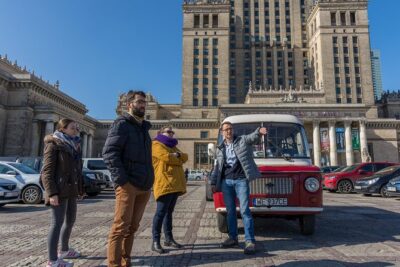
The tour begins at the Palace of Culture and Science, Warsaw’s most recognizable communist-era landmark. It was built between 1952 and 1955 as a “gift” from the Soviet Union. Even today, it is controversial. The building dominates the skyline, and locals still argue about what it represents, pride, power, or occupation-era influence.
You also skip the most touristy add-on. The plan does not include an XXXth floor terrace visit, so you do not spend this time on views that are common in other Warsaw tours. Instead, your focus stays on the political meaning of the building itself and the surrounding government-era context. For me, that is a smart choice because the terrace can turn a history tour into a photo stop. Here, you get the building’s story first, then the city’s story continues around it.
One practical tip: treat this as a stop for looking and listening, not for long wandering. The time here is about 20 minutes, with no admission cost required for what is included. You will likely spend that time at ground-level cues, statues, and architectural signals, then move on while the guide’s explanation is still fresh.
If you love architecture as evidence, you are going to enjoy this start. Soviet-influenced “monumental” building styles were designed to be seen from far away, to impose scale and certainty. Starting here sets the tone for every later stop.
Muranów: rebuilding neighborhoods as an idea about society
Next up is Muranów, a residential district built in the late 1940s on wartime ruins. To understand why this matters, you have to know what came before. Before World War II, Warsaw had a dense, tenement-filled city life, very different from the cleaner, planned look the postwar authorities wanted.
Communist authorities and modernist architects treated reconstruction as a chance to redesign society. Muranów became a “model socialist neighborhood,” with green spaces and new housing shaping how people were supposed to live, meet, and belong.
This stop lasts about 20 minutes, and you will do a short walk with free admission included. The value here is that your guide can connect visible features to intentions. You can often see it in how blocks are arranged, how the area feels more planned than older streets, and how space gets used as a statement.
A small drawback to consider: because the time is brief, you will not be doing deep reading at any single building. This tour is meant to build a big picture through several locations, not to linger forever in one neighborhood. If you are the kind of traveler who wants to photograph every doorway and read every plaque, you might wish you had more time in Muranów. The good news is, you are not just passing by. The ride structure keeps each stop purposeful.
Old Town under reconstruction energy, then toward Praga
There is a key postwar reconstruction story you will encounter as you pass through the area on the way to Praga. The Old Town was rebuilt, and beneath it, a major traffic route was built with help from Soviet engineers linked to the Moscow metro.
That detail is the kind of thing you only catch when someone points it out. It connects Warsaw’s recovery effort to a wider Soviet technical presence, showing how modernization projects were tied to ideology. You get an example of how “rebuilding” was never only about fixing damage. It was also about controlling movement, shaping the city’s function, and importing know-how that carried influence.
This section is more of a narrative bridge than a standalone stop. You might not feel like you are doing a “sightseeing moment,” but you will understand why the city’s layout changed where it did.
Why this matters for you: if you plan to explore Old Town later on your own, you will notice how movement patterns and underlying infrastructure affect what you see above. You are leaving with a sharper eye for how the city’s surface tells the story of decisions made underneath.
Warsaw rebuilt itself twice over. Here is how else we saw it
- Warsaw: Chopin Concert in the Old Town★ 4.8 · 2,287 reviews
- Warsaw: Traditional Galar Cruise on The Vistula River★ 4.6 · 1,640 reviews
- Warsaw: Old Town Highlights Walking Tour in English★ 4.7 · 1,516 reviews
- Warsaw Concert: Chopin – Painted by Candlelights with Wine★ 4.8 · 1,442 reviews
- Warsaw: City Sightseeing Hop-On Hop-Off Bus Tour★ 3.6 · 1,415 reviews
Praga Polnoc: when communism meets neglect and informal survival
Praga Polnoc is where the tour turns darker. This district offers a glimpse into realities that did not fit the official story of a planned society.
Many areas were largely neglected by state investment. That neglect helped create space for informal and illegal activity. Behind courtyards, residents exchanged foreign currency, traded Western music, and searched for goods unavailable elsewhere. In other words, decline became survival.
This is the stop that tends to stick with people, because it shows how ordinary life adapted to political conditions. It lasts about 30 minutes, and admission is free for what is included.
What I like about this part is the balance. You are not only hearing about ideology at the top of the system. You are seeing how the system affected everyday choices, from where people could find music to how trade worked in practice.
Praga Polnoc can also feel like a reminder that “communist architecture” is only one piece of the puzzle. The official image of order and progress did not erase the messiness of real life. The courtyards and side spaces help communicate that.
One consideration: the tour uses walking segments at stops, so wear footwear that handles mixed sidewalks and uneven areas. Also, because you spend time in this district, it can help to keep your camera handy, but keep listening more than shooting. The guide’s explanation gives context to details you might otherwise overlook.
Śródmieście: government district modernism and the awkward joke
The tour ends in Śródmieście, Warsaw’s government district, where prewar modernist architecture meets monumental socialist realism. This is where the “theme” of the day becomes physical. You see how different eras tried to set the rules for aesthetics, power, and the public eye.
There is a story your guide can share that adds a sharp edge to the architecture. It is said the leader of communist Poland reportedly refused to move into the new party headquarters because it looked more like a capitalist bank than an office for a workers’ party. Even if you treat it as a wry anecdote, the point is clear: architecture sent signals, and those signals could embarrass the people trying to control them.
This ending stop lasts about 45 minutes, which is long enough to take in the space rather than just snap photos and hurry out. Admission is free for the included stops.
For you, the best payoff here is perspective. Once you have seen Palace Culture, Muranów, the reconstruction story under Old Town, and Praga Polnoc, Śródmieście hits differently. The architecture is not just pretty or imposing. It becomes a record of who wanted to look legitimate, and what happens when legitimacy is contested.
Price and logistics: what $134.43 buys you
At $134.43 per person for about 3 hours, this is not a budget bus tour. It is a private tour with hotel pickup, so part of the cost is paying for convenience and guide time, not only for transportation.
Here is where the value shows up for most people:
- Hotel pickup and drop-off saves time and stress, especially if you do not want to plan transit routes
- Private format keeps the guide focused on your group, which is useful for questions and pace
- Retro minibus ride adds a fun, themed way to move around the city while you learn
- Free admission tickets for the included stops means you are not hit with extra on-site costs
It also helps that each minibus handles up to 8 passengers, and there are multiple vehicles available. That capacity detail matters if your group size is larger, because you are less likely to be squeezed into a cramped experience.
Two practical points to keep in mind. First, your total time can include the transfer from and to your hotel. If your lodging is far from central pickup points, you might spend more of the 3 hours on the route rather than at the sights. Second, classic vintage vehicles may not have air conditioning, and some historic vehicles might lack seat belts. You are allowed to ride without them since the vehicles are historic, but comfort planning is still on you.
Also, tips are not included. If you like giving a tip for good, clear interpreting, you will want to plan that into your budget.
Who this tour suits best, and who should choose another day plan
This tour fits best if you want a structured explanation of communist Warsaw without turning your day into a navigation contest. It is especially good for:
- First-time visitors who want the big political timeline anchored to real places
- Travelers who prefer short, focused walks paired with vehicle time
- People who value a guide who can connect buildings to the way power worked
It is less ideal if you want to spend long hours inside museums or if you are hoping for a lot of independent wandering. This is about getting the story in the right order, not about free-form exploration at every stop.
Another good fit: if you are traveling with someone who gets tired from constant walking, the minibus keeps effort low while still letting you see multiple districts. And since the tour is in English and has a professional local guide, you can expect straightforward interpretation rather than relying on your own reading of signage.
Should you book Communist Warsaw with retro minibus pickup?
I would book this if you like your history told through places, and you want comfort baked in. The biggest reasons are the private attention, the hotel pickup, and the way the stops move from symbols of power to neighborhoods shaped by hardship. Starting at Palace of Culture and Science, then working through Muranów, Old Town’s reconstruction link, Praga Polnoc’s survival economy, and finishing in Śródmieście gives you a clear arc.
Book a different kind of tour instead if you are chasing a lot of museum time or you hate sitting in a vehicle for transfers, because part of your experience time is spent moving between districts. Also keep in mind the vintage vehicle comfort factor if you are traveling in hot weather.
If you want one simple decision rule: if you would rather listen to history and see the city in order than chart every turn yourself, this private retro minibus tour is a smart way to spend a half-day in Warsaw.
FAQ
How long is the Communist Warsaw private tour?
The tour lasts about 3 hours.
Is hotel pickup and drop-off included?
Yes, hotel pickup and drop-off are included.
Is the tour private?
Yes. It is a private tour, so only your group participates.
Is the tour offered in English?
Yes, it is offered in English.
Do you visit the Palace of Culture and Science terrace?
No. The tour does not include visiting the terrace.
Is admission included for the stops?
Yes, admission tickets for the included stops are free.
What about air conditioning on the minibus?
Classic vintage minibuses are not equipped with air conditioning, though vehicles have heating for winter.
How many passengers can each minibus carry?
Each minibus accommodates up to 8 passengers.
Is free cancellation available?
Yes, you can cancel for a full refund up to 24 hours in advance.
Are children allowed, and are boosters needed?
The tour can be booked for adults and children over 150 cm (4 ft 9 in). For children under 150 cm, you must contact the tour operator in advance to check availability of seat boosters, which are mandatory under Polish law.
Vintage Rides Around Warsaw


Warsaw, Keep Looking



Nowa Huta, the Rest of Our Notes

Recently written up around Warsaw

More Nowa Huta and Communism Tours.
 ★ 4.9Nowa Huta Guided Tour in Vintage CarFrom $75277 reviews
 ★ 5.0Legendary Private Nowa Huta Communism Tour with Crazy GuidesFrom $131262 reviews
 ★ 4.9Nowa Huta: Steelworks Administration Buildings/Shelters TourFrom $24160 reviews
 ★ 5.0Private Tour: Warsaw’s Communist History by Retro FiatFrom $108115 reviews
 ★ 4.9Private Nowa Huta Adventure Tour in Communist CarsFrom $108114 reviews
 ★ 4.93.5-Hour Communism Deluxe Tour by TrabantFrom $21584 reviews
 ★ 4.9Communism Tour in an Original Socialist VanFrom $7875 reviews
 ★ 4.8Communist History Self-Driving TourFrom $6952 reviews
Also on these Poland lists