
REVIEW · WARSAW CITY TOURS
Private 4h Tour in Warsaw Old Town
Warsaw tells its story in layers. This private 4-hour walk threads key spots in the Old Town and the Royal Route, with clear context on what was destroyed, what was rebuilt, and what still feels unmistakably Warsaw. I love the focus on before-and-after history and the way the stops connect into one readable storyline. I also like that it stays human-sized, with a local guide to keep you from getting lost in details. One drawback to note is that the day can get emotionally heavy, especially around the Warsaw Uprising.
This is offered in English and run as a private tour, meaning only your group goes along. Expect a professional local guide to point out what matters at each stop, with free-entry sightseeing built into the route. The pricing is listed as $111.75 per person, and it often looks best for couples, small groups, or anyone who wants a guided plan without the scramble of a big group tour.
Value-wise, you are paying for interpretation, not entrances. Most stops are marked admission ticket free, so the money goes toward context, pacing, and practical local insight like where to slow down and what to notice as you walk.
In This Review
- Key highlights you will feel on the ground
- Sigismund’s Column to Old Town walls, a timeline on foot
- Inside Warsaw’s rebuilt center, from Royal Castle Gardens to St. John’s Cathedral
- Rynek Starego Miasta and Barbakan, square life and defensive architecture
- Warsaw Uprising Monument to Ulica Miodowa, where the city’s elite lived
- Theatre Square, Tomb of the Unknown Soldier, and the Royal Route finale
- Price, format, and why a private guide matters here
- Should you book this Warsaw Old Town and Royal Route tour?
- FAQ
- How long is the Private 4h Tour in Warsaw Old Town?
- What is the price per person?
- Where does the tour start and end?
- Is the tour private?
- Is the tour offered in English?
- Are there admission tickets required for the stops?
- What is the cancellation policy?
Key highlights you will feel on the ground
- Sigismund’s Column moved through history, and a clear explanation of why its location is part of the story
- Old Town told as a timeline, from medieval trade to near-total destruction in 1944 and UNESCO reconstruction
- Royal Castle Gardens as a reminder that rebuilding can be faithful, not just cosmetic
- St. John the Baptist Cathedral with a special music angle (organ concerts in summer) and major historical ties
- Barbakan plus seasonal photo and model exhibitions that help you picture the old defensive lines
- A strong finale on the Royal Route, ending near Nowy Świat and Krakowskie Przedmieście
Warsaw rebuilt itself twice over. Here is how else we saw it
- Warsaw: Chopin Concert in the Old Town
★ 4.8 · 2,287 reviews - Warsaw: Traditional Galar Cruise on The Vistula River
★ 4.6 · 1,640 reviews - Warsaw: Old Town Highlights Walking Tour in English
★ 4.7 · 1,516 reviews - Warsaw Concert: Chopin – Painted by Candlelights with Wine
★ 4.8 · 1,442 reviews
Sigismund’s Column to Old Town walls, a timeline on foot
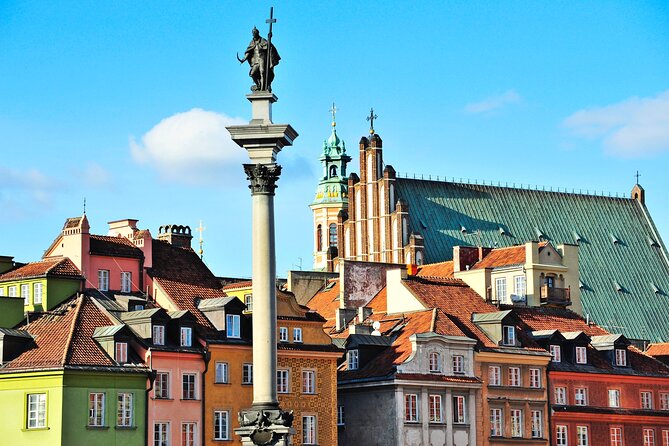
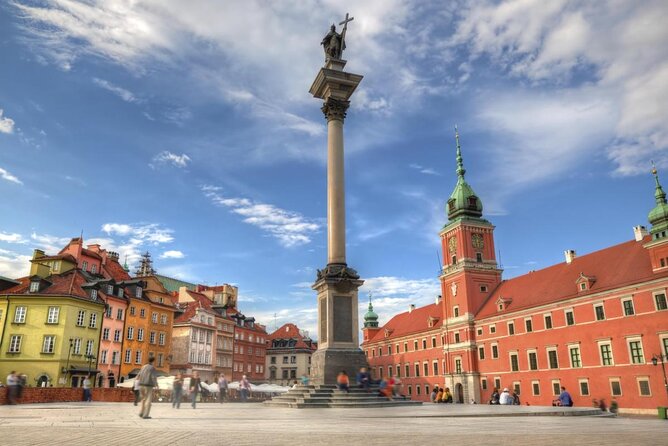
You start at Sigismund’s Column by plac Zamkowy, a small stop that punches above its size. It is the oldest public memorial in Warsaw, but it is not where it originally stood. The column was moved more than once, including after changes to the alignment of Krakowskie Przedmieście Street and again during development of the WZ route. During World War II, German troops brought the column down on September 2, 1944, and reconstruction was completed in 1949.
What I like here is how it sets your “reading glasses” for the entire tour. Warsaw is not just historic, it is layered, rebuilt, reoriented, and still responding to its past. If you are the type who enjoys turning a walk into a timeline, this opening gives you a payoff right away.
Then you move into Old Town for about 45 minutes. The area grew where the river supported trade between the Baltic Sea and the Black Sea, and the city’s look shifted over centuries as wooden buildings were replaced by masonry tenements and ramparts evolved into stone walls. You get the big landmarks too, including the parish church that is now Cathedral of St. John, plus defensive towers and a barbican.
The tour also doesn’t skip the brutal part. In 1944, about 90 percent of the Old Town area was razed to the ground. Reconstruction took many years and ended with a place on UNESCO’s World Heritage List. That UNESCO label can sometimes feel like a slogan, but here it lands as a practical story: you are walking through a rebuilt urban plan, not just pretty scenery.
Practical tip: Old Town streets can be uneven. Comfortable shoes matter more than style on this one, especially since you will keep moving for hours.
Inside Warsaw’s rebuilt center, from Royal Castle Gardens to St. John’s Cathedral
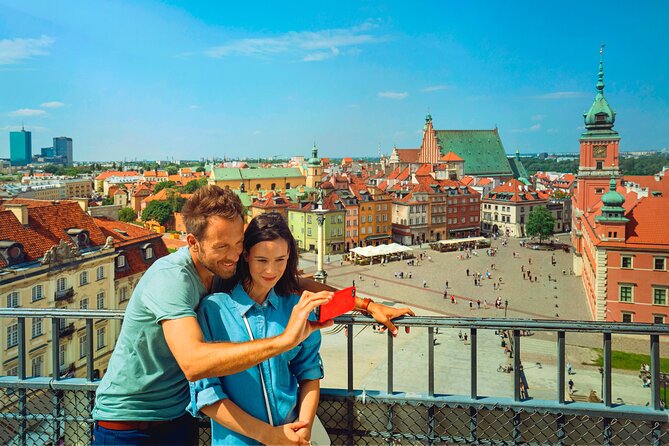
Next up is Warsaw Royal Castle Gardens, a quick 15-minute pause that works because it changes your perspective from architecture to mood. The Royal Castle gained royal-residence status in the 16th century, after Masovia joined the Crown. It was destroyed and rebuilt multiple times, including during the Deluge and later during the annexation of Poland, so it was already carrying scars before World War II.
During the first days of the war, the castle was bombed and nearly destroyed by fire. Some priceless works of art were saved because they were carried out in time and hidden, but remaining works were plundered. In 1944, the castle was blown up in retaliation for the Warsaw Uprising. Reconstruction was only decided later, in 1971, and the site opened to visitors in 1984. UNESCO later recognized it as an example of a successful, faithful reconstruction of an historic structure.
Here’s the practical value: this stop helps you understand why Warsaw looks the way it does today. It is not copied style for tourist postcards. It is a reconstruction effort tied to identity, and it is worth noticing.
After the gardens, you head to Archcathedral Basilica of St. John the Baptist (about 15 minutes). St. John’s is one of Warsaw’s oldest churches, and it has a strong connection to both religion and national history. Every Sunday from July to September, there are organ concerts at 4 PM as part of the International Organ Music Festival. If your timing lines up, that can turn a normal visit into a memorable one.
You also get references to major historic moments, including the Constitution of May 3 oath, described here as the first of its kind in Europe. The crypt holds tombs of many historical figures, including the Chapel-Mausoleum of the Primate of the Millennium.
What I like: even in a short visit, the guide can steer you toward what to look for, instead of letting you wander through a big church wondering what matters most.
Rynek Starego Miasta and Barbakan, square life and defensive architecture
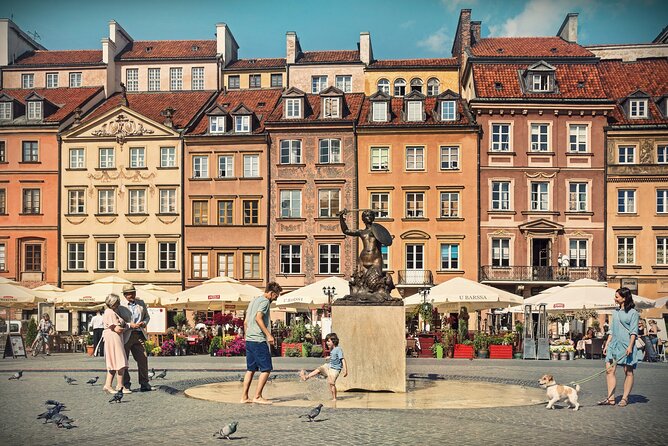
The route then enters Rynek Starego Miasta, the Old Town Marketplace. You spend about 15 minutes here, but it is the kind of place where 15 minutes can feel like 45, because the square is designed for people to linger. It is surrounded by tenement buildings with restaurants, cafes, clubs, galleries, and museums. At the center sits a statue of Warsaw’s symbol, the Warsaw Mermaid.
This stop also includes a very Warsaw detail: the marketplace was subdivided into four sections named for enlightenment activists. The names given are Kołłątaj, Dekert, Barss, and Zakrzewski. It is a smart detail because it shows how Warsaw’s identity is not only about monuments, it is also about ideas and civic movements.
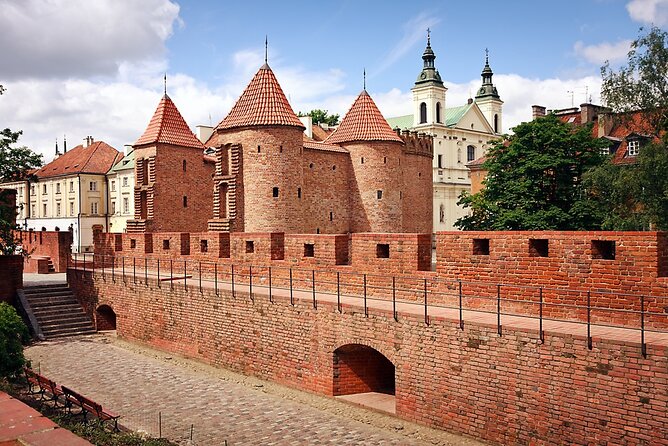
After the square, you move to Warsaw Barbican (Barbakan Warszawski) for around 15 minutes. The barbican is not just an old wall you pass by. It was part of Warsaw’s defensive walls and built in 1548 as part of about 4,000 feet of ramparts. Today, it draws painters exhibiting their work and musicians who help make the Old Town walk feel alive.
Inside the Barbican, there can be a seasonal exhibition from May to October with historical photos of Warsaw and models showing the defensive lines and towers that no longer exist. Even if you only catch the outside structure, the guide can help you connect those old plans to what you see now. That is one of the best ways to understand how destruction changes a city’s silhouette.
Season note: if you are traveling outside May to October, you may see less inside. Ask your guide what is currently on view so you know what to expect that day.
Warsaw Uprising Monument to Ulica Miodowa, where the city’s elite lived
You then tackle one of the most emotionally important stops on the walk, the Warsaw Uprising Monument (about 10 minutes). It depicts groups of insurgents during battle. The Warsaw Uprising ended in defeat and, as described here, resulted in the death of about 200,000 Poles. This is not a monument that tries to soften the message, and that is exactly why it belongs on this route.
From there, the tour flows to Krasiński Palace, also known as the Palace of the Republic, and it comes with extra context. The palace began as the residence of Jan Krasiński, Prefect of Warsaw, and today it hosts special collections for the National Library. The building is regarded here as Warsaw’s most enchanting Baroque structure, with reliefs inspired by antique works.
There is also a practical reset built in. The park behind the palace is listed as a good place to walk a bit and relax, and the area adds another layer of government presence with the recently-built seat of the Supreme Court nearby. This matters because it gives your brain a breather after a heavy stop.
Next is Ulica Miodowa for about 20 minutes, a narrow street that feels like you are slipping into a different world. It is lined with ancient, luxurious residences and includes several “this is why it matters” stops.
A few highlights you will likely hear about:
- Number 24 on the left housed the Collegium Nobilium, described here as the first school for young members of the ruling elite. It now houses the Academy of Theatre.
- Number 17 on the left is the residence of the Primate of Poland, the Palace of Warsaw’s Archbishops, built in the 18th century.
- Number 16 on the right is Warsaw’s only Eastern Catholic Church.
- Pac Palace, housing the Ministry of Health, sits next to the Primate’s residence.
- The Church of the Capuchins has a right-side altar featuring the heart of Jan III Sobieski, the founder.
The tour also notes a view toward the Monument of Warsaw’s Heroes, commonly called the Monument of Nike. Ulica Miodowa is a strong example of how Warsaw isn’t only about big squares and famous castles. It is also about the smaller streets where power, faith, education, and daily life overlapped.
Below are the other Warsaw trips we have logged
- Private Tour: Warsaw City Sightseeing by Retro Fiat★ 5.0 · 562 reviews
- Warsaw: Warsaw Ghetto Private Walking Tour with Hotel Pickup★ 4.9 · 369 reviews
- Private Tour: Warsaw’s Jewish Heritage by Retro Fiat★ 5.0 · 208 reviews
- Private Historical Tour of Warsaw by a Retro Fiat with Pickup★ 5.0 · 190 reviews
- Warsaw for WWII Buffs – private tour with hotel pickup★ 5.0 · 166 reviews
Theatre Square, Tomb of the Unknown Soldier, and the Royal Route finale
Your final act starts at Plac Teatralny (Theatre Square), about 15 minutes. The area is bordered by the Late Baroque Blank Palace, and behind it is Jabłonowski Palace, which previously functioned as city hall before World War II. The building was razed during the war and rebuilt in the 1990s, but only the façade and the clock tower remain from the original design. A great practical moment here is being directed to walk through the gate under the tower to see the foundations laid in the 19th century.
Then the tour points you toward the Grand Theatre, a huge Classicist building facing Jabłonowski Palace and serving as the seat of the National Opera and the National Theatre. If you attend a performance, the information here says you can see interiors including cut glass chandeliers, a spacious foyer with columns, and impressive floor tiling. The opera stage is noted as one of the largest in Europe.
To round out the square, you end near the Petrykus Tenement House from 1821, which houses restaurants and clubs, something locals value for an evening out.
Next comes the Tomb of the Unknown Soldier for about 10 minutes. This symbolic tomb commemorates millions of soldiers who sacrificed their lives for Poland’s freedom. It holds ashes of a defender of Lvov, plus an urn with soil from World War I battlefields. The tomb also holds urns from every battlefield where Polish troops fell in the last century. An eternal flame burns beside it, and there is a military honor guard that changes daily at noon.
If you time it right, that noon change can be a real moment. Even if you do not, the symbolism is the point, and your guide should give it weight in a way that feels respectful rather than rushed.
Then you walk into the last segment: the Royal Route. The route runs from Zamkowy Square to Trzech Krzyży Square. You will cover around 30 minutes of it and hit named landmarks like:
- St. Anne’s Church, including the view from the church tower
- Polonia House, once the Museum of Industry and Trade, where Maria Skłodowska-Curie worked
- Radziwiłł Palace, which is described here as the current residence of the President of Poland
- Warsaw University campus with Kazimierzowski Palace
- Czapski Palace, home to the Academy of Fine Arts
- Elegant stores and restaurants on Nowy Świat Street, described as an extension of Krakowskie Przedmieście Street
For a practical end, the tour notes that your guide will leave you at the Nicolas Copernicus Monument on Krakowskie Przedmieście. That sets you up well for self-guided wandering, coffee stops, or another walk without needing to cram in everything.
Price, format, and why a private guide matters here
At $111.75 per person for about 4 hours, the big question is what you are buying. You are buying a local guide and a focused route through some of Warsaw’s most meaningful rebuilt spaces. Most of the stops here are marked as admission ticket free, so you are not paying for a stack of museum tickets. You are paying for interpretation, pacing, and the ability to ask questions in real time.
This tour is also listed as private, meaning only your group participates. That often translates to less rushing and better attention to your pace, especially if your group includes history lovers or people who want more context rather than just a checklist of sights.
English is the stated language offered. Past guide names that received standout praise include Maria, Mariola, Cesar, and Carolina, with one Francophone guide also mentioned for making the visit interesting from start to finish. Even without matching any one guide style, you can expect a guide who knows how to connect details, like why the column was moved or how the barbican fits into the city’s defensive story.
One more value angle: it is marked as near public transportation, which helps if you want to arrive a bit early or extend your day afterward. Also, with an average booking window of about 58 days in advance, this is a popular way to get oriented. If your dates are fixed, booking earlier can help avoid end-of-trip schedule stress.
Should you book this Warsaw Old Town and Royal Route tour?
I would book it if you want a guided, first-time friendly plan that explains why Warsaw looks the way it does now. The route mixes landmark stops with the kind of details that make history feel connected, not like a set of disconnected plaques. It is also a good choice if you prefer walking with context, instead of hopping between sights on your own with guesswork.
Skip it or consider something else if you want long museum time or very hands-on interior access at many stops. This is built around outdoors, walkable stops, and meaningful viewpoints, including the emotional weight of the Warsaw Uprising theme.
If your goal is to understand Warsaw’s past and rebuild story in a single half-day, this tour is a strong match. Bring good walking shoes, dress for the weather, and plan to stop when your guide asks you to look up or notice a detail, because that is where the tour pays off.
FAQ
How long is the Private 4h Tour in Warsaw Old Town?
It lasts about 4 hours.
What is the price per person?
The price is listed as $111.75 per person.
Where does the tour start and end?
It starts at Sigismund’s Column (plac Zamkowy, 00-001 Warszawa). It ends on the Royal Route (Krakowskie Przedmieście, 00-079 Warszawa), and the guide leaves you at the Nicolas Copernicus Monument on Krakowskie Przedmieście.
Is the tour private?
Yes. It is a private tour, so only your group participates.
Is the tour offered in English?
Yes. The tour is offered in English.
Are there admission tickets required for the stops?
The stops are listed with admission ticket free.
What is the cancellation policy?
You can cancel up to 24 hours in advance for a full refund. If you cancel less than 24 hours before the start time, the amount you paid will not be refunded.
More Tours in Warsaw


More Tour Reviews in Warsaw


Warsaw, Keep Looking
Recently written up around Warsaw


More Warsaw City Tours.
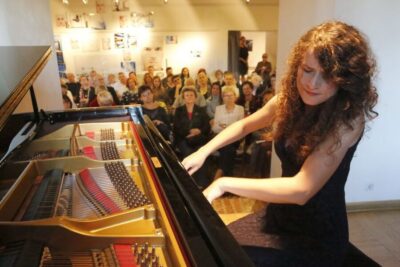 ★ 4.8Chopin Concert in the Old TownFrom $262,287 reviews
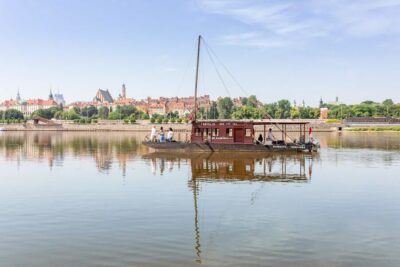 ★ 4.6Traditional Galar Cruise on The Vistula RiverFrom $201,640 reviews
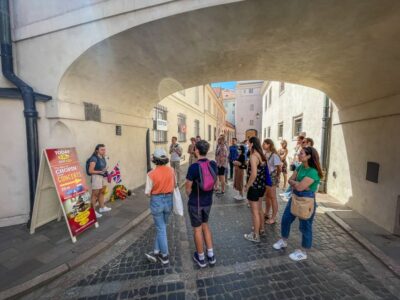 ★ 4.7Old Town Highlights Walking Tour in EnglishFrom $261,516 reviews
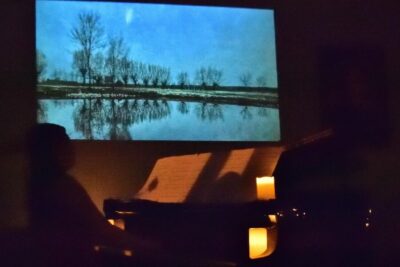 ★ 4.8Warsaw Concert: Chopin – Painted by Candlelights with WineFrom $251,442 reviews
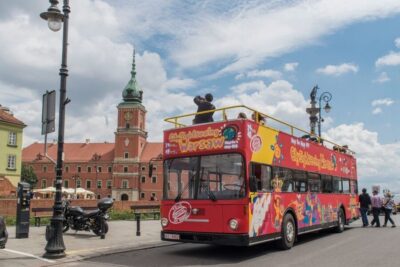 ★ 3.6City Sightseeing Hop-On Hop-Off Bus TourFrom $411,415 reviews
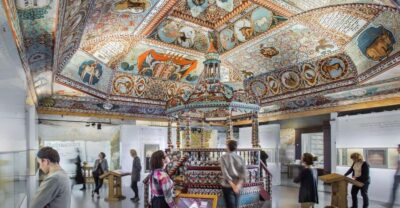 ★ 4.7POLIN Museum of the History of Polish Jews TicketFrom $121,142 reviews
 ★ 5.0#1 Pub Crawl Warsaw with Optional Premium 1 Hour Open BarFrom $28790 reviews
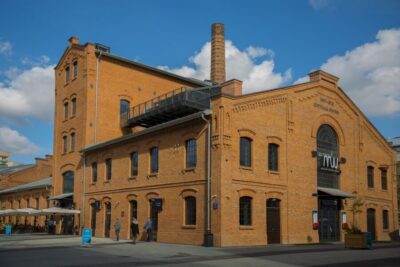 ★ 4.6Polish Vodka Museum Tour with TastingFrom $22788 reviews